Hello,
first thread on this extremely knowledgeable forum. I hope I get it right and that someone has some input.
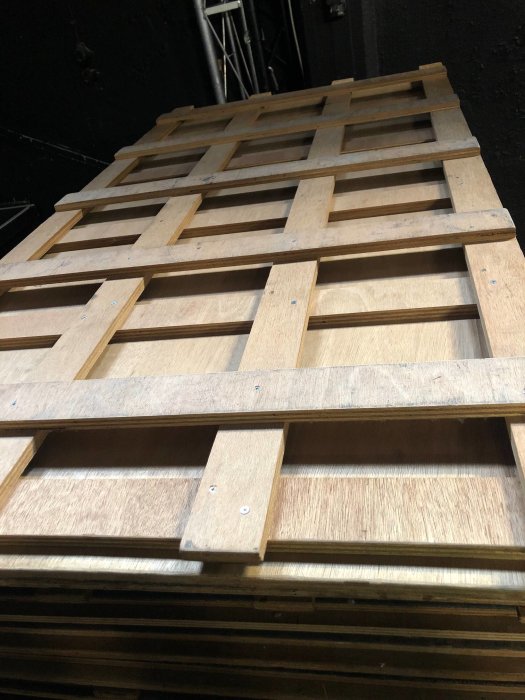
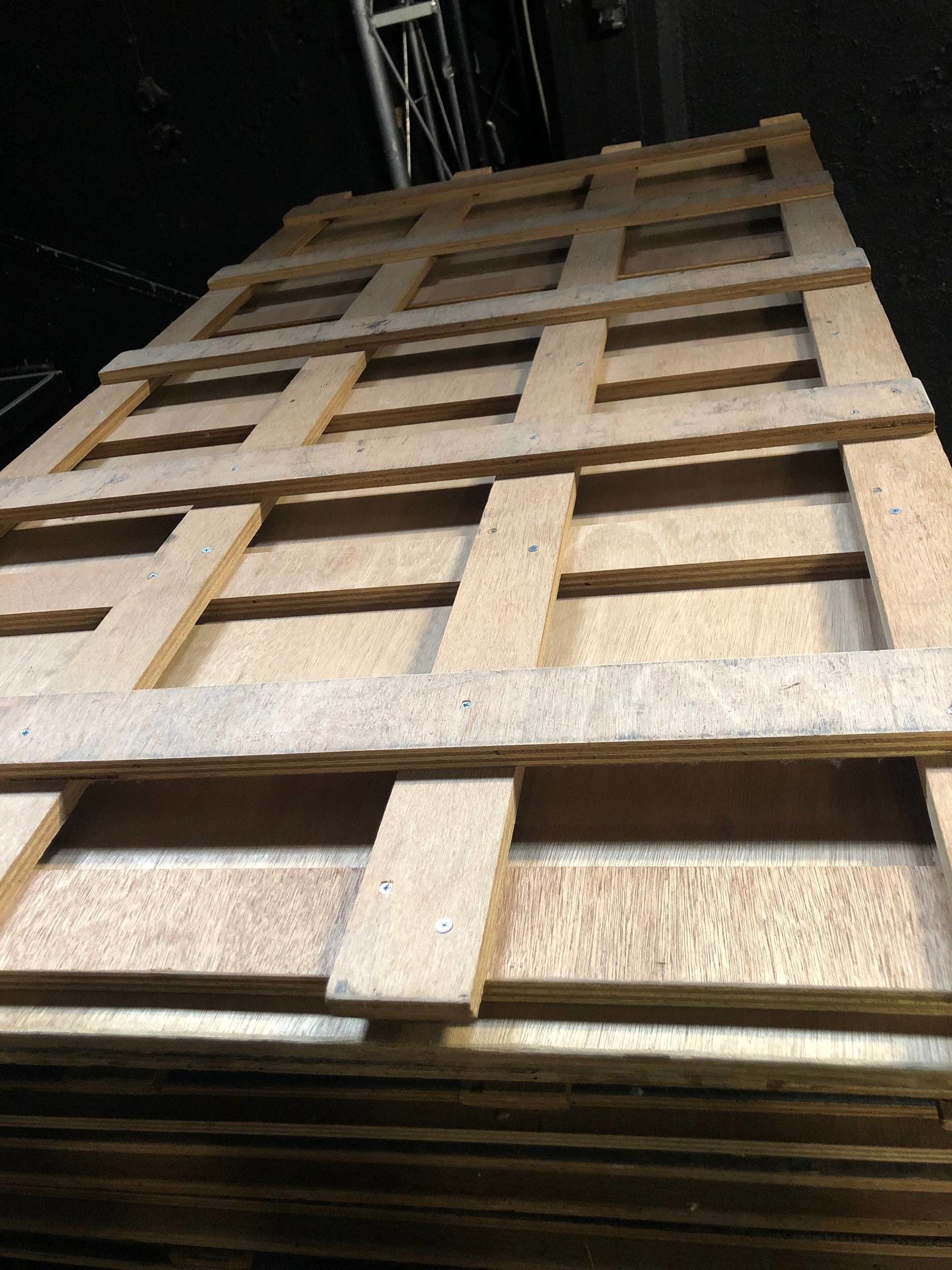
I have laid a floor for an association that deals with dance/acrobatic. The existing one they have received,
I believe it's made of birch, at least it's a very nice plywood in my eyes.
Now I need to build 90m2 more and I was thinking of making a compromise and building the base with
K-plywood with a birch BB/X sheet on top.
But, it seems there is a loooong delivery time and skyrocketing prices on nicer sheets, so I'm starting to think
about using K-plywood all the way.
The finish is not that important, they're going to put a dance mat on it, but I'm thinking that a K-sheet might
be more prone to warping? Or might not have the same strength or "bounce."
The modules lie loosely on a concrete floor indoors and heated.
My experience with different types of plywood is that there is a very big difference between, for example, birch plywood and k-plywood, primarily in terms of stiffness. An 18/21 mm k-plywood, I believe, is made up of 7 layers, while an 18 mm birch plywood has 13 layers. Therefore, it's difficult to go into depth without knowing the specific conditions regarding the substructure.
That's exactly what I'm thinking about as well. Unfortunately, I don't have any more pictures right now, but the plywood is 18mm, and they are loosely placed on the floor, and the layers in the understructure "tongue" into the adjoining modules. It should have a pleasant bounce for activities and withstand being driven on with a 3.2-ton scissor lift. Then we will place loose 18mm sheets in another layer under the lift.
What I'm most concerned about is that the sheets will warp like K-ply often do when they are stacked.
Tobbe
For a person not knowledgeable in dance to understand the conditions, some form of baseline values are needed, e.g., in the form of deflection requirements. I found nothing in my books except about dance floors... Loose k-plyfa is poorly shape-stable compared to björkplyfa. I guess you need to reach 24 mm k-plyfa for it to be OK.
Thank you for your commitment. It becomes a bit difficult to integrate 24mm with existing modules that are built on 4 layers of 18mm. The existing modules were donated by a professional institution that doesn't need to think about the cost, we might have to compromise a bit on the deflection requirements. I haven't handled too many 18mm birch plyboards but had a feeling about the dimensional stability. That's why I started the thread and got to hear what I didn't want but suspected. I think I will build a couple of modules as a test, with the slats placed closer together. Hopefully, it will be good enough, otherwise, it will have to be done properly, even if it will hurt.
If you plan to replicate the construction with cheaper materials, you must start with the modulus of elasticity of the materials in question. The exact specifications are most easily obtained from the manufacturer. The number of layers in relation to the thickness provides some guidance. The plywood in the picture does not seem to be of premium quality. Generally, I believe that it's the quality of the face veneer that most influences the price. If you choose a simpler face veneer, birch plywood doesn't have to be so expensive. One should not purchase through the general construction trade, but opt for companies that are more focused on the furniture and interior design industry.
Click here to reply
Vi vill skicka notiser för ämnen du bevakar och händelser som berör dig.