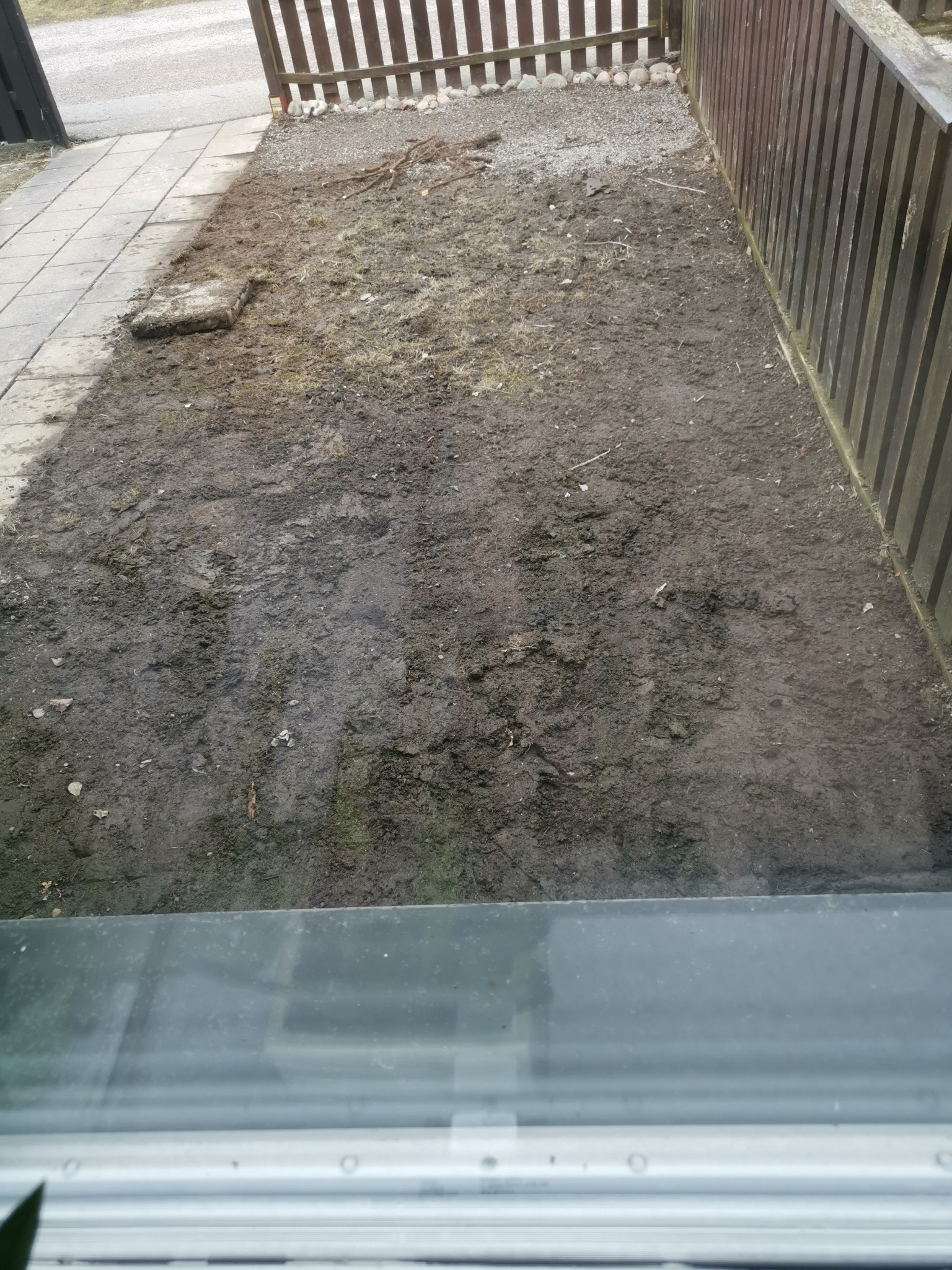
Hello, instead of creating a new thread, I hope someone can help me here. I am going to build a deck on slabs, but it needs to be raised 30 cm in height to be level with the entrance door. It's an area of 2.5 m x 6.5 m.
I have bought 45x145 joists to form the frame, and on it, I will lay decking 28x120. The offcuts from the 45x145 will be used as feet around the framework to achieve the 30 cm height.
I don't plan to dig out, fill with gravel. Instead, I will use a ground cloth directly.
Some questions.
1. I have a gutter that makes it difficult to fit the frame, as the joist on the short side does not fit behind the downspout. How should this be resolved? The frame must still be right-angled in all corners.
2. I will not use joist hangers but plan to screw all the joists together. My question is whether it can be done with regular decking screws 5x80 (3-4 screws) or must it be lag screws? Alternatively carriage bolts?
3. I will have a number of fence posts, 70x70, in the framework. Anything to keep in mind? I plan to use two lag screws 8x100 in each post in the outermost joist forming the frame.
I am grateful for any help. I am a beginner, so I have zero experience but have read and Googled quite a bit.
Thank you in advance!
1. Place the studs as close to the downpipe as you can, then cut a short stud at 45° to place in front of the downpipe.
2. Use 6x80 instead. Standard wood screws for outdoor use, class C4.
3. It's best if you can place the post in an inner corner where the outer stud and floor stud meet so you can screw it in from two sides. It's fine to use 6x80 wood screws for this too. If you can only screw it in from one side, use a French screw and place a scrap piece on either side of the post to secure it at least laterally.
1. Set the studs as close to the downpipe as you can, then miter a short stud at 45° that you place in front of the downpipe.
2. Use 6x80 instead. Regular wood screws for outdoor use, class C4
3. It will be best if you can place the post in an inner corner where the outer stud and floor joist meet so you can screw it from two directions. It's also fine to screw with 6x80 wood screws. If you can only screw it from one direction, use a lag screw and place a scrap piece on each side of the post to secure it at least sideways.
Hi, thanks for the quick response. I should probably replace the 5x80 screws with 6x80, thanks
Regarding the first question, do you have a picture of how it can look? I find it a bit difficult to understand what you mean since the outer stud that is supposed to form the frame on the long side is the stud I'm supposed to attach all the fence posts to, and when you mention mitering at 45 degrees, I won't be able to have a post in the frame for the fence post closest to the facade, as I don't want to screw into the facade. I hope you understand what I mean.
Regarding question three, there were no floor joists, just a frame that I will screw the decking boards onto. So there is no main beam first and then studs on that. If I understood you correctly.
You don't need to screw the inner beam into the facade. Just prop it up to the correct level with some ground slabs or similar. When you screw everything together with all the beams and decking, it won't move anywhere.
But I don't understand where you're going to have the posts, against the existing fence on the left or against the walkway of ground slabs on the right?
You don't need to screw the inner joist into the facade. Just prop it up to the right level with some paving stones or similar. Once you screw everything together with all the joists and decking, it won't move anywhere.
But I don't understand where you're going to have the posts, against the existing fence on the left or toward the walkway of paving stones on the right?
maah said:
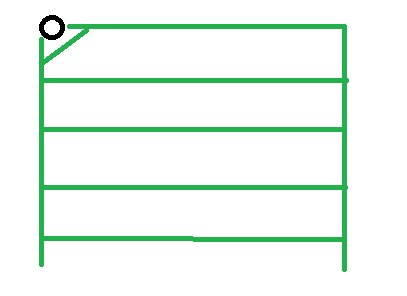
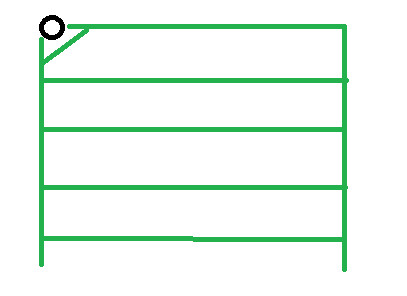
I was thinking like this
[image]
You don't need to screw the inner joist into the facade. Just prop it up to the right level with some paving stones or similar. Once you screw everything together with all the joists and decking, it won't move anywhere.
But I don't understand where you're going to have the posts, against the existing fence on the left or toward the walkway of paving stones on the right?
Thank you, now I understand what you mean. But if I'm going to have the joists lengthwise instead of crosswise as you've drawn, does this work just as well? I need to lay the decking the same way as the decking at our entrance. So I must have the joists lengthwise. And for that, I have planned for 15 slabs according to the picture.
I'm going to tear down the existing fence you see on both the long and short sides and have the 70x70 screwed into the frame. But about 70 cm apart center to center between the fence posts.
I have never used ready-made posts when making railings.
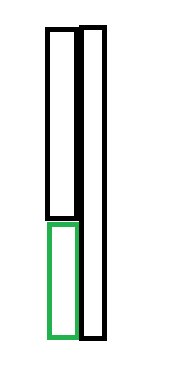
I always take 2 pieces of 45x95 that I screw and glue together. One of the beams is then allowed to go down along the floor beam while the other rests on top.
It becomes very stable that way.
I've never used ready-made posts when I've made railings.
I always take two 45x95 that I screw and glue together. One of the beams is allowed to go down along with the floor beam while the other rests on top.
It becomes very stable that way.
Something like this:
[image]
Okay, that's good.
Okay, yes, it seems to become very stable like that, unfortunately, my 70x70 are already purchased, so it'll have to be like that on the back instead. Thanks for the help.
Click here to reply
Vi vill skicka notiser för ämnen du bevakar och händelser som berör dig.



maah said:
1. Set the studs as close to the downpipe as you can, then miter a short stud at 45° that you place in front of the downpipe.