
3,365 views ·
13 replies
3k views
13 replies
Blue concrete according to inspection, but not according to technical description
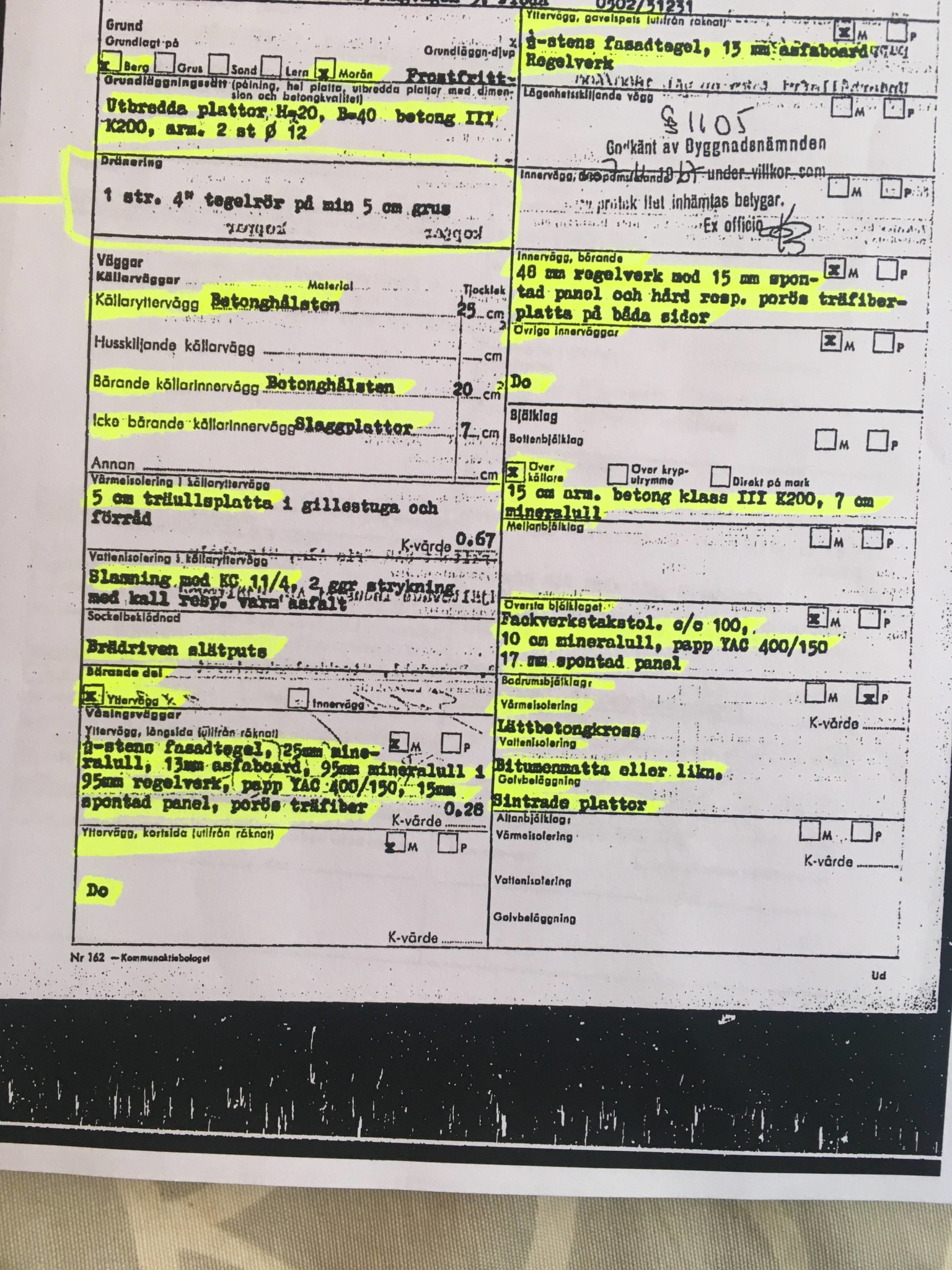
Hello dear construction enthusiasts! We want to buy a house from 1968 which is stated in the inspection report to have walls made of blåbetong. I requested the technical description from the municipality, but it doesn't mention blåbetong in the walls (it does mention lightweight concrete as insulation, which could be blåbetong). I called the inspector (he had inspected the house once before during another sale) and asked. He didn't remember how he concluded that they contained blåbetong (it was likely during the previous sale when he determined this). He said he usually taps and listens to see if it's lightweight concrete and that he can see from, for example, boreholes if it's blåbetong. He said it wasn't the deep blue blåbetong, which is the most radioactive. I know I can check everything perfectly with a gamma meter, but it's Stockholm and pandemic times - no seller would agree to a picky buyer who wants to measure when they have already made a fortune on their house, and there are other bidders. I want to know if the inspector could be wrong, or if it's common for the technical description to be inaccurate. I don't care as much if there's blåbetong in the basement walls, but I don't want it in all the interior walls. Can you help me interpret?
INSPECTION REPORT:
Foundation: basement (on a slope) and crawl space with concrete slab (my comment: the house has two parts, one with a crawl space and one with a basement)
Structure: wood and lightweight concrete (gray/blue)
Floor structure: concrete slab between split-level floors and wooden structure towards attic space
Facade: sand-lime brick type mexi
TECHNICAL DESCRIPTION:
Foundation
Foundation type: spread slabs, concrete III K200, reinforced.
Walls
Basement walls:
Exterior basement wall: hollow concrete blocks
Load-bearing interior basement wall: hollow concrete blocks
Non-load-bearing interior basement wall: slag plates
Thermal insulation in exterior basement wall: wood wool slab
Floor walls:
Long side exterior wall: (unclear)-stone facing brick, mineral wool, asfalt board, mineral wool in the framework, paper, tongue and groove panel, porous wood fiber
Short side exterior wall: Do
Gable peak exterior wall: (unclear)-stone facing brick, asphalt board Framework
Load-bearing interior wall: framework with tongue and groove panel and hard vs. porous wood fiber board on both sides
Other interior walls: Do
Floor structures
Ground floor structure (above basement): reinforced concrete class III K200, mineral wool
Top floor structure: Truss roof, mineral wool, paper, tongue and groove panel
Bathroom floor structure:
Thermal insulation: lightweight concrete crush
Waterproofing: bitumen mat or similar
Floor covering: sintered tiles
INSPECTION REPORT:
Foundation: basement (on a slope) and crawl space with concrete slab (my comment: the house has two parts, one with a crawl space and one with a basement)
Structure: wood and lightweight concrete (gray/blue)
Floor structure: concrete slab between split-level floors and wooden structure towards attic space
Facade: sand-lime brick type mexi
TECHNICAL DESCRIPTION:
Foundation
Foundation type: spread slabs, concrete III K200, reinforced.
Walls
Basement walls:
Exterior basement wall: hollow concrete blocks
Load-bearing interior basement wall: hollow concrete blocks
Non-load-bearing interior basement wall: slag plates
Thermal insulation in exterior basement wall: wood wool slab
Floor walls:
Long side exterior wall: (unclear)-stone facing brick, mineral wool, asfalt board, mineral wool in the framework, paper, tongue and groove panel, porous wood fiber
Short side exterior wall: Do
Gable peak exterior wall: (unclear)-stone facing brick, asphalt board Framework
Load-bearing interior wall: framework with tongue and groove panel and hard vs. porous wood fiber board on both sides
Other interior walls: Do
Floor structures
Ground floor structure (above basement): reinforced concrete class III K200, mineral wool
Top floor structure: Truss roof, mineral wool, paper, tongue and groove panel
Bathroom floor structure:
Thermal insulation: lightweight concrete crush
Waterproofing: bitumen mat or similar
Floor covering: sintered tiles


The house is built in two different parts: a basement level with a floor above, and a crawl space with two floors above. There is a short-term measurement taken outside the heating season on three levels. It's unclear which levels, as it was done by a previous owner. The municipality has no measurement. One floor was at 110+-60 with 95% confidence, but it could be 40% higher. The other two were below 100. It's unclear if the finished basement was measured, probably not. There has been an FTX since the '90s, so a lot is ventilated out.
My question is rather about whether it is possible to identify WHERE the blåbetong might be located, not about how much radon has been measured, whether it can be ventilated away, etc. They could just as easily have taken the measurements while they were on vacation and left the windows slightly open.
My question is rather about whether it is possible to identify WHERE the blåbetong might be located, not about how much radon has been measured, whether it can be ventilated away, etc. They could just as easily have taken the measurements while they were on vacation and left the windows slightly open.
I don't want blåbetong where I sleep. My question isn't about how dangerous blåbetong is, that you can ventilate it, etc. My question is whether you can help me, is there anything in the technical description that indicates it could be blåbetong?


It has been determined with great certainty that there is no radon problem, yet you are hung up on not wanting to live near blåbetong. It is obvious that this is completely irrational and solely in your head. Even if it turned out that it is not blåbetong, would you be able to relax then? Do you have evidence that blåbetong is the greatest health risk to you?U Umma01 said:
In a house of that age, you will surely have asbestos channels, insulation with asbestos, black glue, and lots of other questionable substances and chemicals that were considered okay at the time. And 60 years of ingrained dirt/smoke/mold/nicotine and other things that previous owners have left behind over the years. A little ventilated blåbetong is hardly the issue. In a modern house, you would instead have lots of questionable plastics and other chemicals whose effects are not yet known. And the air both indoors and outdoors is always full of harmful particles, including natural radon which is probably at a lower level than that from ventilated blåbetong.
You have decided that blåbetong is your worst enemy, and no one here will be able to convince you to start thinking rationally. So the answer to your question is no, no one here can help you, as you will dismiss any answers that do not suit you. This is hardly a constructional question.
Last edited:
Hehe, as I've said a few times now, the question is not about debating radon. I'm not asking for opinions or facts about radon; it's the building material I have a question about. No more posts about radon are needed. My question is whether it's possible to determine from the technical description where there is aerated concrete that could be blåbetong.
Answer: NoU Umma01 said:Hehe, as I have said a few times now, the question is not to debate radon. Opinions and facts about radon are not what I'm asking for, it's the building material I have a question about. No more posts about radon are needed. My question is whether, based on the technical description, it is possible to determine where there is lightweight concrete that could be blåbetong.
Have I understood this correctly?
According to the technical description, there is lightweight concrete rubble under the bathroom. However, the inspection states that there is lightweight concrete in the walls. The inspector who wrote that doesn't even know where he saw the lightweight concrete, or if he even saw it during this inspection. It could be that he didn't even see any lightweight concrete in this house, but read/remembered incorrectly?
If you are so worried about lightweight concrete (which can range from white to blue) that an uncertain statement from an inspector makes you hesitate to buy, then I think you should refrain from buying a house from '68. A little blue concrete is nothing compared to all the amounts of asbestos found in carpets, pipe insulation, fireproofing, etc., in that house.
According to the technical description, there is lightweight concrete rubble under the bathroom. However, the inspection states that there is lightweight concrete in the walls. The inspector who wrote that doesn't even know where he saw the lightweight concrete, or if he even saw it during this inspection. It could be that he didn't even see any lightweight concrete in this house, but read/remembered incorrectly?
If you are so worried about lightweight concrete (which can range from white to blue) that an uncertain statement from an inspector makes you hesitate to buy, then I think you should refrain from buying a house from '68. A little blue concrete is nothing compared to all the amounts of asbestos found in carpets, pipe insulation, fireproofing, etc., in that house.
He has seen gray-blue aerated concrete. My thought was that those with experience handling houses from that time might be able to offer some tips on where blue concrete might be hidden, if it was often used together with something else or so.
I get it, it was a time when they experimented a lot, not just with drugs.
I get it, it was a time when they experimented a lot, not just with drugs.
Click here to reply