
11,517 views ·
10 replies
12k views
10 replies
Black mold in wall after minor water damage - appropriate action?

After recently discovering a spot on the wallpaper, we opened up the "kulvert" where the sewage, water, etc., run from the upstairs to the basement. A double socket on the sewage pipe had leaked small amounts (barely even drips) and slowly but surely soaked the fiberglass insulation surrounding it. This caused the spot on the wallpaper, but when I now remove the insulation, I see that it has also caused black mold on the wall behind (an interior wall to the hall).
The insurance company has been contacted, but since the initial assessment was that the extent was small, no damage case has been filed. We said we would take it up if it turns out to be worse than expected. A plumber has been here and tapped the socket, which may have been disturbed a bit when the bathroom above was redone 1.5 years ago. We will keep an eye on it to ensure it doesn't leak anymore; if it does, we will replace the socket with some rubber gasket with hose clamps according to the plumber.
My question now is what needs to be done about the mold itself before we then close everything up. Is it enough to spray something mold-killing on it? I really hope we don't have to replace parts of the wall in our newly renovated living room...
The double socket on the sewage pipe is so tight against the wall behind it that I can't remove the last bits of damp insulation, but it should dry out since it's only a matter of a few centimeters of insulation, right?
The insurance company has been contacted, but since the initial assessment was that the extent was small, no damage case has been filed. We said we would take it up if it turns out to be worse than expected. A plumber has been here and tapped the socket, which may have been disturbed a bit when the bathroom above was redone 1.5 years ago. We will keep an eye on it to ensure it doesn't leak anymore; if it does, we will replace the socket with some rubber gasket with hose clamps according to the plumber.
My question now is what needs to be done about the mold itself before we then close everything up. Is it enough to spray something mold-killing on it? I really hope we don't have to replace parts of the wall in our newly renovated living room...
The double socket on the sewage pipe is so tight against the wall behind it that I can't remove the last bits of damp insulation, but it should dry out since it's only a matter of a few centimeters of insulation, right?
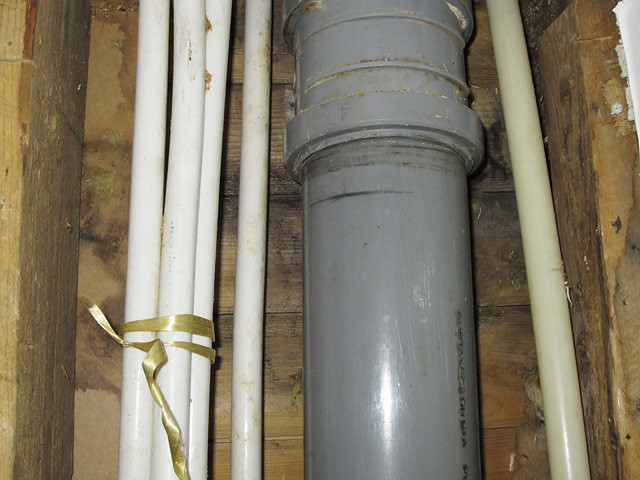
A few more pictures showing the culvert on the wall, the hole with insulation left, close-up of wall with mold.
The wood and other materials are not as wet as they appear now. Most of it is essentially dry, some a little damp. I have now placed paper around the upper joint of the coupling (where it leaked) to see if anything more comes. The plumber who was here tapped up the coupling about 2 cm with a hammer to make it fit tighter.
The wood and other materials are not as wet as they appear now. Most of it is essentially dry, some a little damp. I have now placed paper around the upper joint of the coupling (where it leaked) to see if anything more comes. The plumber who was here tapped up the coupling about 2 cm with a hammer to make it fit tighter.
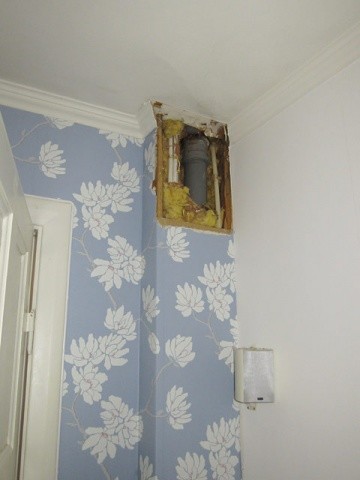
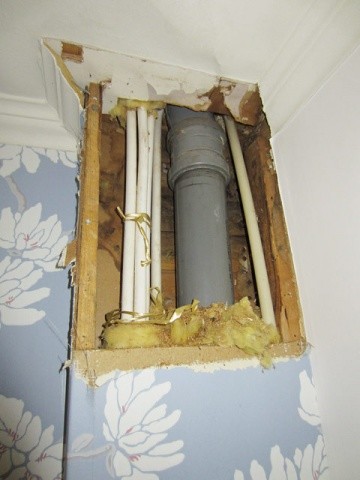
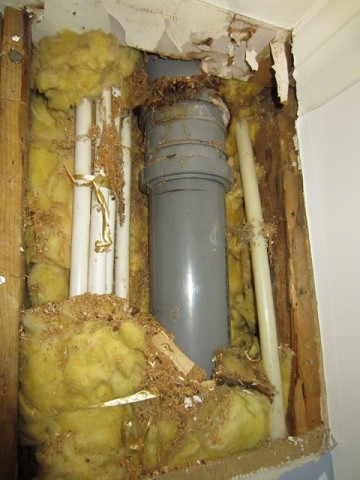
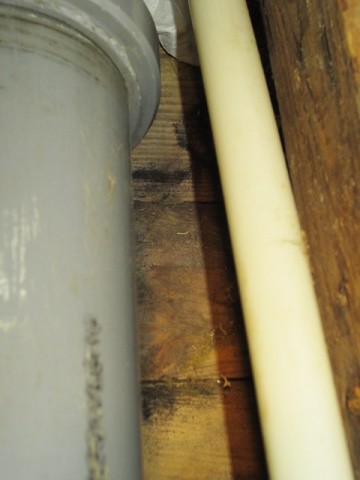
Perhaps I should also add that from now on, we will not fill the hole and wallpaper over it as we did when renovating and as it was when we bought the house. We will put a white-painted wooden hatch there instead so that we can avoid further damage.
Hi, sorry to hear about your injuries, but it seems to be limited at least. It also doesn't look like it has run along the wall (might be worth checking though), probably because the insulation was tight against the pipe.
It looks a bit strange with the angles at the coupling, but maybe it's hard to see in the picture? Are the pipes tightly tensioned sideways?
It looks a bit strange with the angles at the coupling, but maybe it's hard to see in the picture? Are the pipes tightly tensioned sideways?
The pipes are firmly in place in the forward/backward direction, which is why I can't remove the insulation. To move them a few millimeters sideways, you have to apply considerable force. What comes down into the joint from above is an angled pipe I believe, which might be why it looks odd?
It also hasn't flowed down the wall. As mentioned, there have been very small amounts of water leaking out, but over maybe a 1.5-year period?
It also hasn't flowed down the wall. As mentioned, there have been very small amounts of water leaking out, but over maybe a 1.5-year period?

Do the pipes really join together properly at the joint, so they pass the rubber gasket adequately?
One way to check and fix the leak is otherwise to cut the pipe, a bit down, and place a new coupling sleeve at the top and a new coupling sleeve at the bottom with a new piece of pipe between.
Looks like it has leaked quite a lot.
One way to check and fix the leak is otherwise to cut the pipe, a bit down, and place a new coupling sleeve at the top and a new coupling sleeve at the bottom with a new piece of pipe between.
Looks like it has leaked quite a lot.
If the pipes are tightly stressed, possibly combined with too short an insertion in the double socket, one side of the rubber gasket may gap. I would examine the connection a bit more closely.
Can't help but say something about the gift ribbon around the prisole, haven't seen that in Bauhaus's assortment ;-)
Can't help but say something about the gift ribbon around the prisole, haven't seen that in Bauhaus's assortment ;-)
A little tension probably doesn't matter, if the pipes go together there's just a 5 mm stop edge in the middle. To my knowledge, the plumber's rubber gasket isn't for these pipes. If there's a bend at the top, maybe it can be carved a bit there in the ceiling to get the pipe out.
Gift ribbons are in a class of their own, they adorn their place.
Gift ribbons are in a class of their own, they adorn their place.
Last edited:

Click here to reply