Hello, I've been searching and searching but can't find any information about the load-bearing capacity of standing form plywood, or regular plywood for that matter. Probably because plywood itself is normally not used in any form of load-bearing construction.
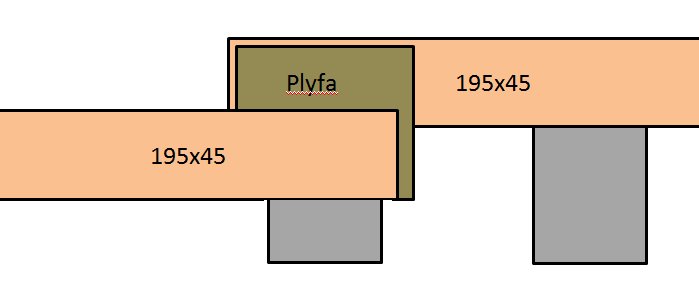
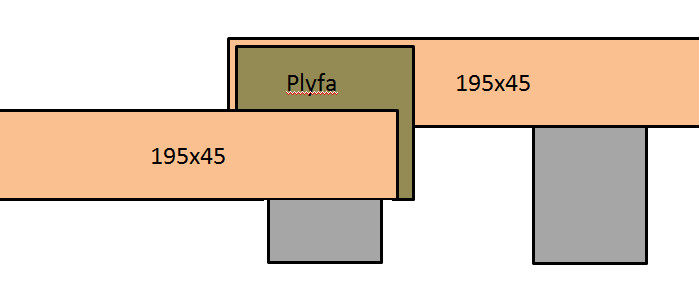
But, I've been poking around in my crawl space again and found an interesting setup where two beams, 195x45, are nailed together at slightly different heights with about a 40x40cm piece of form plywood between them. Note, the beams are not placed so that one is on top of the other, they are slightly offset, hence the piece of plywood, I assume.
Regardless of the perhaps, to me at least, obvious question 'why', how much weight can a standing plywood piece hold in this way?
Assuming the gray ones are posts. It naturally depends on how much the upper beam extends outside the post. If it's less than 60 cm, then there is no worse load-bearing capacity there.
Of course, the load-bearing capacity of the entire structure depends on the overhang, I understand that. What I was pondering was more about how much load-bearing capacity the plywood provides to the upper support beam, if it provides any significant support at all? I have seen plywood used in trusses, for example, but perhaps not to carry load in this way.
Yes, I might have expressed myself clumsily. The question was more generally intended regarding the potential load-bearing capacity of plywood, and thus whether it's even a material one should use in such contexts. I wasn't really looking to find out the load-bearing capacity of just my specific construction. Not initially, anyway.
Additionally, I probably misled even more by including the image in the post.
I have absolutely no idea how to calculate load-bearing capacity, so perhaps it was a silly question from the start.
I'll see if I can crawl down and measure a bit one evening this week, so maybe future generations can still get something out of this thread.
It is very strong. There are special floor joists made with a 45*45 or 45*70 at the bottom and top, and OSB/hardboard/plywood is placed standing in between. Can handle spans of 9 meters.
Yes, I might have expressed myself clumsily. The question was more generally intended regarding the potential load-bearing capacity of plywood, and thus whether it's even a material one should use in such contexts. I wasn't really seeking to know the load-bearing capacity of my specific construction. Not initially, at least.
In addition, I probably misled even further by including the picture in the post.
I have no clue how to calculate load-bearing capacity, so perhaps it was a silly question from the start.
I'll see if I can crawl down and measure a bit some evening this week, so maybe the future can get something out of this thread.
Yes, plyfa is strong as h-ll, but in your case, it's the fastening of the plyfa that is the weak link to the upper bearer.
In this case, plywood can be considered equivalent to a nailing plate or laskbricka, and in addition to the board's dimensions, the number of nails and their dimensions also play a significant role.
The attachment consisted of five or six 4-inch nails per support beam, so I took the opportunity to add about ten screws (5.0x60mm) per support beam while I was down there crawling. The plywood was formply 12mm thick.
But thanks a lot! Now I know more about plyfa not being a bad choice to use in such contexts, and I can feel quite confident that this construction works pretty well in my case.
Click here to reply
Vi vill skicka notiser för ämnen du bevakar och händelser som berör dig.