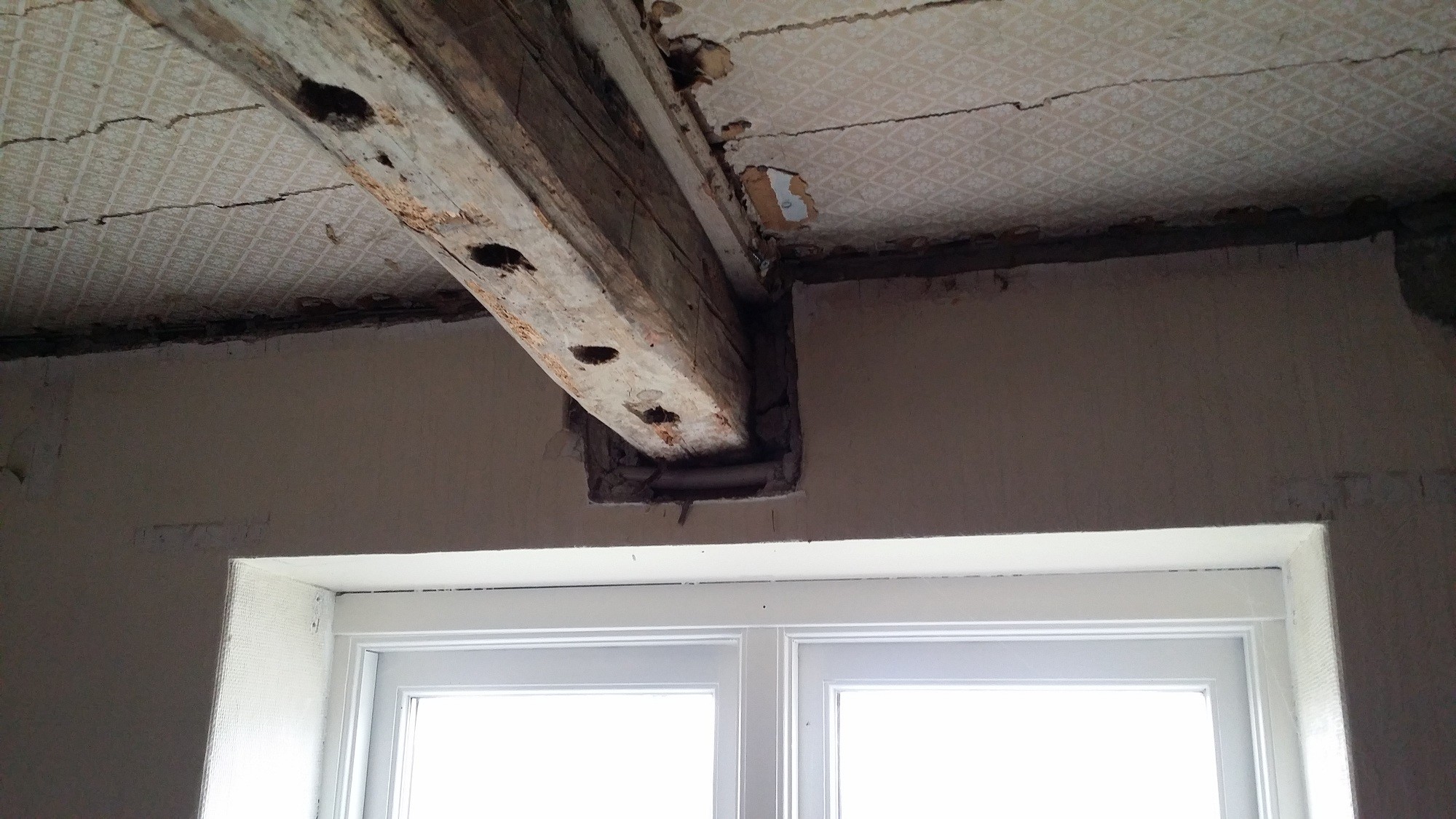
The wooden beam rests on a 70 mm stud over the window opening.
It has indeed held for the past 60 years since someone decided to install a window under the beam, but it feels like something I want to address during renovation.
The wall will be built out with a 45 mm stud and plasterboard because it is very uneven and both heating pipes and electrical conduits need to be installed.
The idea is to place a horizontal steel beam under the wooden beam with dimensions around 70x45 mm with support legs on the sides that are also attached to the wall.
The question is, what type of beam is best for this purpose? And are there suitable standard dimensions?
Or are there other solutions I haven't thought of?
Yes, it doesn't look so good. It is probably the center post of the window frame that is bearing. To be able to help you, one needs to know the load that the beam represents. The best basis is drawings, both floor plans and a cross-section. The beam's free length, the distance between the beams, and what is on the floor above are the most important information.
Steel is only available in standard dimensions and types. What is suitable/possible mainly depends on the size of the load.
Counting loads and managing them is of course wise, but one does not do that in an old Skånelänga like this. Also, I'm not at all sure that the beam is supported on the window sash's mullion - the frame is quite far out due to the facade brick.
I will replace the alternating rule and recess a steel beam or profile (once I find one that is suitable) into the wall above the window and slightly down over the window frame's head, which will be about 100 mm and should be more than sufficient. Sacrificing a bit of the aesthetics, but at least it cannot get worse.
I agree, sometimes you don't need to calculate so much. It's lasted a long time as it is, a 100mm steel beam must make it last an eternity!
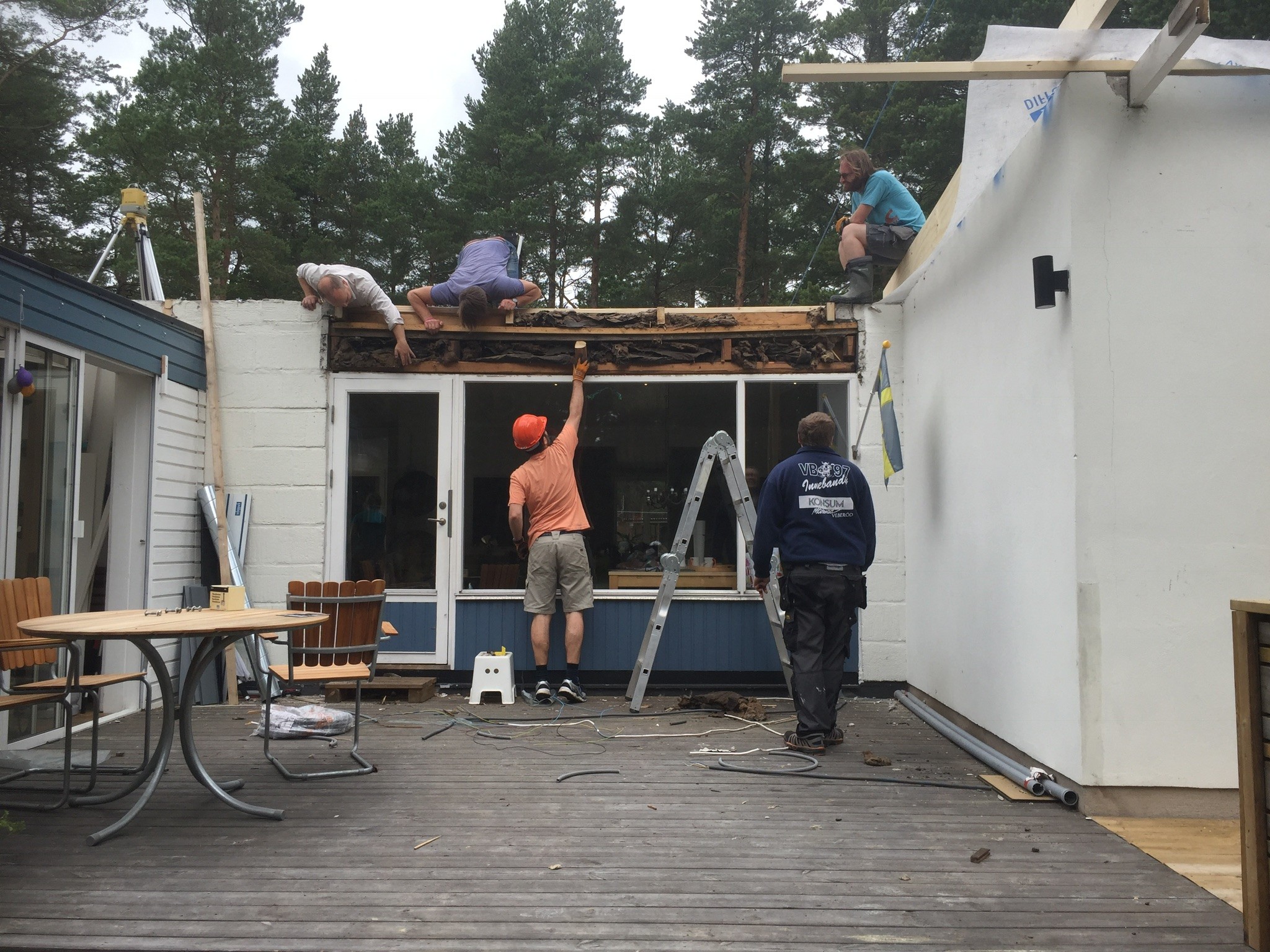
Check out the picture of our load-bearing glass section we found this summer! It's been holding up since 1985, but I chose to reinforce it quite heavily.
There is hardly any point in embedding a beam if you don't know in which realm of loads to search. It is not particularly difficult to figure this out.
Nothing is difficult if you know it, and with the help of this fantastic forum, you can almost always find or get answers to your questions. I am deeply impressed by people's knowledge and willingness to help every time I am here.
There is hardly any point in embedding a beam if you don't know in which range of loads to look. It's not particularly difficult to calculate this.
Thanks for the response and opinion. But I believe that an embedded steel beam of 100 mm is significantly better than the current old 70 mm wooden beam. More than 100 mm is not possible, as it would reach the level of the window frame, so it's not worth calculating in my opinion
The beam is not hung from anything transverse above the window/ceiling so that the load is distributed to the side of the window? (you don't always have to let a load press straight down)
I also live in an old Skånelänga. It might very well be that the beam is attached to a wall frame/top plate that is equally sturdy. This is how we have it in a couple of places in our old barn. Since they used half-timbering with thick beams, you can do it this way.
We have the same situation over a window. There is absolutely no problem with load-bearing capacity there.
We also have transverse thick beams across the roof beams in a couple of places, which help support the roof beams. Such beams may also be present. (Their span is a couple of meters shorter than the roof beams, and they have their supports on transverse load-bearing interior walls.)
So, it’s advisable to first check the frame construction, and be prepared that it might need reinforcement if the structure/load-bearing capacity has been compromised during previous renovations. It also depends on what loads are acting on the roof beam. That is, is there an attic that has been furnished, or not? If it’s just an attic above, there are no loads. If a rafter leg also comes down in the same place, there is some load, of course, depending on the roof construction and roofing material.
If it has held for 60 years without creaking and groaning, it can probably last another 60 years, unless the loads are increased now?
Click here to reply
Vi vill skicka notiser för ämnen du bevakar och händelser som berör dig.