
3,572 views ·
27 replies
4k views
27 replies
Attaching kitchen island to concrete floor - screws and plugs

The following 800x600 cabinets with three drawers weigh 55-60 kg each
https://www.ikea.com/se/sv/p/metod-maximera-baenkskap-med-3-lador-vit-veddinge-vit-s29049708/
So in your case, two cabinets (empty) must be lifted with a lever arm of max 30 cm by two children/teenagers.
I would say that it is totally impossible.
There is a higher risk that the countertop will break than that the cabinet would lift 0.1 mm above the floor.
https://www.ikea.com/se/sv/p/metod-maximera-baenkskap-med-3-lador-vit-veddinge-vit-s29049708/
So in your case, two cabinets (empty) must be lifted with a lever arm of max 30 cm by two children/teenagers.
I would say that it is totally impossible.
There is a higher risk that the countertop will break than that the cabinet would lift 0.1 mm above the floor.
No, it's completely free-standing.Demmpa said:
So it's four cabinets joined together, two 800x600 and two 800x400 next to each other, so the total floor space the cabinets occupy is 1600x1000 with a countertop weighing about 50 kg.
Is one short side against a wall?
It doesn't need to be screwed to the floor, it won't tip over even if five adults stand at the edge of the overhang on the long side.
But if one wants to fixate it with something, would screws 5.0 x 60 mm and plugs 6 x 35 mm work together, or is the plug too short for a 60 mm screw?
I've seen that the screw should be at least 5 mm longer than the plug, but here it's 25 mm too long. There should be a relatively short part of the screw that, through the plug, attaches to the concrete.
Maybe mostly it's Ikea wanting to be extra cautious, but it would still feel good to have it secured somehow.The following 800x600 cabinet with three drawers weighs 55-60 kg each
[link]
So in your case, two cabinets (empty) must be lifted with a lever of max 30 cm by two children/teenagers.
I would say it is completely impossible.
There is a greater risk that the countertop breaks than that the cabinet would lift 0.1 mm off the floor.
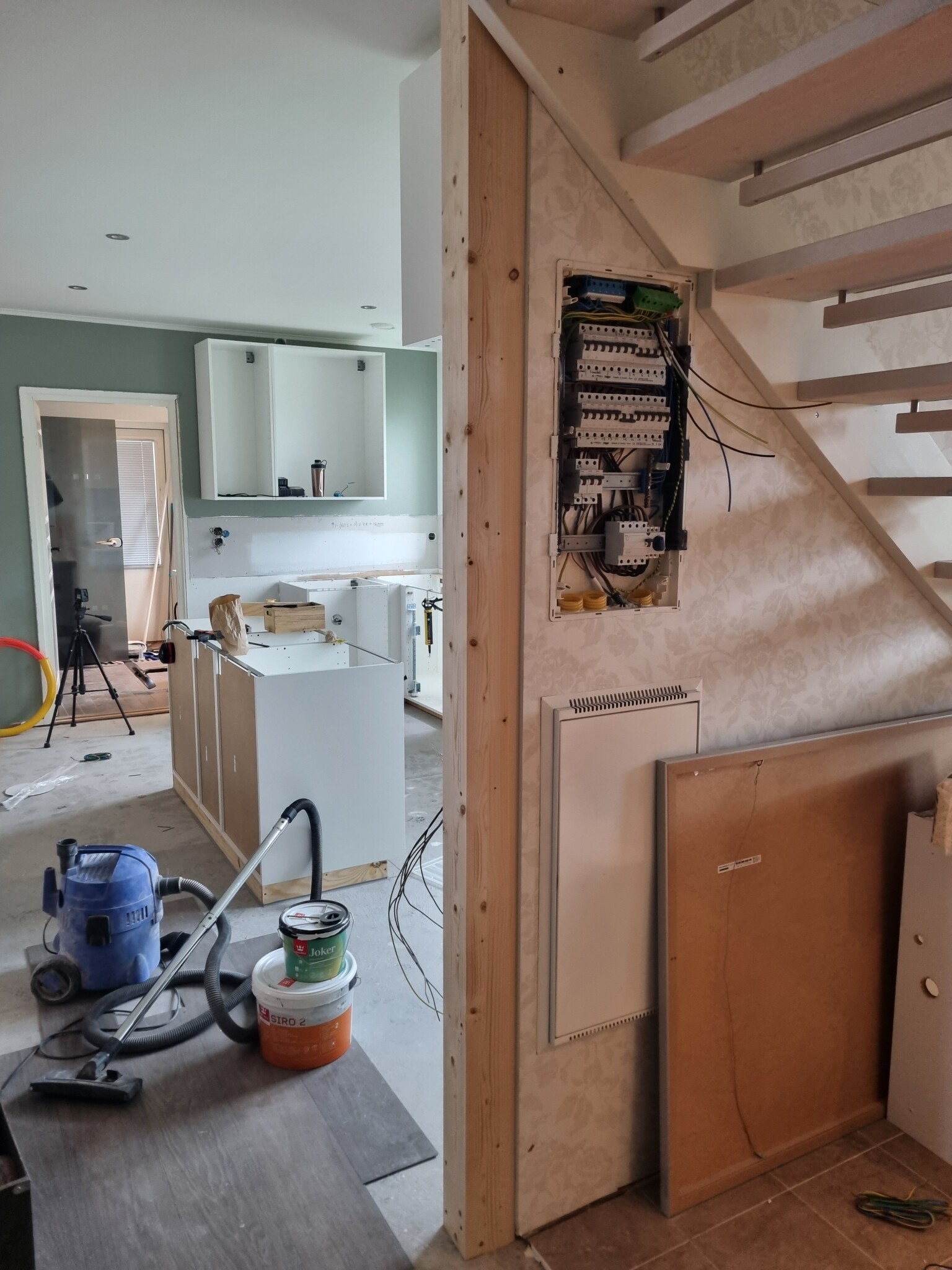
We have a "kitchen island" against a wall, a 600x600 tall cabinet against the wall, then a 600x600 base cabinet + 400x600 base cabinet back to back. On the back of the base cabinets, we have two base cabinets (the base cabinets take up a floor area of 1000x1200). The cabinets are connected to each other but not attached to the floor/wall/ceiling. It's barely possible to move the cabinets sideways even if you brace against the wall/cabinet. If we only had one row, we would need to secure the cabinets at the rear, mainly in case several drawers are pulled out simultaneously.
The tall cabinet can "sway"/swing a little at the top, just so the tall cabinet doesn't risk tipping over if more than half of the built-in drawers are pulled out simultaneously, and to have a nice backside, we have attached cover panels that go all the way up to the ceiling.
The tall cabinet can "sway"/swing a little at the top, just so the tall cabinet doesn't risk tipping over if more than half of the built-in drawers are pulled out simultaneously, and to have a nice backside, we have attached cover panels that go all the way up to the ceiling.

If you have a fully-threaded screw, it doesn't matter that the screw is so much longer. The problem with the short plug is that a large part of it ends up in the tile, and that doesn't count towards the load-bearing part. You can resolve it by screwing in the screw a turn or two and then tapping it down so that the entire plug passes through the tile into the concrete.R Relik said:No, it is completely standalone.
But if you still want to fixate it with something, would a 5.0 x 60 mm screw and a 6 x 35 mm plug work together, or is the plug too short for a 60 mm long screw?
I've seen that the screw should be at least 5 mm longer than the plug, but here it's 25 mm too long. It should be a relatively short part of the screw that then via the plug attaches to the concrete.
How do you handle any unevenness in the slab then? The advantage of screwing is that you can adjust the frame/fittings so that it is level, won't that be difficult with glue?T Taren43 said:
I had a warp of about 2mm over the slab where the kitchen island was installed, laid a 5mm bead of superfix and then tapped down the foundation so it was level.R Relik said:
So I built a separate frame in plywood which was glued to the floor, then I placed the cabinets on it and screwed them down from the inside into the frame.
You should remember that an adult 120kg+ person playing with the children puts quite large lateral forces on the kitchen island if you crash into it (ask me how I know...) Tipping is not such a big risk perhaps, but you can easily get it to move sideways, especially if it's placed on tiles which are quite hard and don't offer much friction. I have an additional 35cm overhang for barstools on mine.
Member
· Västra Götaland
· 3 642 posts
If you're afraid that the kitchen island will slide on the floor, you can place/glue/lay thin rubber mats under the legs of the cabinets to increase the friction.T Taren43 said:one should remember that an adult 120kg+ person playing with the children exposes the kitchen island to quite large lateral forces if they collide with it (ask me how I know...) tipping over is perhaps not a major risk, but you can easily get it to move sideways, especially if it is placed on tiles which are quite hard and do not offer much friction. I have an additional 35cm overhang for barstools on mine.
or, you can glue it in place. That way, it will stay there without any maybes or hopefullys. AND you avoid the anxiety of drilling into a floor with underfloor heating

Now it was fixation using plugs and screws. Got the tip to glue it from another side as well, but it felt best with screws.
I can report that it went smoothly to use the impact drill through tiles and concrete without any major impact on the tiles.
I can report that it went smoothly to use the impact drill through tiles and concrete without any major impact on the tiles.
Click here to reply