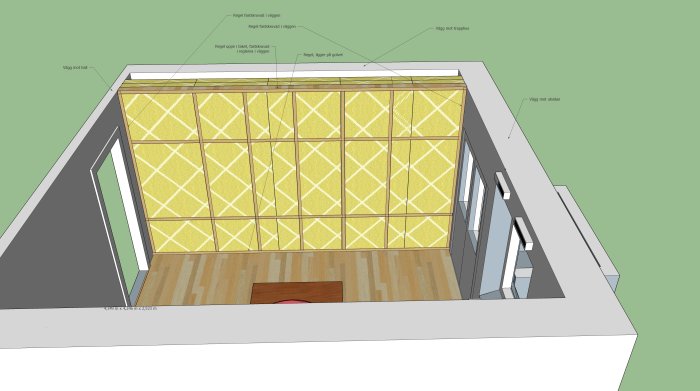
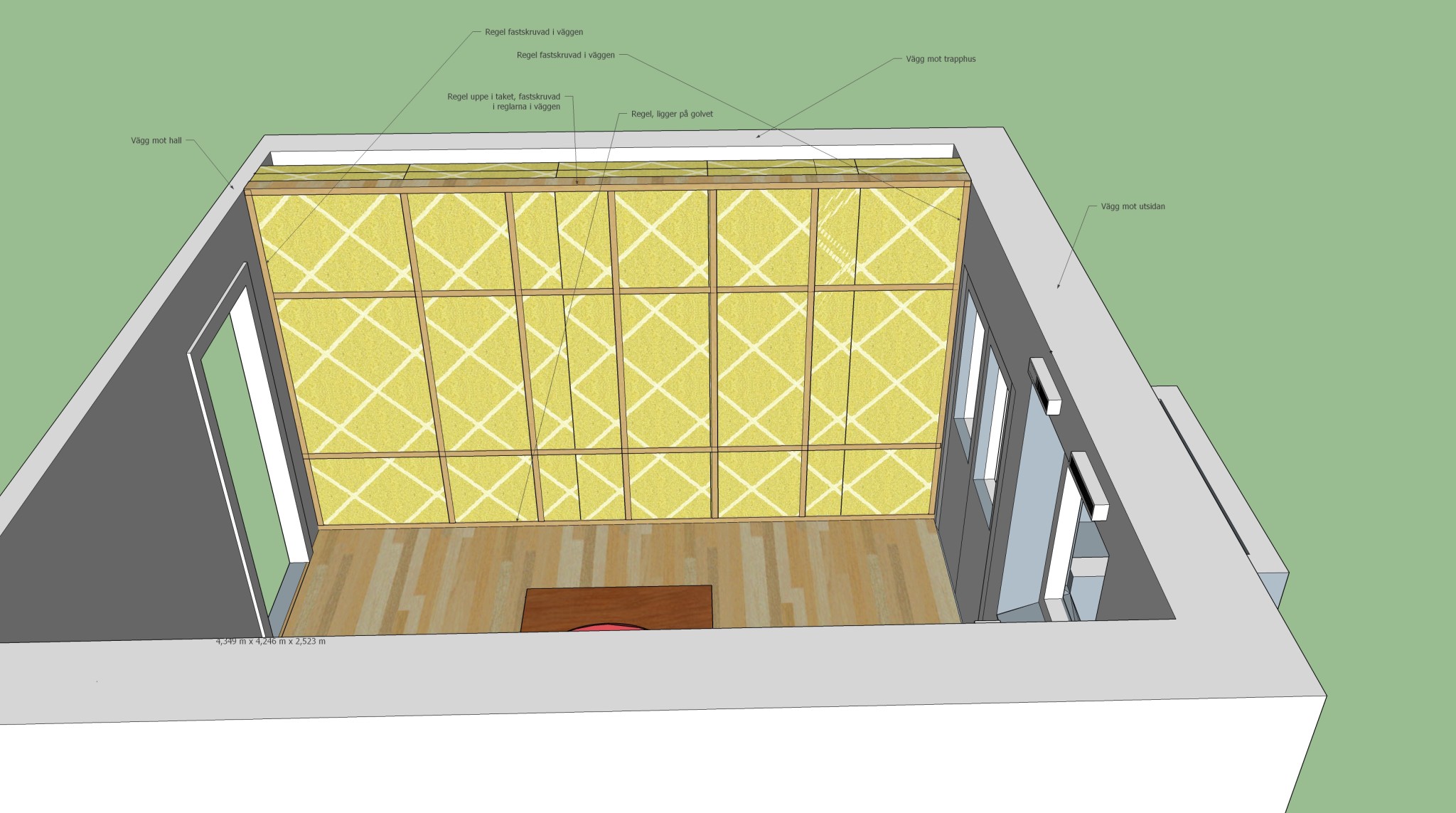
Wow, it looks sturdy! It seems like it can handle quite a bit.
However, I have a question I haven't really gotten an answer to. The wall feels very porous, and some have suggested plaster as the surface material. I'm thinking if it's plaster, I must somehow get behind the plaster with the plug, into the aerated concrete. But if it's aerated concrete, it's enough to drill to the same depth as the plug. Just the fact that I could hammer in a wood screw without a problem, can you do that in aerated concrete?
I know you've mentioned you believe it's aerated concrete, but I'm just wondering if you can hammer in a wood screw into the material?
Just made a discovery in a socket in one of the interior walls. There are two materials there. A gray material innermost that seems to be what the wall is made of, and on top of that 2 cm of a more yellow-gray/light brown-gray material. Could it be aerated concrete and plaster perhaps? Or aerated concrete and gypsum?
Okay, then it must be lightweight concrete, because I assume you can't hammer in a wood screw into regular concrete? Then the wall must be as follows: First two cm of whatever it is, then lightweight concrete. So I must drill the hole 2 cm deeper than the plug to get it completely into the lightweight concrete? Alternatively, use a plug like this, where the expanding part starts a bit inside. https://www.hilti.se/medias/sys_master/images/h6d/9208262459422/23252_APC_ORIG.jpg That's how it must be, right?
Made a discovery, not sure if it matters. But the hole I looked into in the kitchen doesn't share the wall with the living room at all. There's a bathroom in between. The wall is around 9-10 cm thick. Is there a risk that there are pipes inside? Considering there's a bathroom on the other side? Can I drill without risk?
Floor plan with comment: https://ibb.co/cOcLQ5
Perhaps it was a bit unclear, what I mean is that on the other side of the inner wall there is a bathroom. Are there risks with drilling into such a wall? Could there be water pipes in the wall? The wall is 9-10 cm thick.
In the wall you are going to drill into, there should not be any water. Check with the property owner and take the opportunity to ask how the walls are constructed if you feel unsure.
Hello! I asked the property owner, and he didn't know since there aren't exact drawings. However, he thought like you that there shouldn't be any pipes there. He did say that I'm doing it at my own risk and if anything happens, I will be responsible. But I'm aware of that.
The thing is, both the sink and toilet are attached to the wall facing the kitchen. The only thing attached to the wall facing the living room is a shower, and its pipes go straight up into a ceiling. A ceiling like this http://image.basekit.com/bkpam261176_undertak.jpg
So one might think that the pipes continue over the ceiling and connect on the other side of the room. Otherwise, why would there be a ceiling if not to conceal pipes? If they are water pipes, they should be metal(?), and then I should notice it when drilling, right? It should suddenly stop. And if they are sewage pipes, they are probably plastic, and I should notice that it becomes much easier to drill if I've come through one. By then, the damage is likely already done. But I do know there are sewage pipes in the other wall, so it would be strange if there were sewage pipes in two walls. The tenant above me's drainage goes down in the wall behind the toilet. So then the wall towards the living room must be free from pipes, unless there are water pipes there. But that shouldn't be a problem since I would notice that when drilling. (If they are metal, that is.) If they are plastic, there will be water damage if I happen to puncture one.
What do you think?
By the way, is it common to have water pipes in plastic?
I'm thinking of starting now. I'll begin with the back wall. I'll do the ceiling last.
One question, the floor is linoleum. Can I place a joist directly on it or do I need some protection underneath? I'm wondering if it will leave a mark. How wide do you think the joist should be to have on the floor? The wider it is, the more the load is spread out on the floor. Is 120 mm enough or should I go wider?
Another question is: Do I need to ventilate this wall just like the front corners? That is, to create a channel where air can circulate. There is about a 20-mm air gap between the wool and the wall but no opening where air can enter. Is it needed for this wall?
/Jens
Ok, awesome! Thank you so much! What do you think about the rug on the floor? Can I lay it directly on the floor or do I need protection underneath? How wide should it be?
A 45mm stud is probably enough, so choose what looks best. I would have placed a floor foam between the stud and floor to reduce the risk of squeaking.
Click here to reply
Vi vill skicka notiser för ämnen du bevakar och händelser som berör dig.