
19,640 views ·
62 replies
20k views
62 replies
Advice on actions in an old basement
Yes, the idea was that this would become (relatively speaking) a low-budget project that I mostly do myself. I have at least ordered the dehumidifier from Woods now. The laziest solution for the concrete floor might be to just paint it? Since I have lots of floor drains, there are slopes everywhere. Or if I still want to close most of them, maybe I should cast it evenly instead? Floor heating doesn't seem relevant, so it would only be to lay tiles in that case. Or are there other floors that might be relevant?GoC said:
The walls are a mix of raw concrete on some and plaster (falling off) on others. A lot of wires and pipes in the ceiling. Need lighting too, there's very little right now.
A lot to ponder, indeed.
It's just about putting some cheap tiles right on the existing concrete floor.G Galten said:Yes, the idea was probably that this would become (relatively speaking) a low-budget project that I mostly do myself. Anyway, I've now ordered the dehumidifier from Woods. The laziest solution for the concrete floor might just be to paint it? Since I have a lot of floor drains, there's a slope everywhere. Or if I want to seal most of them, maybe I should level it instead? Underfloor heating doesn't seem relevant, so it would only be to lay tiles in that case. Or are there other floors that might be relevant?
The walls are a mixture of raw concrete on some and plaster (falling off) on others. A lot of wires and pipes in the ceiling. Also need lighting, there's very little right now.
A lot to think about anyway.
I've only pressure washed and scraped off some loose plaster before I installed the floors and walls
Example of a finished laundry room at just under 30m2
Ongoing project and the last how it looks in the upcoming project in the garage, i.e. how the entire basement looked before.
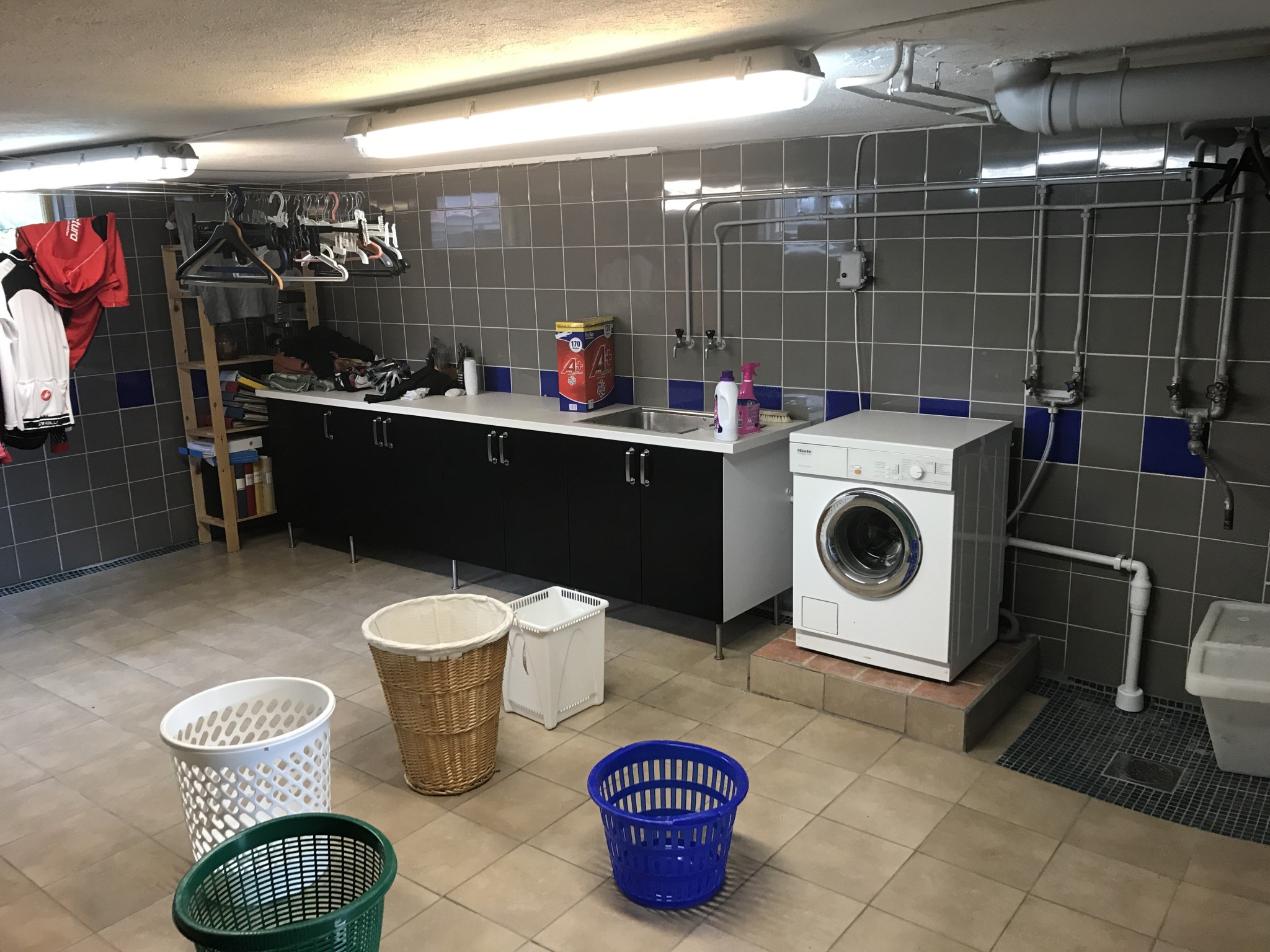
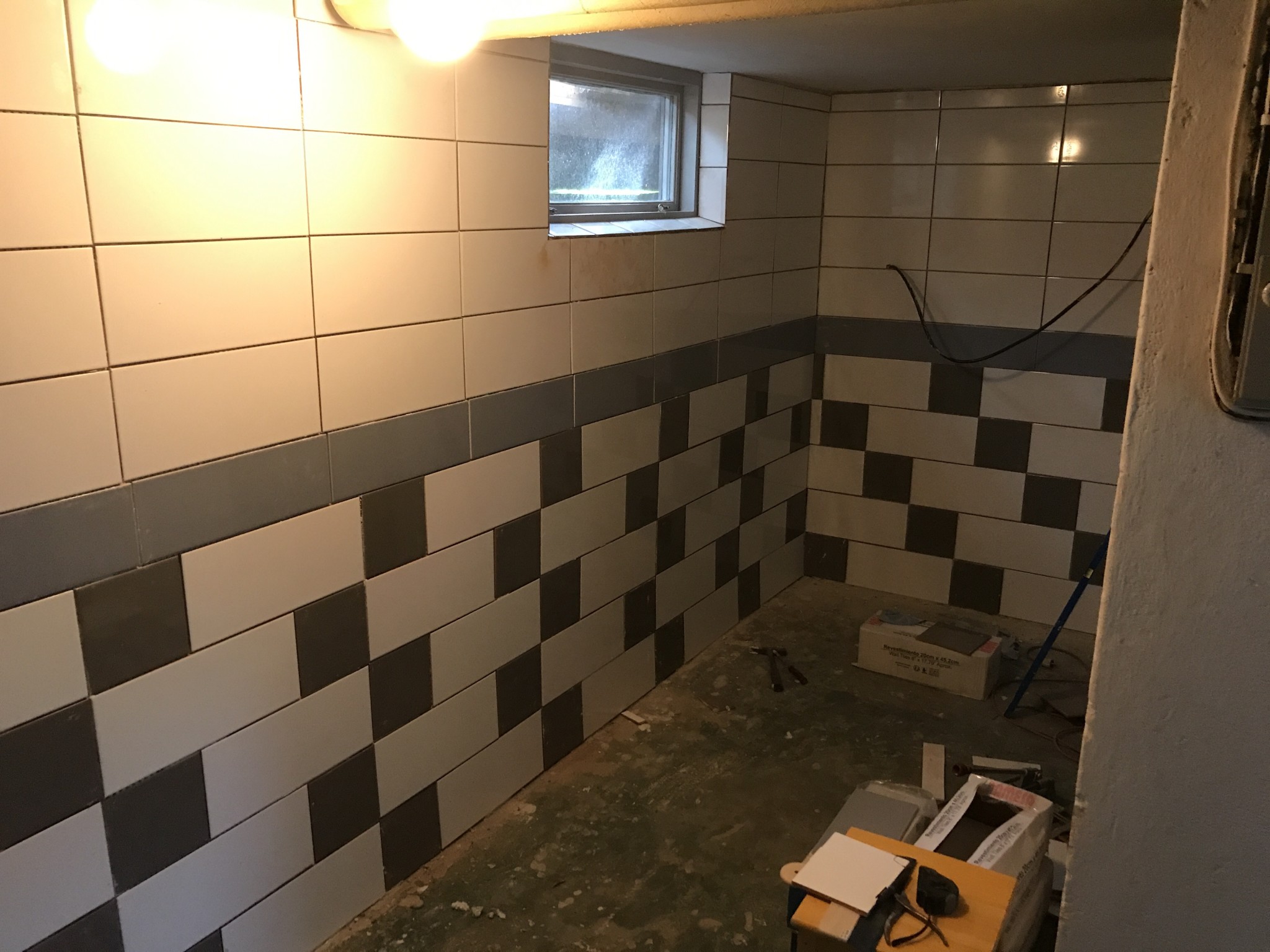
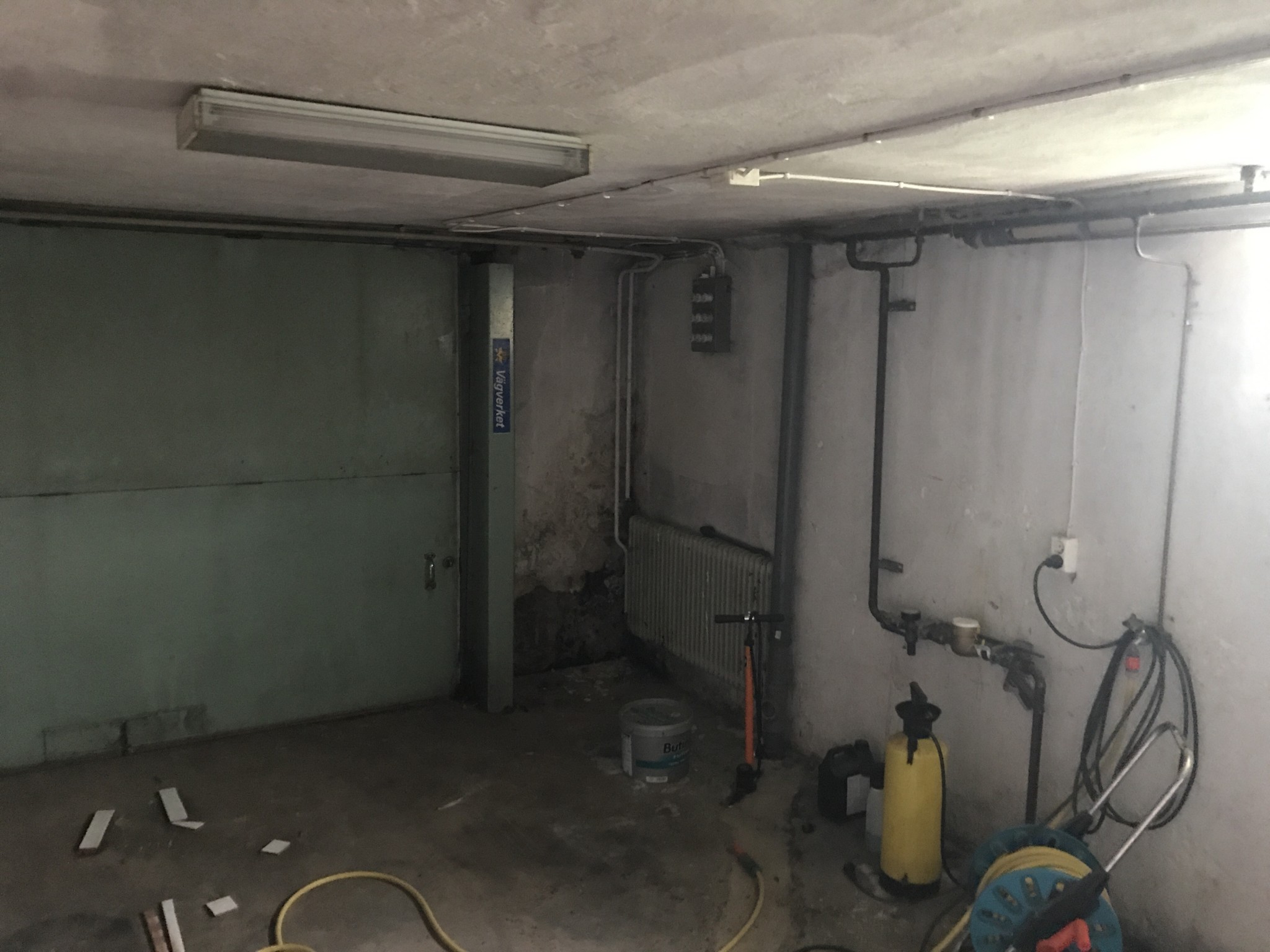
also think you should try other measures before you drain. when we bought, the basement was damp and peeling with plastic floors. Moisture, drain! said the inspector and everyone else, so we spent 80,000 on it. It had poured for several weeks, but 30 cm down the ground was completely dry. No water has ever flowed here, the contractor noted. Sure, we got 2-4 degrees warmer in the basement, but what solved the problem was tiles, silicate paint, some electric heaters, and a dehumidifier. It is also open up since the entrance was in the basement, so warm air came down, cooled off, and created moisture.
Thank you for all the inspiration!
Now it feels crystal clear that I should have tiles in the basement, easy to maintain and neat! However, I'm not completely sold on tiling the walls, even though it is surely extremely easy to maintain. Plastering the walls feels iffy considering how the plastered part of the basement looks right now. It will probably fall down again in a year or so. Is there any other alternative for the walls?
Regarding the floor, it is partially painted with flaking paint. I assume the paint needs to be sanded off before I lay the tiles?
I was also in contact with Woods regarding the dehumidifier I bought at Elgiganten. It is so new that Woods hasn't had time to update their website.
Now it feels crystal clear that I should have tiles in the basement, easy to maintain and neat! However, I'm not completely sold on tiling the walls, even though it is surely extremely easy to maintain. Plastering the walls feels iffy considering how the plastered part of the basement looks right now. It will probably fall down again in a year or so. Is there any other alternative for the walls?
Regarding the floor, it is partially painted with flaking paint. I assume the paint needs to be sanded off before I lay the tiles?
I was also in contact with Woods regarding the dehumidifier I bought at Elgiganten. It is so new that Woods hasn't had time to update their website.
Rinse the floor with a pressure washer with a stone nozzle. It removes everything that's loose. Works well for these projects. Same on the walls, and my tiles haven't fallen down even after nearly ten years. The walls had some plaster peeling, which I just slapped on with a bit of plaster mix; doesn't need to be very precise. Otherwise, you can tile half the wall, up to 1.2m, and paint the rest. Looks nice with less work.G Galten said:Thanks for all the inspiration!
Now it feels crystal clear that I should have tiles in the basement, easy to maintain and neat! However, I'm not completely sold on tiling the walls, even though it's probably extremely easy to maintain. Plastering the walls feels so-so considering how the plastered part of the basement looks right now. It will probably crumble down again in a year or so. Is there any other alternative for the walls?
As for the floor, it's partially painted with peeling paint. I assume the paint needs to be sanded off before I lay tiles?
By the way, I was in contact with Woods regarding the dehumidifier I bought at Elgiganten. It's so new that Woods hasn't had time to update their website.
if you start with a dehumidifier and floor, you might notice that the walls become drier, unless you have lots of penetrating moisture from the ground, but then you know that on the other hand (i.e., drainage). If the walls dry up, it might lead to more plaster falling off. See what happens. Otherwise, maybe you could paint with silicate paint on whatever it is today. A bit of paint is always nice, and the smell is better than with open concrete.
Member
· Västernorrland
· 12 030 posts
When it comes to the floor drains, perhaps one should check if they are even connected to the sewage system? In the past, it wasn't so particular, and such drains might have just led to some seepage pit.
They should be connected, when the downpour came in 2014, water was shooting up like fountains from the floor drains!S Stefan1972 said:
Another thing that might not have anything to do with this: I have a strange hatch in the basement floor. When I open it, there is a 50 cm deep hole with nothing in it. The bottom is covered with sand. What on earth is it?
Member
· Västernorrland
· 12 030 posts
Yes, but I thought if the water came in via other ways if it rained as much as it did. If an old stone chest gets full, it would be the same thing, I guess?G Galten said:They should be connected, when the downpour came in 2014, the water stood like fountains from the floor drains!
Another thing that might not be related to this: I have a strange hatch in the basement floor. When I open it, it's a 50 cm deep hole with nothing in it. The bottom is covered with sand. What on earth is it?
Penetrating ground moisture is not the same as the drainage needing to be fixed. Rather, the waterproofing layer, the asphalt, on the basement wall is finished. Drainage does nothing for ground moisture, but if you have problems with penetrating water. There has been some form of drainage hysteria; all so-called inspectors claim that as soon as the drainage, if there is any at all, is aged, it's worn out and should be replaced. But an old drainage, made of clay pipes, never gets worn out. And usually not the problem. As I wrote at the start, it's the waterproofing layer that's finished. But it's just as good to seal from the inside, I claim.L Lane said:if you start with a dehumidifier and the floor, you might notice that the walls become drier, unless you have lots of penetrating ground moisture, but then you'll know, on the other hand (i.e., drainage). If the walls dry out, it can lead to more plaster falling off. See what happens. Otherwise, maybe you can paint with silicate paint on whatever it is today. A little paint is always nice and the smell is better than with open concrete

You might want to undertake an archaeological excavation in the hole, who knows what is hiding there.G Galten said:They should be connected, when the downpour came in 2014, the water stood like fountains from the floor drains!
Another thing that might not have to do with this: I have a strange hatch in the floor in the basement. When I open it, it is a 50 cm deep hole with nothing in it. The bottom is covered with sand. What on earth is it?
You don’t have any blueprints of the house? If not, the municipality might have them in their archives. There is usually information on how to get a copy of these on the municipality's website.
How do you seal from the inside, and are there any other risks with that?Intruding ground moisture is not the same as saying the drainage needs to be addressed. It's more likely that the waterproofing layer, the asphalt, on the basement wall is finished. Drainage does nothing for ground moisture, however, it helps if you have problems with water intrusion.
There's been some sort of drainage hysteria, all so-called inspectors claim that as soon as the drainage, if there even is one, is old, it's worn out and needs to be replaced.
But an old drainage system, made of tile pipes, never wears out. And usually, that's not the problem. As I mentioned at the beginning, it's the waterproofing layer that's finished. But I claim it's just as good to seal from the inside.
I am putting up tiles. There’s probably no risk with a concrete block wall being a little damp below ground level. The concrete won’t be ruined by being damp.G Galten said:
I have also installed paneling in a small closet that was supposed to be a sauna but served as a wine storage for a while and now a storage for my skis. The walls there are covered with Platon mats, followed by nail battens and paneling.