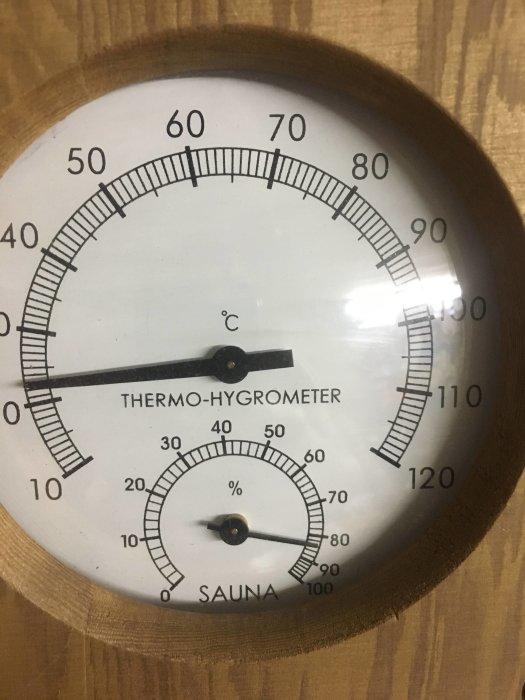
I own a house from 1936 with a basement. Probably no one has done any drainage since the house was built. When I moved in, there was a wooden sauna and wood paneling on the walls in the basement. I've torn all that out since it was mold-damaged. There is high humidity in the basement during the summer, and if you leave a sweater or carpet there, it gets moldy in about a week. In the winter, the air is dry. I've never seen moisture stains on the walls, so it's probably just the warm summer air getting saturated when it comes down to the basement? There is no active ventilation, only vents. There is central heating in the basement, but I never have it on.
The walls and floor are concrete. The basement is mostly like a black unpleasant hole, to be honest.
I have no intention of turning the basement into a cozy nook, but I would like to make it more pleasant to be down there. Maybe have a rehearsal space and a woodworking corner. Get rid of the moisture and smell in the summer. One more thing is that I have three floor drains, and they need to be addressed somehow. Twice in the last five years, water has come up during downpours. But I suppose a professional should fix that.
Do you think it would be enough to install more active ventilation? Do I have to drain the house? I'm happy to receive any tips related to basements! Thanks
I also had a disgusting basement even though the house was much newer. Dark and dirty.
I did the following:
- removed all the junk, everything organic
- clean clean clean
- six dirty ventilation holes were tidied up and equipped with vent valves on the inside. They are open in winter and closed in summer. No more ventilation.
- installed a Woods dehumidifier (4000 SEK) for 60 m2 basement. It runs during the summer. I should add that the entire basement is one big room.
- installed good lighting with some LED fluorescent fixtures
- Some portions of the wall were plastered and painted white
Now it's nice, cozy, and dry. You should fix the floor drains so that the rain doesn't come in. I recall there are backflow valves available.
I also have a basement that I wish was better regarding the moisture. Everything is just as you, TS, describe, and I have a similar situation. What level of humidity do you have? I have just over 80% now in the summer.
I've considered whether it would help to install one or a couple of convector heaters down there. I have two vents in different rooms. Should they be closed? Isn't air circulation needed?
It was probably damp before too, but it became much more noticeable when the oil heater was removed. It's a classic example of increased moisture problems when the heater is thrown out.
Trying to address the symptoms instead of fixing the problem is backwards according to me. If the basement is damp and you don't have a swimming pool indoors, the moisture is coming from outside in one way or another. A house should be dry at the top (roof) and dry at the bottom (drainage). Before you do all sorts of other strange things, make sure to drain the house. Insulate externally with 200mm isodrän/pordrän. Marginally more expensive than 100mm. The air will immediately be much better, and if you continue to have problems with moisture penetration, make sure to create good ventilation in the basement. It will immediately be noticeable on the indoor air quality throughout the house once you have drained it. Possibly review the ventilation in the entire house and install mechanical exhaust on both floors at the same time.
I also realize that the fully correct way to get a basement that you can even live in would be to drain the house. But I'm really hesitant in my case. Along two of the sides runs a magnificent boxwood hedge (1.8x1.5 m) which was probably planted back in 1936. And on one of the sides, there is a nearly new deck. Everything would need to be torn down. I haven't measured the humidity, but you can feel how damp it is right now.
However, I'm doubtful if the moisture is coming through the walls and floor? At least nothing is visible. In the fall and winter, the air in the basement is dry, and that's when the soil is supposed to be the most moisture-laden? Groundwater is not a problem where I live. Are there no alternatives to draining?
It was a good thought in the thread that ventilation might not be what you want in the summer. Pumping in even more warm humid air sounds silly. Maybe a good dehumidifier, and some paint on the floors and walls are enough to make it comfortable enough to have a woodworking corner and a place to scream with the electric guitar. And minimal textiles. Maybe lay tiles? That should at least stop any moisture from below. Backwater valves in the floor drains are also high on the list, especially since there's only one sewer pipe in the street...
I also have a basement where it was extremely humid this summer. I don't have any numbers, but clothes hanging down there felt very damp and it was generally "sticky," so it was probably around 70-80%.
I placed a dehumidifier (a simple one from Jula https://www.jula.se/catalog/bygg-oc...ng/elektriska-avfuktare/luftavfuktare-007015/) that runs 24/7 and a couple of moisture absorbers and restricted the ventilation, and it has made an enormous difference in a couple of months. Down to 40-50% most of the time now. Now, it's almost the best climate in the house in the basement on days when it feels stuffy and humid outside, so I can really recommend it. A simple measure for a relatively cheap amount.
@Galten
What kind of ventilation do you have in the house? Natural or mechanical ventilation?
I myself moved into a house with a basement about 4 years ago. Re-drained after a couple of months and immediately noticed a difference in the air throughout the house. You won't regret it if you do it.
Boxwood hedge, decking, etc., sound like excuses. =0) The hedge can be moved temporarily, the decking can be dismantled. If it's on slabs, maybe it can be lifted off almost intact with a crane? Otherwise, it doesn't take many days to take apart and reassemble.
When I talk about ventilation, I mean taking a comprehensive approach, like f/ftx in the whole house and not just vents in the basement.
If you drain and insulate, you'll raise the temperature in the basement a few degrees, and thus the difference between indoor and outdoor air won't be as pronounced. This won't create the same moisture migration if warm outdoor air enters the basement.
Another consideration, how are the sewage and incoming water? Cast iron and galvanized, or pem and plastic pipes? If you re-drain, you can also replace the incoming water/sewage with modern materials. Is it cast iron in the basement? What condition are they in? If you haven't checked them, they could be broken under the slab and leaking. They can also cause high humidity levels indoors.
Do it thoroughly, even if it hurts the wallet and the yard. =)
It seems like there are many things that need fixing!
The house only has natural ventilation and old classic vents with a flap+spring. The sewer drains are probably original from 1936 (in cast iron). I need to fix these regardless because I had nearly a meter of toilet water in the basement in 2014 during the big flood (I live in Malmö).
The house is completely uninsulated (only an air gap in the walls) and has high energy consumption.
To drain or not to drain... If the issue is solved in the summer with a dehumidifier and increased ventilation, along with tidying it up, maybe that will suffice for what I want to use the basement for. After all, the house has stood like this for 83 years, and the basement was probably never intended as living space.
First, try with simple means for a year or so. You can drain later if needed. If you play the three-lined E on the keyboard persistently enough, you will drive out moisture and spiders from the walls.
He he! Only the heat from the tube amplifier will dry everything up...
Looking at dehumidifiers from Woods now. This one seems to have just as good specifications as the more expensive ones (amount of water/day, area, power consumption etc). Additionally, it is 14 dB quieter and costs half as much. I'll go for it unless someone has bad experiences:
The check valve for the floor drains is easiest to install where the sewage exits the house, which means you need a check valve for the entire house. In this case, you have to break up the floor where the outgoing sewage is and install it, then place a durk sheet over it so you can access it.
There are also versions that can be installed outdoors, which can then be placed in a well with a lid outside, allowing you access if needed. Like one of these: https://www.avloppscenter.se/vara-produkter/fettavskiljare/tillbehor/backventil-zbk-110mm.html
Or equivalent.
Perfect to do when you are re-draining and replacing the incoming water and sewage. (Couldn't resist, I understand you are not too keen on re-draining)
He he! The heat from the tube amplifier alone will dry everything up...
Looking at dehumidifiers from Woods now. This one seems to have at least as good specifications as the more expensive ones (amount of water/day, area, electricity consumption, etc.). Additionally, it's 14 dB quieter and costs half. Will go for it if no one has bad experiences:
[link]
It seems good but I can't find it on Woods's website... Is it perhaps an older version?
I also have an old basement from 1946
Never had it drained and have no plans to do so.
Tiles and klinker for 49kr/m2 fix the problem and at the same time make it stylish and durable.
Better to spend the money, that a drainage would cost, on a heat pump that drastically reduces heating costs in an old uninsulated house.
Vi vill skicka notiser för ämnen du bevakar och händelser som berör dig.