
2,529 views ·
3 replies
3k views
3 replies
Adding insulation to the foundation, PIR
Hello,
I'm planning to add insulation to an uninsulated concrete base of 30 cm and apply a granite stone veneer. The height between the ground and the outer panel varies from 70 to 210 cm. The basement is currently heated to 19-20 degrees and I hope to have it at 21 degrees after insulation. A small FTX unit ventilates any possible moisture. From June to August, the relative humidity is around 60% (3-year series) and around 35% in winter, so it’s a dry basement. However, it has recently been redrained around the entire house with 200 mm Optidrain. (up to a maximum of 70 cm from the ceiling). I have limited space from the concrete wall to the top edge of the outer panel/laths, it will already build out a bit with the tops of the granite cladding.
The plan is:
1. On those with over 2 "courses" (span of max 6-7 on one side of the house) I will first install stainless steel angle irons, 2 per 60 cm, every other course (i.e., every other stone in height).
2. Glue 5 cm PIR boards with aluminum foil outside. 6 stripes/board (1.2 m) to maintain a few mm distance to the concrete wall for condensed water to run into the drainage. Bostik Extreme as adhesive, expensive but bonds strongly unlike Biltema Multibond Rapid which just became soft with weak force...
3. Attach fiberglass mesh 165 g/m2 4x4 mm grid with stainless steel anchor bolts/washers or if I manage to find stainless steel nail plugs.. 4 pcs/m2.
4. Ardex X32 or LIP Multifog a first thin layer in the fiberglass mesh
5. Same natural stone fix and apply with 15-45 mm irregular granite veneer. Weighs 14 kg (600x300 mm) per stone or 80 kg/m2.
Questions:
A). The expander/nail plug easily holds 80 kg/m2, 2 m in height on the tall wall. There will be 8 bolts for 2 m height and the weight is 160 kg for 2 m. 20 kg/bolt/nail plug...? Unnecessary with stainless steel angle irons? It's hard to get in the perfect position before insulation is in place... Any comments?
B). A few mm of distance between the concrete wall and PIR theoretically allows condensation to occur in the space, but when I think about it, condensation will happen on the outside of the aluminum foil in the natural stone fix. 30 cm concrete will be virtually consistent in temperature when I apply 5 cm PIR so the space of a few mm will be "warm". With such low humidity levels (overestimated 75%@19 degrees gives 100%@14 degrees), the temperature would need to drop to 14 degrees for condensation. Condensation cannot occur in the airtight PIR, so it will be outside in the fix. Any comments?
Best regards, Jocke
I'm planning to add insulation to an uninsulated concrete base of 30 cm and apply a granite stone veneer. The height between the ground and the outer panel varies from 70 to 210 cm. The basement is currently heated to 19-20 degrees and I hope to have it at 21 degrees after insulation. A small FTX unit ventilates any possible moisture. From June to August, the relative humidity is around 60% (3-year series) and around 35% in winter, so it’s a dry basement. However, it has recently been redrained around the entire house with 200 mm Optidrain. (up to a maximum of 70 cm from the ceiling). I have limited space from the concrete wall to the top edge of the outer panel/laths, it will already build out a bit with the tops of the granite cladding.
The plan is:
1. On those with over 2 "courses" (span of max 6-7 on one side of the house) I will first install stainless steel angle irons, 2 per 60 cm, every other course (i.e., every other stone in height).
2. Glue 5 cm PIR boards with aluminum foil outside. 6 stripes/board (1.2 m) to maintain a few mm distance to the concrete wall for condensed water to run into the drainage. Bostik Extreme as adhesive, expensive but bonds strongly unlike Biltema Multibond Rapid which just became soft with weak force...
3. Attach fiberglass mesh 165 g/m2 4x4 mm grid with stainless steel anchor bolts/washers or if I manage to find stainless steel nail plugs.. 4 pcs/m2.
4. Ardex X32 or LIP Multifog a first thin layer in the fiberglass mesh
5. Same natural stone fix and apply with 15-45 mm irregular granite veneer. Weighs 14 kg (600x300 mm) per stone or 80 kg/m2.
Questions:
A). The expander/nail plug easily holds 80 kg/m2, 2 m in height on the tall wall. There will be 8 bolts for 2 m height and the weight is 160 kg for 2 m. 20 kg/bolt/nail plug...? Unnecessary with stainless steel angle irons? It's hard to get in the perfect position before insulation is in place... Any comments?
B). A few mm of distance between the concrete wall and PIR theoretically allows condensation to occur in the space, but when I think about it, condensation will happen on the outside of the aluminum foil in the natural stone fix. 30 cm concrete will be virtually consistent in temperature when I apply 5 cm PIR so the space of a few mm will be "warm". With such low humidity levels (overestimated 75%@19 degrees gives 100%@14 degrees), the temperature would need to drop to 14 degrees for condensation. Condensation cannot occur in the airtight PIR, so it will be outside in the fix. Any comments?
Best regards, Jocke

I am uncertain about the moisture permeability of the PIR boards and the brick cladding. Regardless of possible relative humidity levels and dew points, there is a risk that water may remain between the layers if they are sufficiently moisture-resistant, which could lead to problems. A draining insulation board like isodrän might be a safer alternative then. Likely worse insulating ability, but safer from a moisture perspective.
If I understand you correctly, you intend to try to glue the PIR boards with some distance to the wall. The boards will then support the granite cladding together with plastered fiberglass mesh. I might be wrong, but that sounds optimistic. With an air gap in the construction, the expander/plug will run freely and have significantly less load-bearing capacity than if compression against the wall also occurs.
What kind of brick cladding are you considering?
I have also considered building on my plinth. To a large extent, it is an aesthetic measure since the wood facade is additionally insulated and "protrudes" a bit too much compared to the plinth. Right now, I'm leaning towards installing träullit boards to then plaster. Without having the figures in front of me, it is likely yet another step down in insulating ability, but it will provide a more homogeneous construction that doesn't risk trapping moisture or causing issues in terms of strength.
If I understand you correctly, you intend to try to glue the PIR boards with some distance to the wall. The boards will then support the granite cladding together with plastered fiberglass mesh. I might be wrong, but that sounds optimistic. With an air gap in the construction, the expander/plug will run freely and have significantly less load-bearing capacity than if compression against the wall also occurs.
What kind of brick cladding are you considering?
I have also considered building on my plinth. To a large extent, it is an aesthetic measure since the wood facade is additionally insulated and "protrudes" a bit too much compared to the plinth. Right now, I'm leaning towards installing träullit boards to then plaster. Without having the figures in front of me, it is likely yet another step down in insulating ability, but it will provide a more homogeneous construction that doesn't risk trapping moisture or causing issues in terms of strength.
At the same time, the indoor humidity levels are low because we have FTX. An air gap between the wall and PIR through glue strings at maybe 5 mm that drains straight into the drainage if anything should still condense.S Sam_u_El said:I'm unsure about how moisture-permeable the PIR boards and the wall cladding are. Regardless of any possible relative humidity levels and dew points, there is a risk that water may stand between the layers if they are sufficiently moisture-resistant, which could lead to problems. A draining insulation board like isodrän could be a safer alternative. Likely with worse insulating ability, but safer from a moisture perspective.
If I understand you correctly, you're trying to glue the PIR boards with some distance from the wall. The boards will then support the granite cladding together with plastered fiberglass mesh. I could be wrong, but it sounds optimistic to me. With an air gap in the construction, the expander/nail plug will be free and have significantly less load-bearing capacity than if compression against the wall also occurs.
What type of wall cladding are you considering?
I have also thought about building on my plinth. To a large extent, it's an aesthetic measure since the wooden facade is additionally insulated and sticks out quite a bit compared to the plinth. Right now, I'm leaning towards installing wood wool boards and then plastering. Without having the numbers in front of me, it's likely another step down in insulating ability, but it will give a more homogeneous construction that doesn't risk trapping moisture or causing issues with durability.
Flexfix tile adhesive with vertical setting for the air gap above theoretically holds 100 tons/m2 (1 MPa). Assume one hundredth practically, that's still 1 ton/m2. Then, insulation holders to fix the fiberglass mesh are only to keep the mesh up before a new layer of Flexfix is applied on the outside of the PIR board. The fiberglass mesh is only to keep board to board together, I don’t really think it’s needed, but it was too cheap to pass up.
Then granite cladding 80 kg/m2 in the Flexfix.
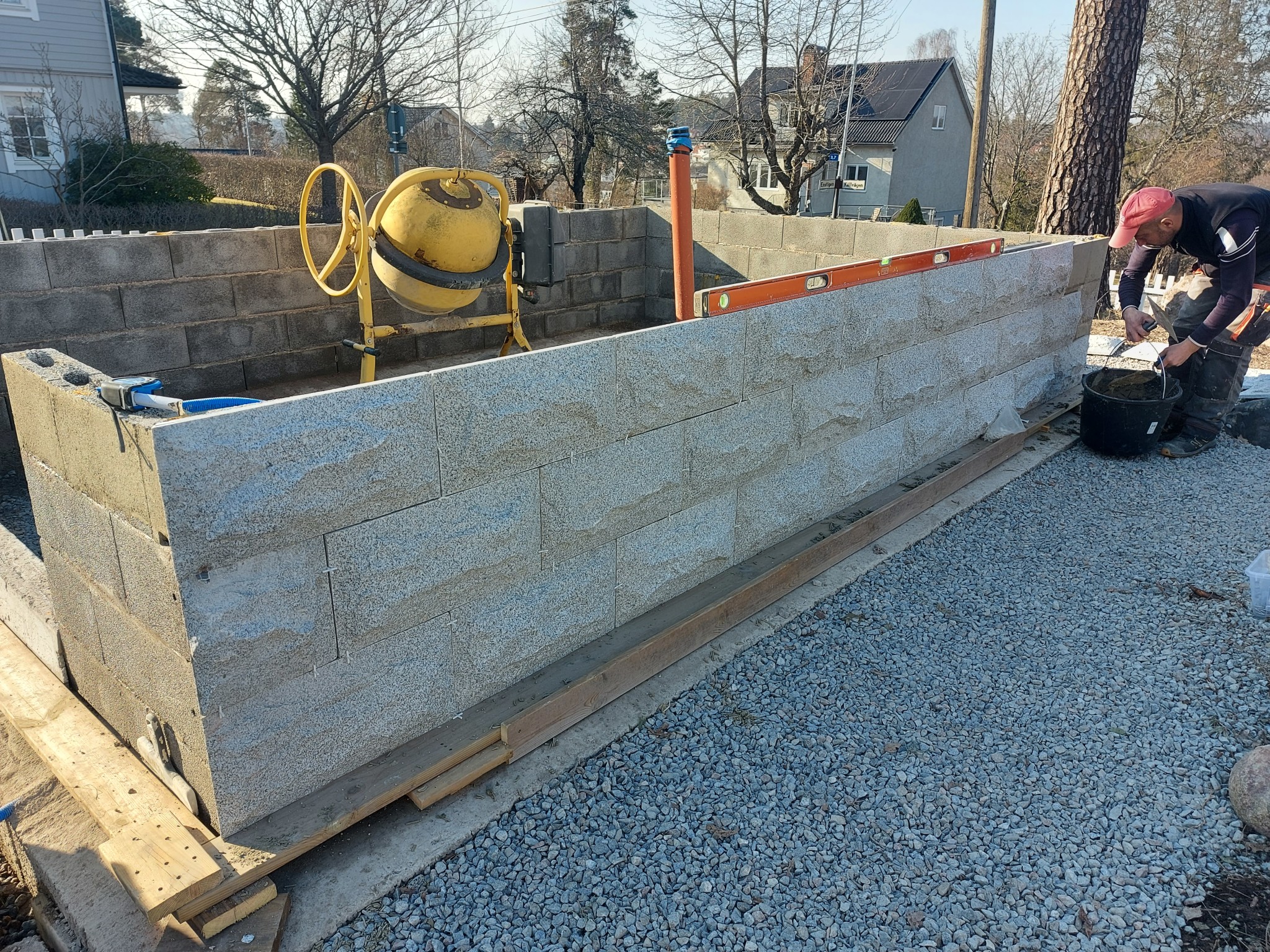
The same granite cladding being installed on the new greenhouse now.
Click here to reply