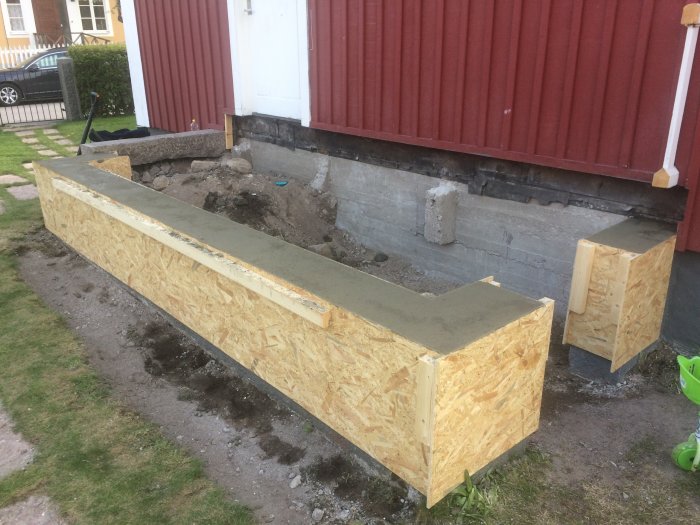
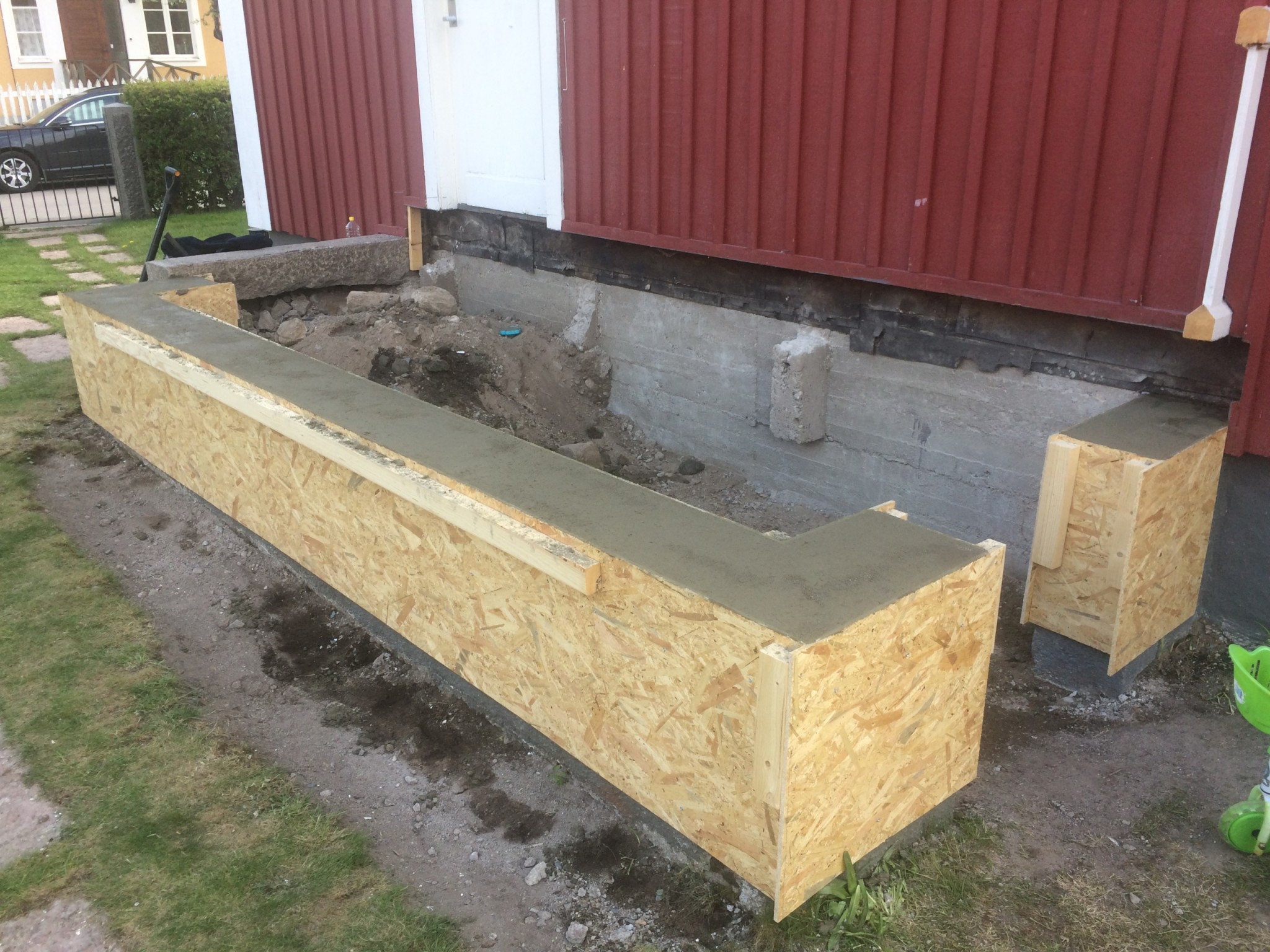
I'm in the process of building in a porch, about 2x4.5 m, where there will be a crawl space. Wood joist structure 45x220. The rest of the house has a basement, so only the new part will have a crawl space. A picture from the casting of the wall can illustrate how it looks (the pile of earth will of course be removed):
I'm now considering how to make the subfloor. One idea I have is to attach 50 mm tongue and groove XPS 200 to the underside of the joists, nailed to the beams with nail plates. Besides contributing to insulation and protection against thermal bridges, the boards would support the joist insulation in the form of cellulose. I realize that the protection against stepping through won't be great, but are there any other drawbacks to such a solution?
I have it under one of my floors, I think it works excellently, both as extra insulation and subfloor. Now, a few years later, it still looks like when it was new. But if you have plenty of mice, there's nothing stopping them from easily gnawing through the sheet and building a nest. I have a mouse-free crawl space.
I mounted a ground board made of mineral wool as a subfloor. Got the go-ahead for this solution from Isover, even though it was a bit tricky as they have to be attached from underneath. http://www.isover.se/products/isover-markskiva-38
I mounted ground slab of stone wool as subfloor. Got approval for this solution from Isover, even though it was a bit tricky as they have to be attached from underneath. [link]
Aha, that could also be a good alternative. Even with XPS, I have thought of mounting from underneath and taking advantage of the fact that the sheets are tongue-and-groove so that I can join in the middle of a compartment. A bit tricky to lie on my back but nice to avoid tinkering with support battens and fitting pieces in a cc300 floor structure.
Aha, that could also be a good alternative. Even with XPS, I have planned to mount from underneath and take advantage of the boards being tongue and groove so that I can join in the middle of a section. A bit of a hassle to lie on the back but nice to avoid messing with support rails and fitting pieces in a cc300 floor structure.
The downside of ground boards is, however, the weight.
Click here to reply
Vi vill skicka notiser för ämnen du bevakar och händelser som berör dig.