
27,033 views ·
18 replies
27k views
18 replies
Widen door in load-bearing wall.
Hello!
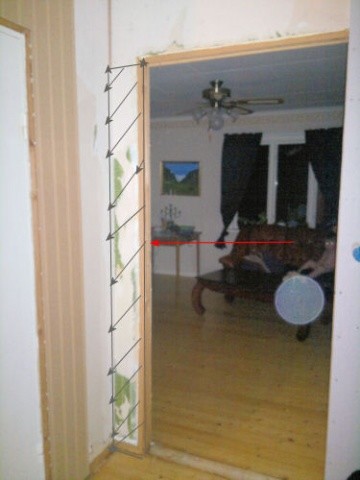
We are renovating the hallway and are thinking of widening a doorway in the hallway leading to the living room. The thing is, the wall is load-bearing and we thought of "just" removing about 20 cm of the wall to the corner where the next wall comes in. (See picture).
I wonder if it matters if you just remove a small piece of the wall. It shouldn't make a bigger difference in load-bearing capacity, right? Or?
Am I allowed to remove a piece of a load-bearing wall?
The entire wall from one end of the house to the other consists of tongue-and-groove 2 1/4 inch lumber. With a chimney breaking it in the middle and a doorway on each side about 1m from the chimney. The house is from 1947.
We are renovating the hallway and are thinking of widening a doorway in the hallway leading to the living room. The thing is, the wall is load-bearing and we thought of "just" removing about 20 cm of the wall to the corner where the next wall comes in. (See picture).
I wonder if it matters if you just remove a small piece of the wall. It shouldn't make a bigger difference in load-bearing capacity, right? Or?
Am I allowed to remove a piece of a load-bearing wall?
The entire wall from one end of the house to the other consists of tongue-and-groove 2 1/4 inch lumber. With a chimney breaking it in the middle and a doorway on each side about 1m from the chimney. The house is from 1947.
Member
· Västra Götalands Län
· 529 posts
"May I?"
For whom?
Is it an apartment?
Then board approval is required.
A bit more information is needed to answer, floor plan and the floor plan of the floor above are a good start...
For whom?
Is it an apartment?
Then board approval is required.
A bit more information is needed to answer, floor plan and the floor plan of the floor above are a good start...


It depends on what is above. If, for example, a beam rests exactly on those 20 cm that you want to remove, then it wouldn't be very good.
According to the rules, you should file a building notification when making modifications to load-bearing parts.
According to the rules, you should file a building notification when making modifications to load-bearing parts.
If it turns out as bad as hempularen fears, you can always strip down the wall in the hallway where you plan to make the modification and see how it looks. It's not impossible that you already have a lintel above the door. (Simply a plank on its side). If so, it might need to be replaced with a longer one and, of course, supported at both bearing points. I guess you have an upper floor, and as hempularen pointed out, floor joists might be exactly where you want to remove the support, in the wall below. Even if it (the beam, joist) is situated to the side, you've probably removed one of the bearing points for the lintel. It's entirely possible to do as you describe, but it needs to be checked thoroughly.
No, it's not an apartment. It's our own house!Niclas Jonsson said:
May I = what do the rules, building codes, etc. say.
Unfortunately, as far as we know, there are no drawings of the house.
Hi!vojma said:
Not sure how much extra work it will be. However, I don't think it will be that much.
I will lay click flooring in the hallway and new lower "thresholds" in the doorways.
Regards, Jarkko

Put the reciprocating saw at the top and make a cut of 20 cm. If the blade doesn't catch, I promise nothing will happen. If you're worried, invite friends and have a disco above and then check!
Such a small piece can hardly affect the construction. Would the upper floor fall down?
Such a small piece can hardly affect the construction. Would the upper floor fall down?
That depends on what you're cutting off, right?Michael86 said:
A stud with a truss resting on it...
As mentioned earlier, strip the wall and take a look.
What should one see then? If he has an upper floor and there is a floor joist exactly above the section he intends to cut away, it would have to be a truss constructed with that floor joist for it to cause any stress. The floor above is surely notched/reinforced and sheeted/with raw boards. Minimal damage.Tiger79 said:
If you're a DIYer and about to do something like this and are unsure, you should definitely hire a quality supervisor!
Regards
Kottlat/avväxlat I don't think it is.
If you open the wall, you can see floor joists or the lower part of the roof truss. The joist can be spliced over the heart wall. None of us knows what is above the doorway, it could be a bathroom, etc. It would be unfortunate if it sinks.
Or as mentioned earlier, there could already be a support beam over the opening which is supporting the cut.
If you open the wall, you can see floor joists or the lower part of the roof truss. The joist can be spliced over the heart wall. None of us knows what is above the doorway, it could be a bathroom, etc. It would be unfortunate if it sinks.
Or as mentioned earlier, there could already be a support beam over the opening which is supporting the cut.
hmmm, probably it won't help to open the wall to see what's above, there's probably a top plate / horizontal stud over the vertical studs. it will be difficult to see through it? the only thing that can be seen is if there is a beam.
if it's an attic, at least it's easy to check from above.
if it's an attic, at least it's easy to check from above.
Nothing is set in stone. It's a bit about what the designer and installer thought.Tiger79 said:
But of course, I've opened up floor structures with beams from the 40s.
What you could do is remove the wall covering "on the living room side" a bit into the wall and above the opening. If it's tretex, you can replace it with a glue-screwed plywood!
Last edited: