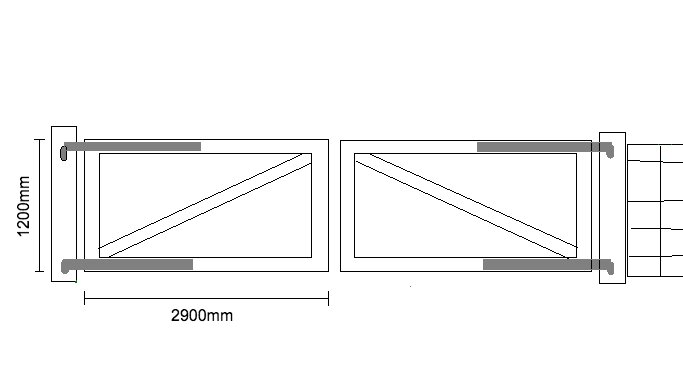
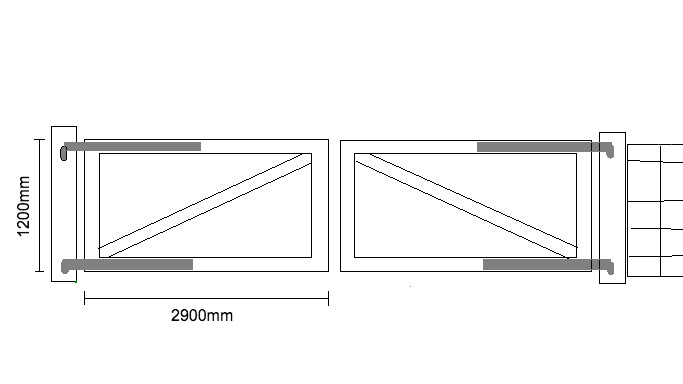
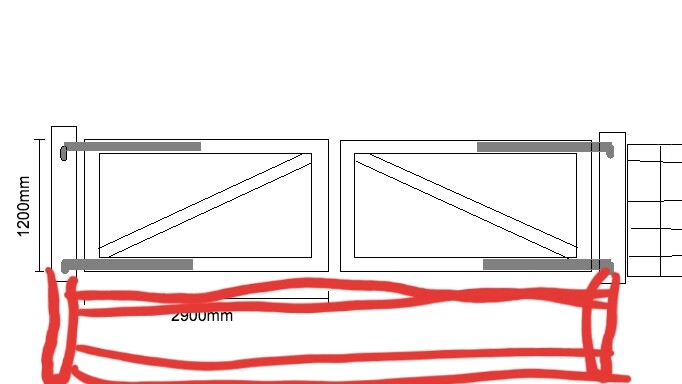
Planning to build a wooden gate 1200mm high, it will be in two parts, each swinging inward on hook hinges attached to a 95x95 post. Each side will be 2900mm wide, the frame will be made of 70x70 pressure-treated timber with crossbars and paneling on the outside for aesthetic purposes.
Sitting and looking for hook hinges that I plan to have both at the top and bottom, torn between 600mm and 1000mm hinge lengths. Obviously, it feels better to have hinges that are a third of the gate door's width, but at the same time, I wonder if that's overkill. Attaching a paint image below for reference.
With that width on a part, there will be problems. All gates tend to sag on the outer part. Then 95X95 as a post is too weak, you should have a square post 100X100 in metal, it won't bend and with anchor irons for through-mounting, then it's possible to adjust if the gate sags. There are those with wide gates that have a post which is 1 meter above the gate and a cable out to the outer end to hold up the sag. Even with the cable anchored 2 meters behind the post, but then it's probably slightly wider gates. Here's a tip on a type of hinge https://www.amazon.se/410650-genoms...0DNSG/?tag=shpngadsglede-21&linkCode=df0&hvad
I do not know the conditions, but I would have put a wheel on the outer edge of the gates if possible. That way you'll get rid of most problems. Such a large gate will become very heavy when wet.
And I would definitely have gone with long hinges.
Now I don't know the conditions, but I would put a wheel on the outer edge of the gates if possible. That would solve most problems. Such a large gate will be very heavy when wet.
And I would definitely use long hinges.
With a wheel and gravel as a base, it needs to be large and wide; otherwise, it will just create a deeper track over time. Otherwise, not a bad thought.
With that width on a component, problems arise. All gates tend to sag on the outer edge. Also, 95X95 as a post is too weak; you should have a square post 100X100 in metal, it won't bend, and with cleat iron for through mounting, you can adjust if the gate sags. There are those with wide gates who have a post that is 1 meter above the gate and a wire out to the outer end to hold up against the sag. Even with the wire anchored 2 meters behind the post, but then it's probably somewhat wider gates. Here's a tip on hinge type [link]
The idea is that the posts are attached to concrete foundations with a shoe and will be buried a little bit in the ground. I can certainly consider a heavier post, but I haven't found any metal post that seems suitable with the construction. I reckon the concrete plinth should be able to support the post and gate with the right length of hinge, at least if you increase to at least 100x100 wood on the posts? Alternatively, glulam 90x90 or 115x115.
I've brushed upon the idea of wheels in the middle, as boschkenta suggested, but it’s more of a contingency solution as the tracks that will result will annoy me.
The idea is for the posts to be attached to concrete foundations with shoes and will be buried a bit in the ground. I can definitely consider a thicker post but haven't found any metal post that seems suitable for the construction. I assume the concrete block should be able to support the post and gate with the right length of hinges, at least if you increase to at least 100x100 wood on the posts?
I have briefly considered wheels in the middle, as boschkenta suggested, but that's more of a last resort as I will be annoyed by the tracks that will form.
It is not the post that is the problem; it is the gate itself. If built out of wood, it will definitely sag. To prevent sagging, it has to be a structure made of square iron and welded. Square iron is available in all dimensions, so that's not an issue. As for the post in concrete or steel/iron that is cast around, it will definitely hold if it's down to the right depth, which in your case is probably at least 600 mm. I highly recommend the type of hinges I linked to, allowing the gate to be adjusted up or down, and it's likely to look better if the gates align in the middle. It's almost impossible with regular hook hinges where one part is on the gate regardless of length and a fixed part on the post, which cannot be adjusted.
A "shared" post with a concrete foundation and post shoe followed by wood will not withstand the moment from such a heavy gate. It will give in at the post shoe.
You either need a full concrete post or a steel post embedded in concrete, and it likely needs to be deep in the ground to withstand the forces.
Your gate will be very heavy, and with a length of 3 m, there will be significant forces pulling the post inward. If you can place a diagonal brace on the outside, it can help.
It is also possible to dig a trench and connect the posts with one or more crossbars underground, and then backfill. This can help prevent the posts from bending inward.
It might also be worth considering having several shorter braces so that they are at a 45-degree angle. The effect of braces diminishes the larger the lower angle in the triangle becomes.
Click here to reply
Vi vill skicka notiser för ämnen du bevakar och händelser som berör dig.