
744 views ·
3 replies
744 views
3 replies
Why is the outer panel bending the "wrong way"?
I have acquired high-quality planed, 25mm spruce paneling for building conservation facade renovation but encountered a problem I hadn't anticipated at all.
I've learned that the heart side should face outward on the paneling. Partly because this side is most resistant to rot, and partly because the paneling then cups with the outer edges inward, towards the facade (as seen in the image below), which seals the gaps between the panels.
Now that I've cut a couple of lengths of paneling and test painted them indoors, they have all cupped the OTHER way. Meaning, if I were to nail them with the heart side out now, the paneling would be convex/bowl-shaped with large gaps in between. This is completely opposite to what the image below shows.
What went wrong? Has the paneling dried too quickly indoors and cupped the other way? Or does spruce behave differently than pine? Everywhere I search online it says that wood cups as shown in the image, so I can't understand why it's the opposite for me...
Grateful for help!
I've learned that the heart side should face outward on the paneling. Partly because this side is most resistant to rot, and partly because the paneling then cups with the outer edges inward, towards the facade (as seen in the image below), which seals the gaps between the panels.
Now that I've cut a couple of lengths of paneling and test painted them indoors, they have all cupped the OTHER way. Meaning, if I were to nail them with the heart side out now, the paneling would be convex/bowl-shaped with large gaps in between. This is completely opposite to what the image below shows.
What went wrong? Has the paneling dried too quickly indoors and cupped the other way? Or does spruce behave differently than pine? Everywhere I search online it says that wood cups as shown in the image, so I can't understand why it's the opposite for me...
Grateful for help!
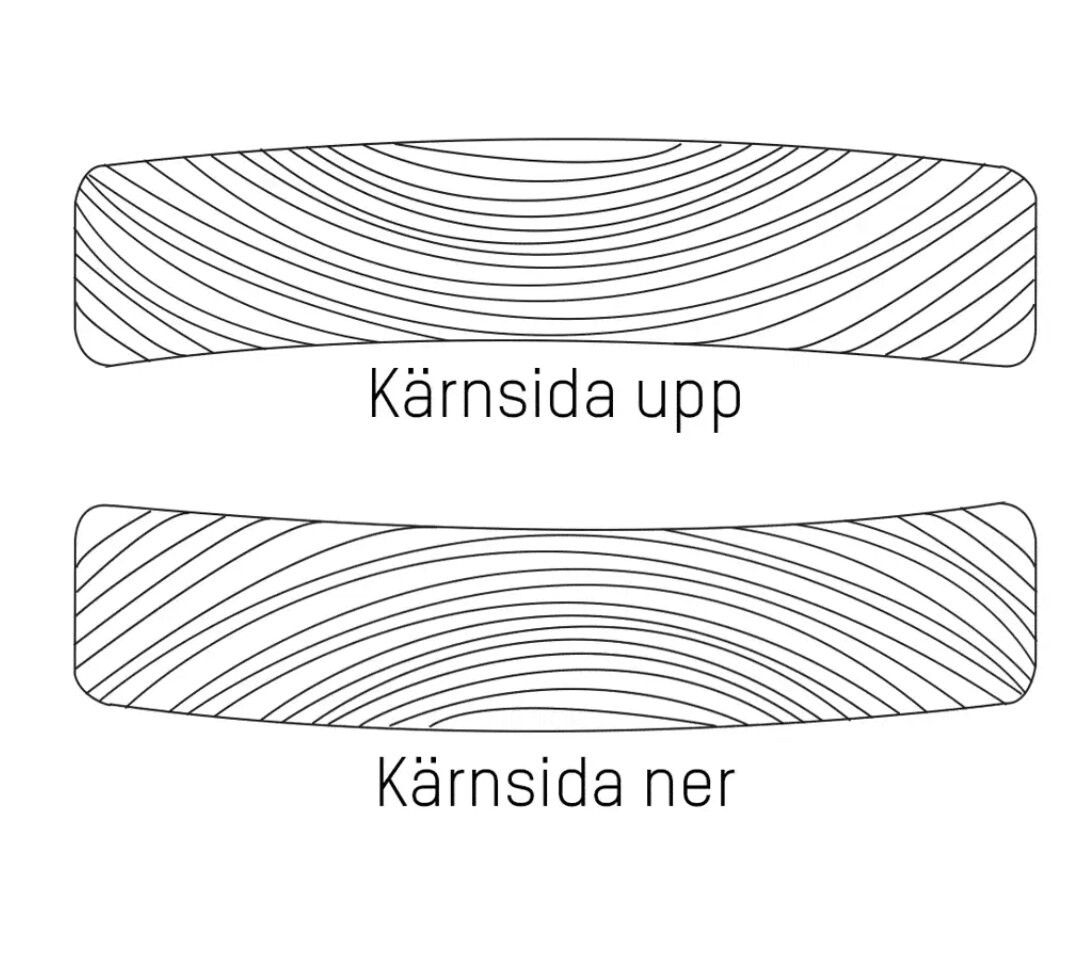
The image above only applies when humidity in the panel decreases = the panel dries. If you have painted with a modern water-based paint, you add moisture as the paint dries quickly on the surface, and the moisture then has to travel through the entire fiber mass to the other side. If you use an old paint where the solvent is turpentine/white spirit, it evaporates through the paint. The bulging will likely disappear after some time. A board is only flat when the humidity is the same as when it was finish treated.

I can only conclude that I am also amazed by the difference between reality and theory. I have also been fed with the sad vs happy face concept, but time and time again I have to conclude that it doesn’t hold true. However, I haven't figured out why it doesn’t work. In my experience, it never gets right over time; a warped board continues to be warped, and if anything, it slowly but surely only gets worse. And it doesn’t seem to make any difference whether you face the board's inner or outer side (happy/sad face) outward/upward.
I link this to modern handling of timber, every step from seedling to the lumberyard, since older wood almost never suffers from such problems.
I link this to modern handling of timber, every step from seedling to the lumberyard, since older wood almost never suffers from such problems.
That kind of thing can usually happen when painting. Once the boards are on the wall, almost all of them will eventually cup the right way over time.
Permanently wrong-way cupped boards occur when sawn boards have been dried intensely in a lumber kiln and then planed. When they then encounter actual outdoor humidity, they cup the wrong way.
Permanently wrong-way cupped boards occur when sawn boards have been dried intensely in a lumber kiln and then planed. When they then encounter actual outdoor humidity, they cup the wrong way.
Click here to reply