
1,074 views ·
3 replies
1k views
3 replies
Why insulated? Is it necessary? Chimney foundation crawl space
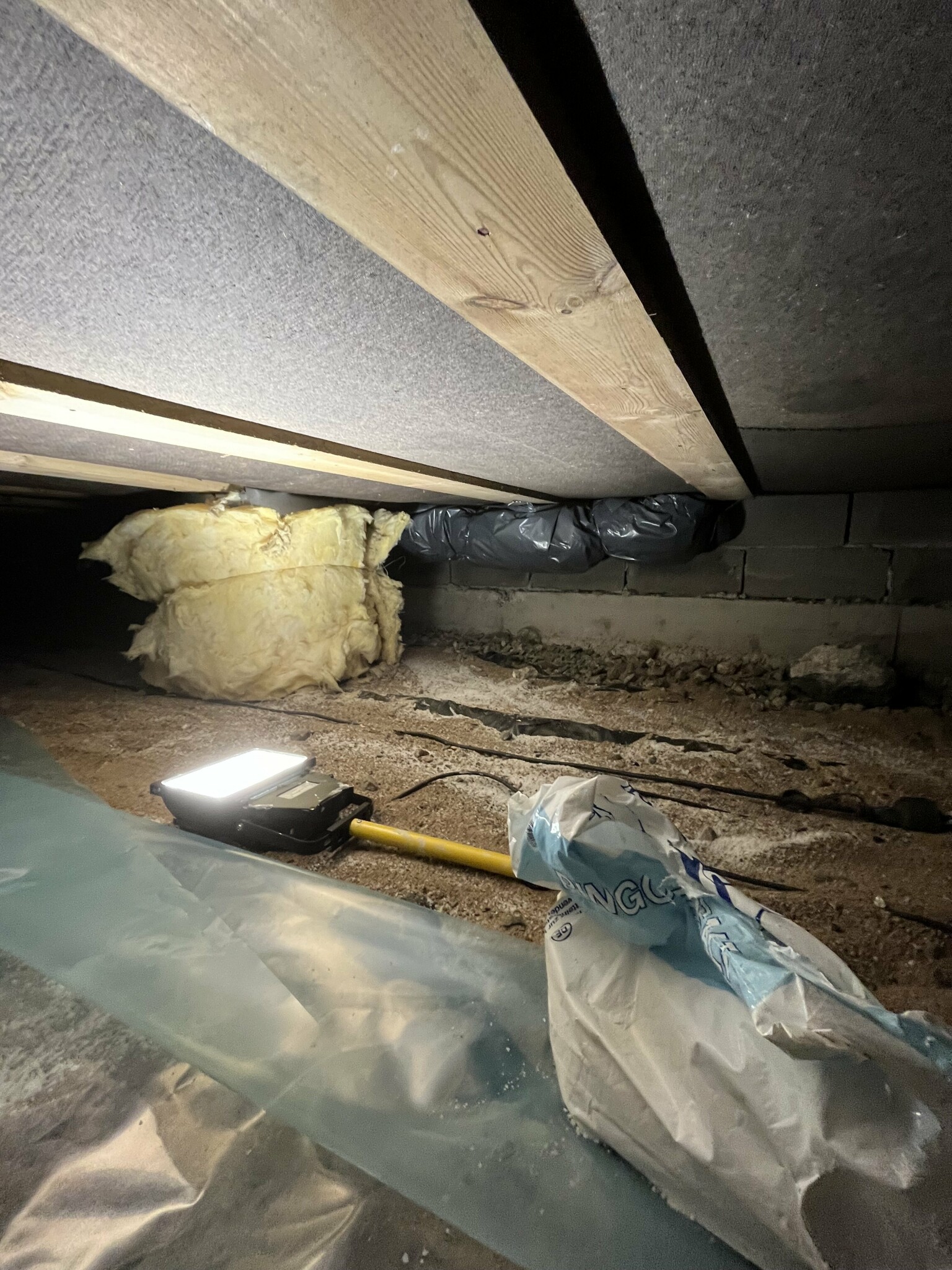
Currently sealing the crawl space, an uninsulated crawl space where I plan to install a sorption dehumidifier due to high RH (and some mold growth on the underside of the floorboards)
But... Chimney foundation, from maybe 2012 (previous owner) is poorly insulated with a loosely fitted layer...? See image. Why? Is it necessary?
The foundation is round with metal around it as it feels/looks.
Second question. There is a pipe going out through a vent from the foundation. I assume it's the air supply to the stove? It is also insulated with a plastic bag over it. Is it necessary?
The stove is a regular Contura, soapstone stove. The chimney goes behind the stove up and out.
But... Chimney foundation, from maybe 2012 (previous owner) is poorly insulated with a loosely fitted layer...? See image. Why? Is it necessary?
The foundation is round with metal around it as it feels/looks.
Second question. There is a pipe going out through a vent from the foundation. I assume it's the air supply to the stove? It is also insulated with a plastic bag over it. Is it necessary?
The stove is a regular Contura, soapstone stove. The chimney goes behind the stove up and out.

It’s necessary if you don’t want to heat the crawl space.W Wannabe-snickarn said:
More interesting is what insulates the chimney from the ground. A lot of heat energy could be lost through conduction there.
If it's supplying air to the stove, the air is cold and if it passes through a crawl space that is warmer, water will condense on the pipe and then drip into the crawl space.W Wannabe-snickarn said:
Otherwise, if there are moisture problems in the crawl space, it might be worth installing moisture meters and temperature sensors of a slightly higher quality down there to monitor the conditions when mold growth is possible.
Does Ytong crawl space / crawl foundation. Fresh air duct from the outside to the large Täjstens oven that we installed 20 years ago.
We built a proper foundation since just the oven weighs 2 tons and the chimney 1 ton.
None of the heat from the oven or living space spreads down to the foundation, as the entire floor consists of tongue-and-groove Ytong beams with a plastic layer on top.
There is a complete plastic cover on the ground throughout the foundation. There is no organic material.
Since 2016, we have an Acetec dehumidifier set at 65% RH. It fluctuates up to 70% at most.
It rarely happens that its heating element activates to add heat so stored moisture can be released, from something that looks like a honeycomb.
It's also possible to set how the built-in fan, which directs dehumidified air to the corners of the foundation via hoses, should be activated.
So energy-efficient? Yes.
According to those who sell Acetec, Anticimex has now set the limit to 80% at 15 degrees temp, which is the danger for mold growth.
Now December 8, 68% RH and 10 degrees in the foundation. Information via display indoors.
In the summer, a maximum of 15 degrees and in January 8 degrees in the foundation.
We built a proper foundation since just the oven weighs 2 tons and the chimney 1 ton.
None of the heat from the oven or living space spreads down to the foundation, as the entire floor consists of tongue-and-groove Ytong beams with a plastic layer on top.
There is a complete plastic cover on the ground throughout the foundation. There is no organic material.
Since 2016, we have an Acetec dehumidifier set at 65% RH. It fluctuates up to 70% at most.
It rarely happens that its heating element activates to add heat so stored moisture can be released, from something that looks like a honeycomb.
It's also possible to set how the built-in fan, which directs dehumidified air to the corners of the foundation via hoses, should be activated.
So energy-efficient? Yes.
According to those who sell Acetec, Anticimex has now set the limit to 80% at 15 degrees temp, which is the danger for mold growth.
Now December 8, 68% RH and 10 degrees in the foundation. Information via display indoors.
In the summer, a maximum of 15 degrees and in January 8 degrees in the foundation.
Last edited:
Yes, why then a dehumidifier at my place?
The house from '82 and up until 2002 had all the exhaust air in the residence directed into the foundation, to release heat.
To what benefit, one may ask. Furthermore, dust, grease, and other things were blown down even if most of it was caught in filters.
Then the exhaust air was drawn from the foundation up to the attic with an idea of air recovery... Failed. Froze time and again.
Currently a Heru 100 SEC that recovers heat solely from the residence. So the foundation is a completely separate space.
Still want to keep relatively low humidity in the foundation, as remains from earlier times are present and
Ytongbalkarna are reinforced with iron. Additionally, the vapor barrier upwards will leak more and more over time.
The house from '82 and up until 2002 had all the exhaust air in the residence directed into the foundation, to release heat.
To what benefit, one may ask. Furthermore, dust, grease, and other things were blown down even if most of it was caught in filters.
Then the exhaust air was drawn from the foundation up to the attic with an idea of air recovery... Failed. Froze time and again.
Currently a Heru 100 SEC that recovers heat solely from the residence. So the foundation is a completely separate space.
Still want to keep relatively low humidity in the foundation, as remains from earlier times are present and
Ytongbalkarna are reinforced with iron. Additionally, the vapor barrier upwards will leak more and more over time.
Last edited:
Click here to reply