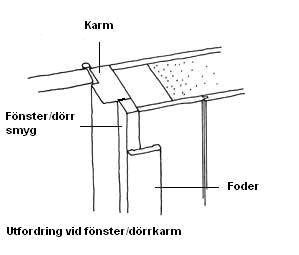
Yes, keep in mind the thing about the hinges, otherwise the door cannot be fully opened and will hit the wall. "Sala ut" means that you broaden the frame as much as needed since your wall becomes thicker than the frame. You simply attach planed wood to the frame (the side that does NOT have the hinges) to make it flush with the wall.
Then there are also wider door frames to buy. But they are probably more expensive and may not be in stock and need to be ordered (at least that was the case at "my" hardware store when I needed two).
But with 45mm studs in the wall and then OSB + gypsum boards, a 92 mm standard frame works. With 70mm studs and OSB + gypsum boards, you either extend or buy a 118 mm frame.
Hello, I'm reviving this old thread to see if anyone bites. We're building a new house and are considering how to get quiet interior walls without them being too thick. Right now, we're leaning towards a 70 stud in the floor/ceiling, 45 studs laid staggered cc45, insulation in the wall, and single drywall on + double drywall on the second side. But the question is whether it's really worth putting time into the walls when the doors have gaps for ventilation. And those gaps can't be built away. Is it a waste of money and time to stagger 45s and use double drywall?
...moreover, there are electrical outlets in the walls that leak sound..maybe better to share the wall with a 13 plasterboard (which is dense) 45 studs on each side and 13 plasterboard on each wall side..what do you think?
We rebuilt our interior walls (not all of them yet...) previously it was 70 framing and single plasterboard, without insulation. Then we used 70 framing, with noggings, rock wool insulation. Plywood+plasterboard on both sides. Then caulked all the edges. It became incredibly much quieter.....
Great Boan - do you have electrical outlets in the wall or rather, do you notice a difference with or without outlets? Do you have air gaps in the doors? Doesn't much sound leak there?
We have ftx so we had to have some air gap, but we installed heavy doors so it's okay. But for it to be really good, there should be heavy, mortise-hinged doors and over-air devices. Yes, we have dosor but I don't think that's so bad...
No one has written about the importance of a heavier wall preventing the spread of vibration noise from, for example, kitchen fans and ventilation units! We only have single plasterboard with tiles in the kitchen, and the fan buzzes in the structure, causing ear popping in the room on the other side of the wall! The builder complained to the appliance supplier, who replaced the fan, but it made no difference. That's how you build if you want to sell a VAZ at the price of a Mercedes.
Hole-in-ones work poorly in osb and with essves osb-screw, the board doesn't pull into the metal stud if you didn't manage to get it flush before, because for some inexplicable reason, it is fully threaded.
If there's something I regret, it's choosing osb in the kitchen instead of plywood. Mounting things on old single-layer gypsum is awful.
Vi vill skicka notiser för ämnen du bevakar och händelser som berör dig.