305,736 views ·
348 replies
306k views
348 replies
Why does everyone use OSB behind drywall?
Even a trained smoke diver has responded to you about the importance of closing doors during a fire - what kind of facts are you really asking for?😉Snoppenpåtoppen said:
Not very long since there's no seal between the frame and the door leaf and in modern houses, there are ventilated thresholds which means completely open underneath. If these doors could withstand fire and smoke, they would be rated. Which most interior doors in small houses are not.
It's not about belittling, but rather about him making a claim without evidence. I've asked for facts a few times but haven't received any, only brief incorrect assertions. So the person in question simply said something they can't back up with facts. Thus, it's not really up to me to disprove. But now I've done so, and the person in question hasn't provided anything to support his claim, so the matter is settled😊
/Krille
Nytt_användarnamn_2024_12
Banned
· Sveriges himmelrike
· 165 posts
Nytt_användarnamn_2024_12
Banned
- Sveriges himmelrike
- 165 posts
Construction veteran
· 2 765 posts
I can only agree (smoke diver since the 80s and still in service)anders07 said:
Open doors let out smoke and bring in new oxygen.
A closed door, even if it is not rated, will reduce oxygen and thereby the intensity of the fire, which in turn reduces the spread of the fire.
If I were building/renovating wood frame houses on a larger scale today, I would probably choose double plasterboard.Tomture61 said:
I have checked prices on various materials behind plasterboard.
Clearly, double plasterboard is the cheapest, although OSB is still the second cheapest building board per m2.
In my own house from 2008, I have single plasterboard on all exterior walls downstairs.
I really regret that choice, you can see how wavy the wall is + really bad soundproofing.
The window reveals are foil-coated MDF that are glued, so it's not easy/cheap to improve them.
Mainly because OSB has become unreasonably expensive! (Perhaps not unreasonable, but compared to what it used to cost, it feels that way)
If I were to have a wood board behind any plasterboard wall, I would probably choose OSB + 1-layer plasterboard. Only in special cases would I consider plywood, I think.
Nytt_användarnamn_2024_12
Banned
· Sveriges himmelrike
· 165 posts
Nytt_användarnamn_2024_12
Banned
- Sveriges himmelrike
- 165 posts
I completely agree with you😊S Slarvpellen said:If I were building/renovating timber-framed houses on a larger scale today, I would probably choose double gypsum.
Mostly because OSB has become unreasonably expensive! (Maybe not unreasonable, but compared to what it used to cost, it feels that way)
If I were to have a wood board behind any gypsum wall, I would probably choose OSB + 1-layer gypsum, only in special cases would I consider plywood, I think.
I came up with a calculation example so that one could see the board cost and how expensive it became with double gypsum + 15mm plywood..
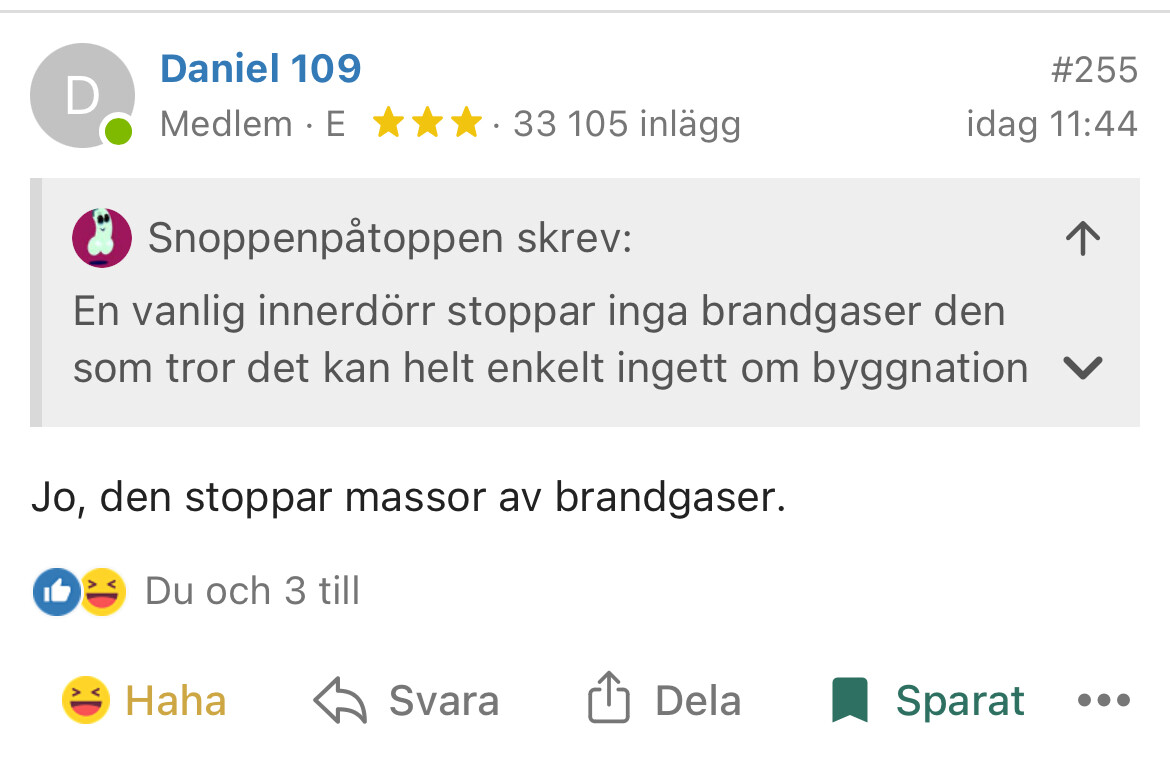
Read the thread today, it wasn't about being stuck in the house or not. It was about whether a regular interior door stops a fire progression... I'd love to receive facts about whether a regular interior door stops large amounts of smoke as post #255 claimed? As I have written earlier, it was his claim about stopping "large amounts" that is incorrect, nothing else... Provide the facts if you agree 😊
Since it's you who claims that the time is negligible (a few seconds), you are welcome to provide facts.
A normal fire progression is not a room becoming fully engulfed in seconds with lots of smoke/fire gas. A closed interior door reduces the oxygen for the fire, and what effect that has everyone probably knows.
I also see now that the other firefighter in the discussion has a different opinion than you 😉
/Krille
Nytt_användarnamn_2024_12
Banned
· Sveriges himmelrike
· 165 posts
Nytt_användarnamn_2024_12
Banned
- Sveriges himmelrike
- 165 posts
Once again, the claim that a regular non-graded interior door would stop "lots" of smoke gas is incorrect; if it stopped smoke gases, it would be graded as I presented a text about...K Krille4 said:Since you claim that the time is negligible (a few seconds), feel free to provide evidence.
A normal fire development does not mean a room becomes fully engulfed in a few seconds with lots of smoke/fire gas. A closed interior door reduces oxygen for the fire and what effect that has is something everyone probably knows.
I also see now that the other smoke diver in the discussion has a different opinion than you 😉
/Krille
You don't seem to be very familiar with how unsealed a regular interior door is. Try using it as an exterior door, and you will feel the flow of cold air pouring in through the unsealed gaps between the frame and door panel and underneath where it's approximately 8-12 mm completely open...
So, smoke and gases will have penetrated the room within several seconds during a developed fire...
If you have evidence to the contrary, I would gladly accept it😊

Know-It-All
· Västra Götaland
· 12 410 posts
As long as one tries to invalidate someone's claim without facts or a reasonable argument, I mostly see it as an attempt at manipulative tactics. I think it's good that we're now raising the level.Not very long as there is no seal between the frame and the door leaf, and in modern houses, there is a ventilated threshold, i.e., completely open underneath.
If these doors withstood fire and smoke, they would be classified.
Which most interior doors in small houses are not.
It's not about belittling but about him making a claim without any evidence. I have asked for facts several times but haven't received any, only short incorrect statements.
So the person in question has simply said something they can't back up with facts, so it's not really up to me to disprove it.
But now I have done it, and the person in question has not provided anything to support his claim, so the matter is clear😊
Basic interior doors in cheap houses are often of MDF-cardboard-MDF type. I don't know how fireproof they are, but probably hold against flame spread for a few minutes at least. It would be interesting to read a test showing the difference between Byggmax's cheapest interior door, unclassified solid door, EI30, EI60, EI120 doors.
Slightly nicer newly built houses very often have solid doors, at least as an option. The ones I have in my house are solid panel doors in a classic style. They have EI30 classification if installed with a tight threshold, and Rw35 for sound so you don't have to hear the fire
 .
.99% of the readers in this thread probably understand that Daniel with "stoppar upp en brand förvånansvärt bra" means that the progression of the fire is significantly slowed down. Not that a closed interior door causes the fire to die out on its own.
If you install an interior door as an exterior door, you will likely realize that it keeps out the cold much better when closed than when open. Even an interior door blocks a lot of the flow that occurs through an open door. The fact that an exterior door is inferior to a fire door or an exterior door doesn't change that. In both cases, it makes a big difference whether it is open or closed.
For goodness' sake, no one has claimed that it completely prevents smoke gases...Once again, the claim that a regular non-rated interior door would stop a lot of smoke gases is wrong; if it did stop smoke gases, it would be rated as I pointed out with a text...
You don't seem to be very aware of how poorly sealed a regular interior door is. Try using it as an exterior door, and you will feel the flow of cold air pouring in through the unsealed gaps between the frame and the door leaf and underneath where it's about 8-12 mm completely open...
So, in the event of a developed fire, smoke and gases will have penetrated the room within a number of seconds...
If you have facts to the contrary, I'd be happy to receive them😊
But that the flow of smoke gases and the entire fire process is slowed by closed doors.
When I've taken fire courses, I've learned to stay close to the floor to avoid gases, so I don't even know how dangerous the modern gaps under the doors are.
/ATW
Member
· Västra Götaland
· 1 712 posts
I want to add a bit to all the other obvious answers about why it's good to have OSB or another wood panel behind the drywall.
For me, it's not the heavy things that improve, because you can hang those with large molly plugs in the drywall. But the SMALL things. The smallest picture hook for a painting. A really nice little screw for a wall-mounted candle holder. With wood behind it, it works, and it's barely noticeable when you remove the hook.
With just drywall, you have to at least use drywall plugs and screws, which is patience-testing but above all much more noticeable when it's removed.
For me, it's not the heavy things that improve, because you can hang those with large molly plugs in the drywall. But the SMALL things. The smallest picture hook for a painting. A really nice little screw for a wall-mounted candle holder. With wood behind it, it works, and it's barely noticeable when you remove the hook.
With just drywall, you have to at least use drywall plugs and screws, which is patience-testing but above all much more noticeable when it's removed.
Nytt_användarnamn_2024_12
Banned
· Sveriges himmelrike
· 165 posts
Nytt_användarnamn_2024_12
Banned
- Sveriges himmelrike
- 165 posts
I'm not quite with you on this, there are far too many who write nonsense that they can't substantiate with either facts or anything else.. It just becomes a lot of unnecessary false claims😉
Yes, but not smoke and fire gases since it is untight between the frame and the door leaf and completely open at the bottom with about 8-12 mm, smoke gases pour in relatively quickly, then there's the hinge attachment. And the door leaf of plastic in an unclassified door. How long do you think the plastic holds in a developed fire?
I remember that in a developed fire in a house, if you locked yourself behind an interior door it was only a matter of a few tens of seconds, max a minute before the smoke had killed you and the fire gases ignited, which means that the door itself has no greater effect since the smoke and gases come in through the untight spots..
Working in construction, I have bought thousands of doors over the years, only a few doors in modern small houses have been solid, because if you take solid from the big manufacturers such as Swedoor, they cost exorbitantly compared to a hollow sandwich door.. we're often talking about 200-300% more expensive than a standard door..It would be interesting to read a test showing the difference between Byggmax's cheapest interior door, unclassified solid door, EI30, EI60, EI120 doors
A bit finer newly built houses very often have solid doors, at least as an option. Those I have in my house are solid panel doors in a classic style. They have EI30 classification if mounted with a sealed threshold, and Rw35 for sound so you don't have to hear the fire
Byggmax doors are only installed by private consumers, no builders order doors there except maybe a few who aren't creditworthy and work off the books..
Nytt_användarnamn_2024_12
Banned
· Sveriges himmelrike
· 165 posts
Nytt_användarnamn_2024_12
Banned
- Sveriges himmelrike
- 165 posts