
5,561 views ·
9 replies
6k views
9 replies
Which render do I have,+ which render is suitable for renovation work
Hello,
I have a house built in the mid-60s, 1966 according to the documents.
I'm in the process of renovating a bit in the basement and am wondering what type of plaster I have there.
I found a building description that I don't quite understand, maybe you can translate it for me.
I'm in the process of removing old paint so I can paint with silicate paint (that's the plan right now), but in the process, the surface becomes quite uneven. Therefore, I want to apply a thin layer of plaster.
What type of plaster do I have (inside) and
What type of plaster would be good for a thin repair layer?
Best regards
Bonus question, the paint that is on dissolves with water, does it need to be completely removed before the silicate paint?
I have a house built in the mid-60s, 1966 according to the documents.
I'm in the process of renovating a bit in the basement and am wondering what type of plaster I have there.
I found a building description that I don't quite understand, maybe you can translate it for me.
I'm in the process of removing old paint so I can paint with silicate paint (that's the plan right now), but in the process, the surface becomes quite uneven. Therefore, I want to apply a thin layer of plaster.
What type of plaster do I have (inside) and
What type of plaster would be good for a thin repair layer?
Best regards
Bonus question, the paint that is on dissolves with water, does it need to be completely removed before the silicate paint?
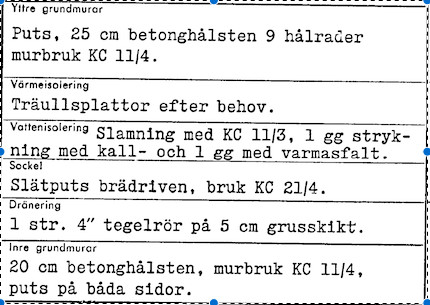

You have a plaster consisting of lime-cement (KC), a mixture of lime and cement. I interpret "11/3" as 11 parts aggregate (sand) and 3 parts lime-cement.
If you are going to replaster, it might be easiest to follow the same recipe now. For example, buy:
https://www.finja.se/produkter/7818_7842_7843_7844/kalkcement-c
If you are going to replaster, it might be easiest to follow the same recipe now. For example, buy:
https://www.finja.se/produkter/7818_7842_7843_7844/kalkcement-c
Thanks for the quick answer, I see that you link to the raw material for mixing yourself.Claes Sörmland said:
Is this one that is pre-mixed suitable?
https://www.bauhaus.se/putsbruk-c


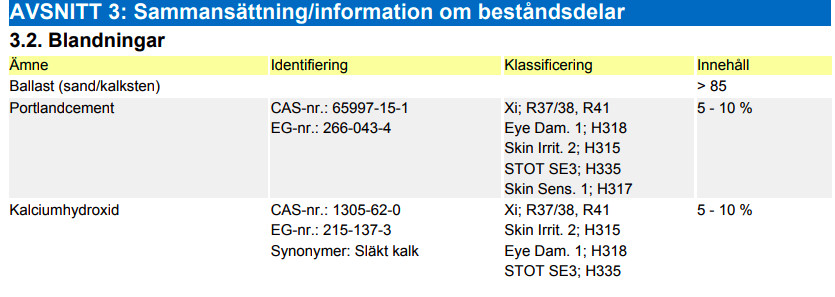
I am not sure what this product contains. A KC-bruk contains slaked lime, cement, and sand. The common mortars today, unless you specifically buy "KC-bruk," contain murkalk (cement mixed with limestone flour) and sand, i.e., they lack the slaked lime.bus_pojken said:
According to the safety data sheet
Does this also adhere to small remnants of paint, or does it need to be completely clean plaster?
Click here to reply