
14,512 views ·
22 replies
15k views
22 replies
Which boards for intermediate floors with underfloor heating?

Exactly how I’m laying it (without gypsum). Then you can also finish building all the walls before laying out the loops and don't risk nails in the wrong places.Fricke said:I'm considering laying Gles, plates, and underfloor heating pipes on top of the floor chipboard, to be able to lower the forward temperature! Also to get a quicker floor regulation-wise!
Hope and believe it will work, can we hear more references!??
There must be several who have it like that...
Then I know there are those who lay gypsum board on top too!
But that feels a bit overworked!?
Best regards,
Tobias.

Diversearbetare
· Göteborg
· 11 228 posts
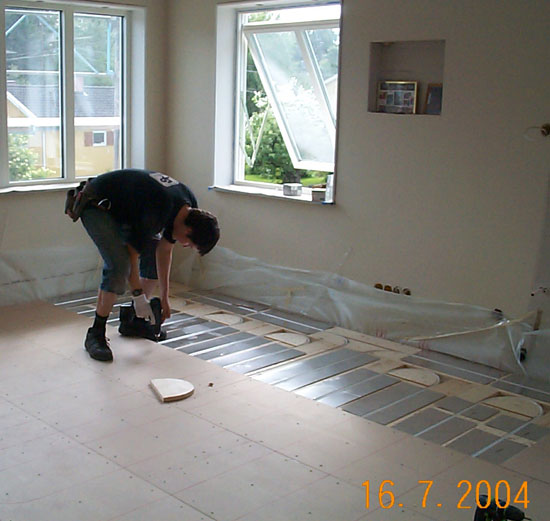
I have installed glued and screwed 22mm chipboard flooring, 21x120 glespanel glued and screwed, heat plates and pipes, cardboard and finally screwed 25mm pine plank floor. It's stable. 
The underfloor heating pipes are fed in protective pipes between the manifold and the room.
The underfloor heating pipes are fed in protective pipes between the manifold and the room.



http://www.familjenlindstrom.se/images/byggahus/vvs/golvvarme_gles/
http://forum.byggahus.se/badrum/1323-golvvaerme-pa-bjaelklag-olika-metoder.html
http://forum.byggahus.se/vaerme-allmaent/43870-golvvaerme-i-sparad-golvspan-vad-ovanpa.html
http://forum.byggahus.se/golv/29377-glespanel-hur-laegger-man-i-aendarna.html
http://forum.byggahus.se/vaerme-allmaent/44207-golvvaerme-pa-oevervaning.html
http://forum.byggahus.se/vaerme-allmaent/43776-egenfraesta-spar-foer-golvvaermeslinga.html
http://forum.byggahus.se/tak-vind/32108-dimensionering-av-glespanel.html
Johan, I recall that you cast the hose in concrete on top of the chipboard flooring in some rooms, even where you were going to have floating floors like parquet? How did it turn out? It should be really good.Johan Gunverth said:
hello building new! I just have to ask one thing? the plastic you see in the picture, is it underneath. what are the sheets resting on, is it gypsum you screw on afterwards, and what will you have on top of this?
Diversearbetare
· Göteborg
· 11 228 posts
Exactly, yes! My conscience was just reminded that I should have reported back.MathiasS said:
I have glued and screwed 22mm floor chipboard everywhere, but where there is to be tiles, I have embedded the tube in fine concrete and then laid the tiles on top of this. The fine concrete is between 31mm and 37mm thick depending on the thickness of the tiles used. So, I have not cast for any parquet flooring, but it would probably work just as well.
My construction differed from the norm in that we also cast in the underfloor heating plates. Check photos here:
http://forum.byggahus.se/vaerme-allmaent/45986-flytspackla-golvvaerme.html#3
The result was very good. The floor is significantly faster than without plates, and you can feel a sharp difference in heat between areas with and without plates.
Unfortunately, the casting wasn't the easiest. Air gets trapped under the plate and wants to leak up along the back after casting. It simmered for a few hours before the concrete stabilized. If the plates had been somewhat perforated, it would have solved the problem. However, it was not of interest to Wirsbo after we discussed the results of my casting. Manufacturing a product variant for a marginal solution probably doesn't pay off.
Fine concrete also has the great advantage of being stronger than filler, and the cost is around a tenth. However, it requires more work with leveling.
It is only the wall plastic you see in the picture, on the recommendation of the parquet supplier (Kährs), it should be plastic under the floor, so it was then taped together with the floor plastic.snickar_lasse said:
http://forum.byggahus.se/vaerme-allmaent/44207-golvvaerme-pa-oevervaning.html
Click here to reply