
1,860 views ·
14 replies
2k views
14 replies
What to do with a stud that is in the way of kitchen cabinets?
I have a concern. I'm about to install a new kitchen but will need to take down a partition wall between the existing kitchen/dining room to accommodate the new cabinets and countertop, which is about 70 cm longer than the old one. The thing is, I bought a pre-cut marble slab and therefore cannot compromise on the length of the countertop. But when the partition wall was demolished, we discovered both a load-bearing stud and electrical conduits in the wall!
How would you reason and solve the problem?
How would you reason and solve the problem?
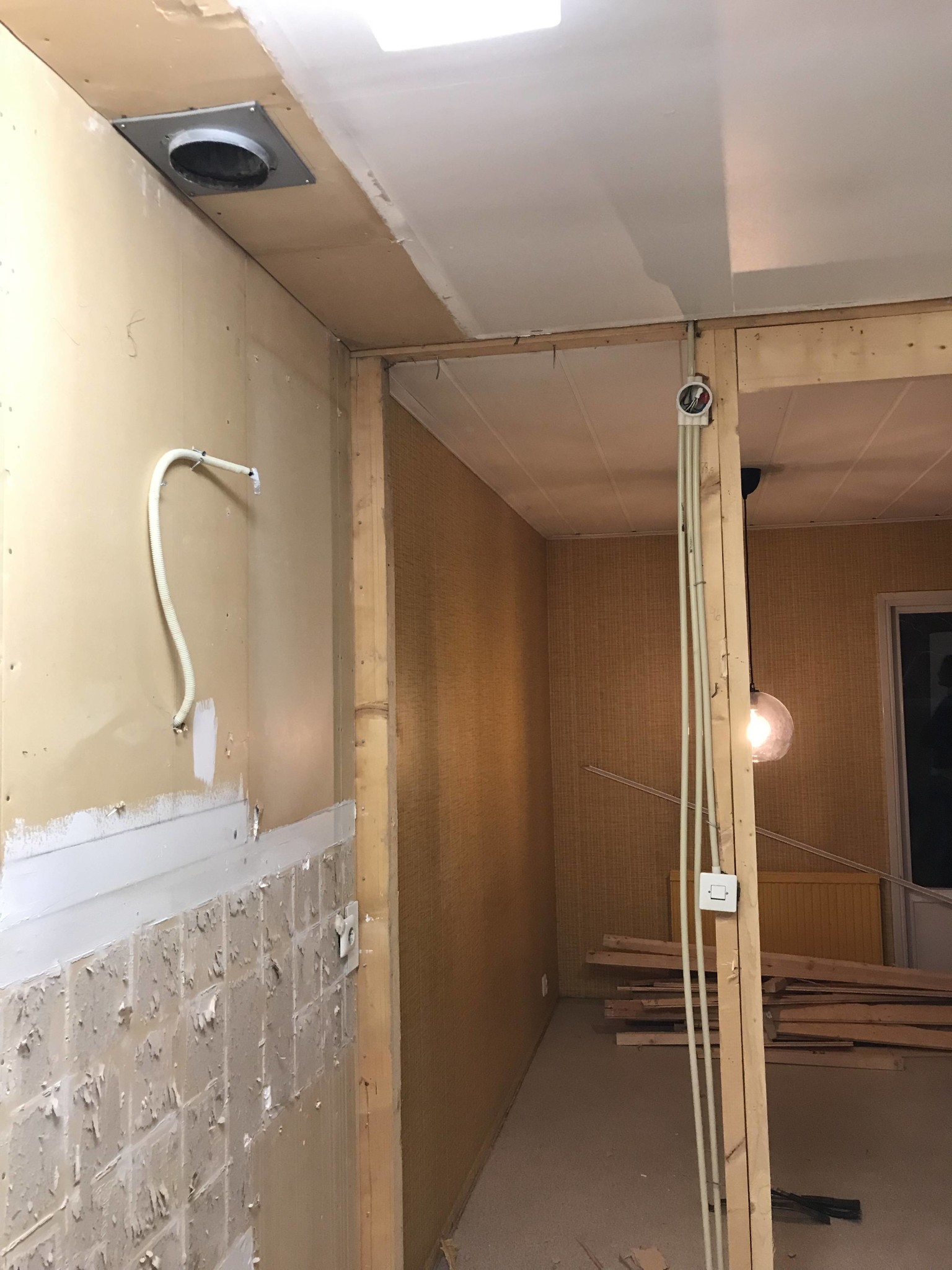
The electrical situation couldn't have been a surprise since there's a switch and a junction box that were visible, but you can reroute the electricity through the ceiling and wall, as you're tearing down anyway. Regarding the studs, if they're load-bearing, it would probably look best to recess a post into the wall and then place a glued laminated beam as a load-bearing beam to the other side instead of the wall. However, it's difficult to say exactly how to proceed based solely on that picture.M Maria_B said:I have a dilemma. I'm installing a new kitchen but need to tear down a partition wall between the existing kitchen/dining room to fit the new cabinets and countertop, which is about 70 cm longer than the old one. The thing is, I bought a pre-cut marble slab and therefore can't compromise on the length of the countertop. But when the partition wall was removed, we discovered both a load-bearing stud and electrical conduits in the wall!
How would you reason and solve the problem?
 I understood that the electricity would be there. But can you, for example, use a flexible conduit to make a bend in the floor? Wouldn't it be difficult to get the cables into the conduit then?
I'm considering framing out the wall a bit to "build in" the stud that way.


You need to tell more about what it is concerning, is it a house or an apartment?
Is there an upper floor?
What does the floor plan look like so one can at least guess if it's something load-bearing, like a hjärtvägg?
If it's a house with an attic, one can see how the rafters are placed and constructed.
Is there an upper floor?
What does the floor plan look like so one can at least guess if it's something load-bearing, like a hjärtvägg?
If it's a house with an attic, one can see how the rafters are placed and constructed.
Absolutely, I don't mean to remove the beam haphazardly. But the boards on the walls should, for example, be removed and it shouldn't be difficult to take away a bit locally at the beam as someone suggested above.M Maria_B said:

Know-It-All
· Västra Götaland
· 12 297 posts
Electricity is most often run in flex conduit today, but the electrician does that.
The rule there does not need to be load-bearing at all, so it is a good idea to post floor plans and construction drawings.
The rule there does not need to be load-bearing at all, so it is a good idea to post floor plans and construction drawings.
Is the stud you want to remove the one next to the electrical outlet or the one by the wall? It looks like there are two studs by the electrical outlet, one seems to be cut out where the switch box (a-dosan) is and therefore can't be load-bearing? The stud next to it looks like a 45x45(?) and feels a bit flimsy to be load-bearing...
Then you'll have to reroute the wiring in flexible conduit.
Then you'll have to reroute the wiring in flexible conduit.

Tomture61
Self-builder
· Född i Luleå
· 6 334 posts
Tomture61
Self-builder
- Född i Luleå
- 6,334 posts
I don't quite understand your thinking here?M Maria_B said:I have a concern. I'm going to install a new kitchen but will need to knock down a partition wall between the existing kitchen/dining room to make space for the new cabinets and countertop that are about 70 cm longer than the old one. The thing is, I've bought a pre-cut marble slab and therefore cannot compromise on the length of the countertop. But when the partition wall was torn down, we discovered both a load-bearing stud and electrical conduits in the wall!
How would you reason and solve the problem?
Whether the wall is load-bearing or not is something you need to find out first, preferably before you start tearing it down.
If it is load-bearing, then you have quite a bit of work to do.
The stud is the one closest to the wall. It's correct that the studs at the electrical box are not load-bearing. But most likely, the upper floor rests on two "frames" of heavier studs, one of which is currently giving me a headache.T TechChad said:
I'll look through some papers from the previous owners and see if I can post them here.
There is a lot of speculation.M Maria_B said:
Provide us with more info if you want concrete help, otherwise tear down what you need to and extend the wall the 5-6cm it involves and let the stud remain.
Edit: Was a bit too quick, saw that you replied to more posts above.
Click here to reply