
2,316 views ·
10 replies
2k views
10 replies
What should I do with this wall?
Hi, our kitchen is a bit cramped so I want to remove a wall, a wall that the previous owner (may he burn in hell for other reasons) put up. I'm pretty clueless when it comes to such things, but it looks like there used to be a door where the previous owner put up the wall, or what do you think? If I had to guess, I don't think I need to put up any supporting beam or anything like that?? We don’t want to put a new door there, but have it completely open - the room behind should be a dining room. Just tear down what the previous owner put up or? You can see what's new and old...
Or do doors usually have a supporting function?
Or do doors usually have a supporting function?
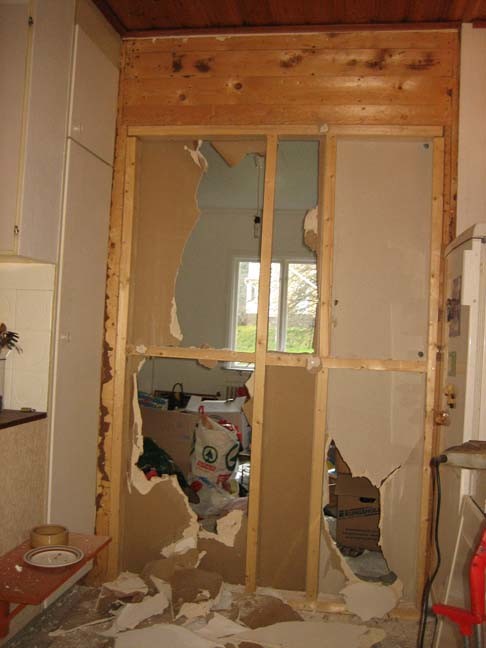
That's what I'm wondering? :
Oki! Didn't see either the last sentence or the picture when I replied, sorry :-[
Have never heard that a door has a load-bearing function as it is removable so to speak
But there is surely someone more competent in the area than me who can help you answer that.
Have never heard that a door has a load-bearing function as it is removable so to speak
But there is surely someone more competent in the area than me who can help you answer that.
Sorry yourself. It was my fault, the image couldn't be uploaded at first, so I edited and added the image and the last sentence to clarify.
What are the dimensions of the framework?
Where is the wall located in the house (e.g. in the middle along the house)?
Is this wall thicker than other interior walls in the house?
What does it look like above and below the wall (is there a supporting "wall" in the foundation right under the wall and do any of the trusses seem to "rest" on the wall)?
Above are some questions I usually start with to find the answer for further analysis.
Where is the wall located in the house (e.g. in the middle along the house)?
Is this wall thicker than other interior walls in the house?
What does it look like above and below the wall (is there a supporting "wall" in the foundation right under the wall and do any of the trusses seem to "rest" on the wall)?
Above are some questions I usually start with to find the answer for further analysis.
The studs are 9 cm wide. But I don't know if that says much, as it's a total hack who owned the house before and put up those studs, and I haven't yet found anything he's done right.
The wall is the thickness that most walls are in the house. However, there is a much thicker wall running through half the house, as you can see in the picture. That wall contains a sliding door, perhaps that's why it's thicker?
How can I tell if any roof truss rests on the wall?
There is no masonry under the stud that lies against the floor; it's wood.
There's a basement underneath, and the basement walls are not aligned with this wall, if that's any help?
Also, it's about the same height as the doors in the house up to the "old" wood. That's why I think there might have been a door there.
EDIT: I've drawn a somewhat rough sketch. The thick wall runs through the middle of the house, lengthways.
The wall is the thickness that most walls are in the house. However, there is a much thicker wall running through half the house, as you can see in the picture. That wall contains a sliding door, perhaps that's why it's thicker?
How can I tell if any roof truss rests on the wall?
There is no masonry under the stud that lies against the floor; it's wood.
There's a basement underneath, and the basement walls are not aligned with this wall, if that's any help?
Also, it's about the same height as the doors in the house up to the "old" wood. That's why I think there might have been a door there.
EDIT: I've drawn a somewhat rough sketch. The thick wall runs through the middle of the house, lengthways.
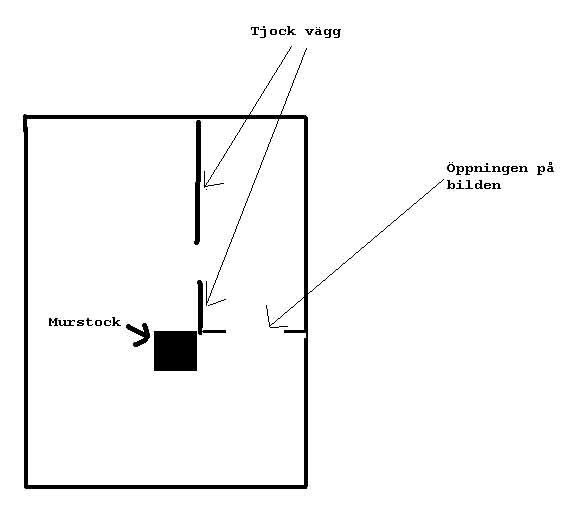

Agree that it is not load-bearing. The trusses probably run from long side to long side of the house? Thus, they are parallel to the current wall. Additionally, you apparently have no wall or pillar in the basement below, so just go ahead and demolish it!
/The Engineer
/The Engineer
Truss.. Now, the thing is there's an upper floor above. It's not called a truss then, right? I'm a bit of a novice, I know.
Anyway, due to a moisture damage, I pulled up the floor in one spot on the upper floor, and now I've peeked under the floorboards, and there is a thick wooden beam (is this called a bjälklag? what you call a truss, right?) going from one long side to the other, and it's directly above the current wall when I measure. This means it's the beam supporting the weight and not the wall, right?
I feel like I can't be too careful considering all the other problems I have with this damned wreck.
EDIT: So, now it's fixed. And the house is still standing. Thanks for the help.
I'm a bit of a novice, I know. Anyway, due to a moisture damage, I pulled up the floor in one spot on the upper floor, and now I've peeked under the floorboards, and there is a thick wooden beam (is this called a bjälklag? what you call a truss, right?) going from one long side to the other, and it's directly above the current wall when I measure. This means it's the beam supporting the weight and not the wall, right?
I feel like I can't be too careful considering all the other problems I have with this damned wreck.
EDIT: So, now it's fixed. And the house is still standing. Thanks for the help.
Click here to reply