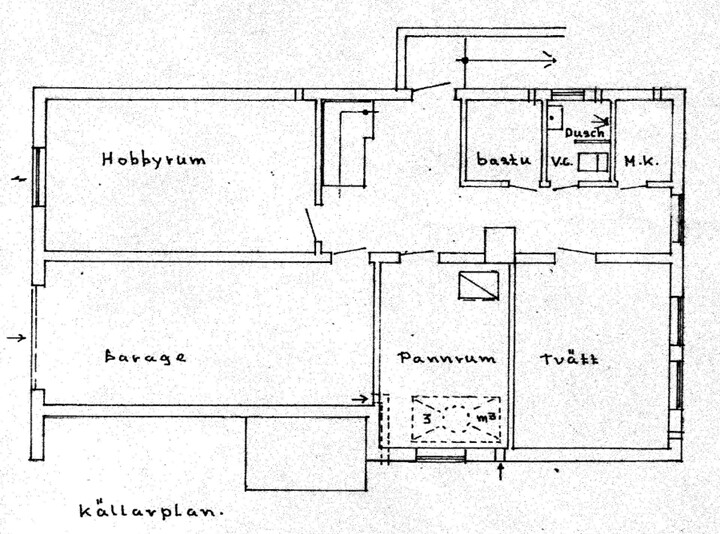
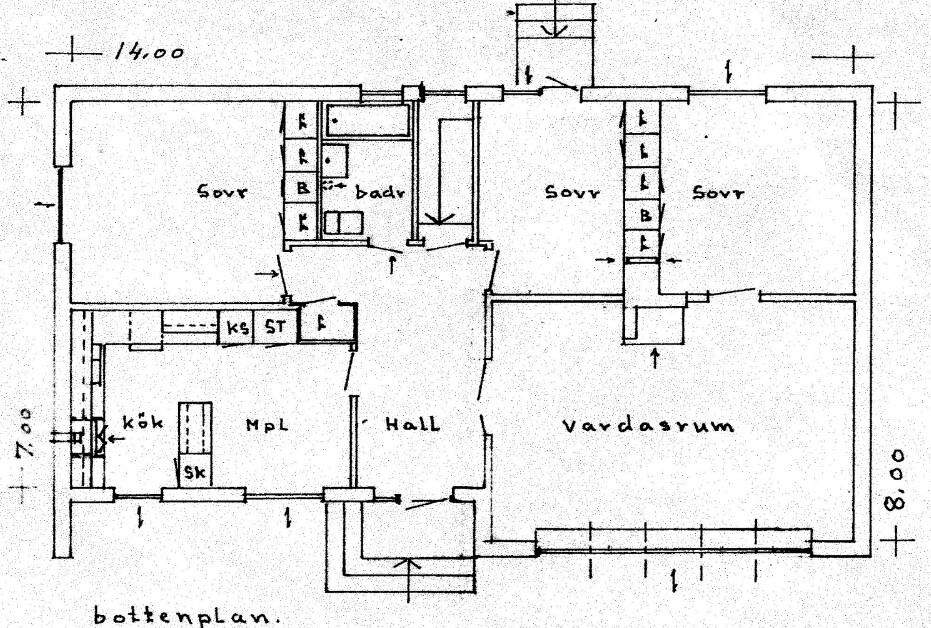
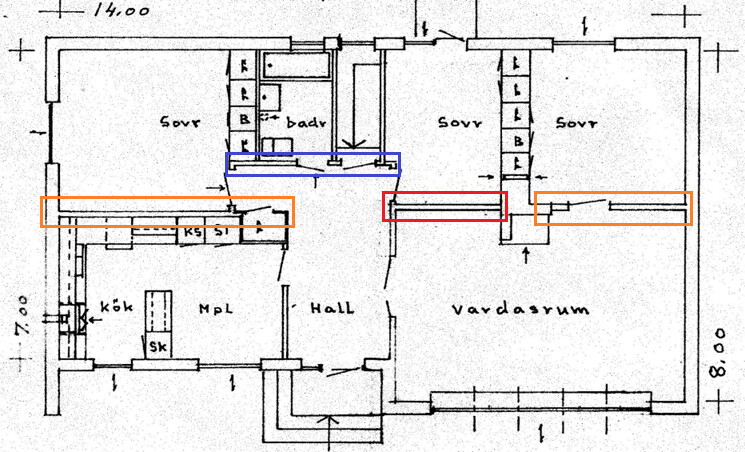
The floor plan is dated 1966, and the house was likely built in the following years.
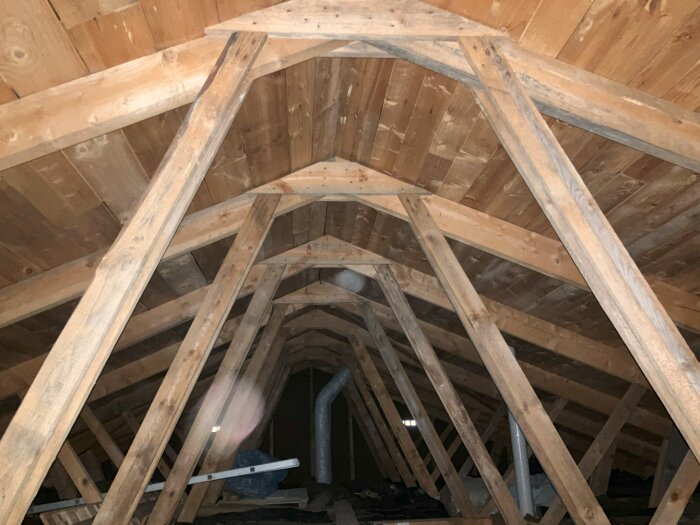
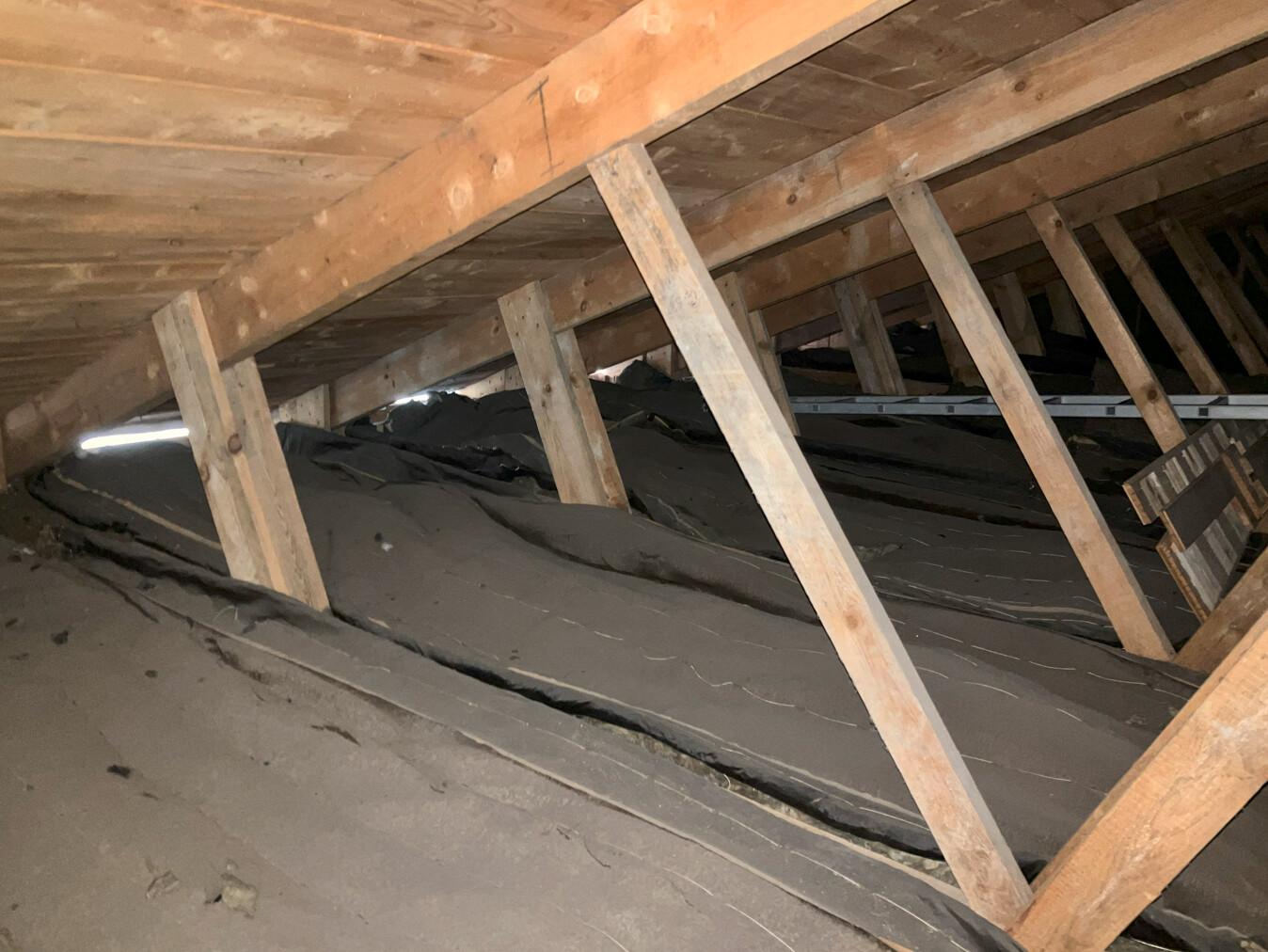
The roof trusses are framework, but not only triangles, they should be self-supporting, right?
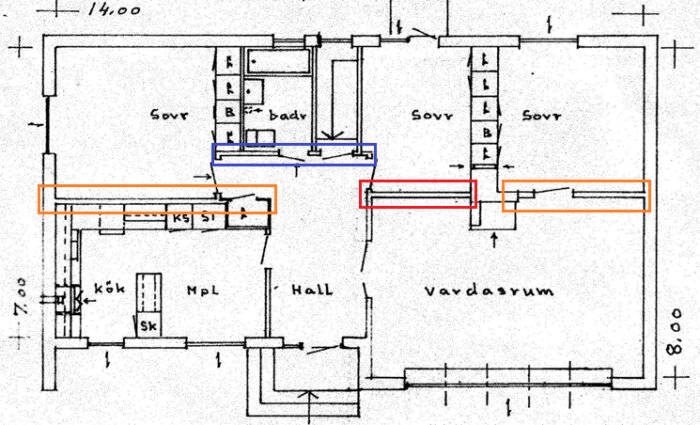
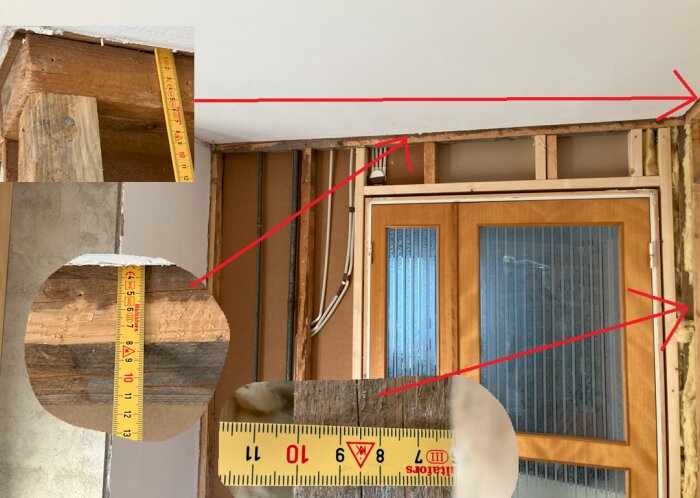
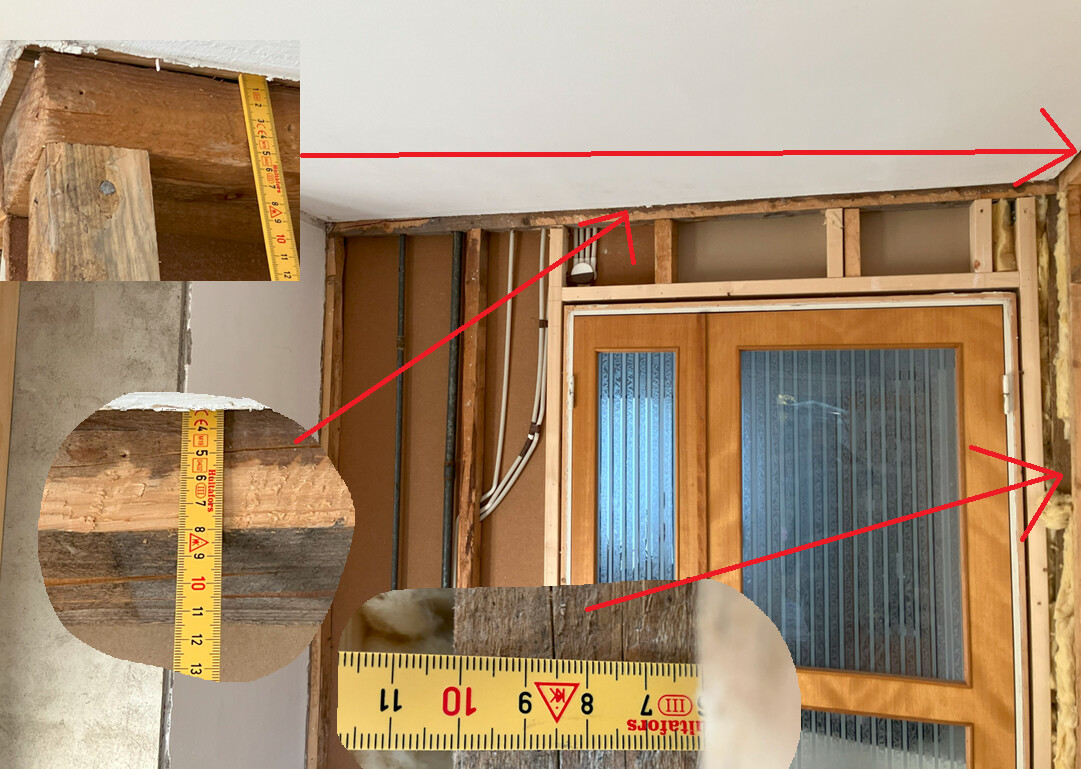
The wall in question (red box in the image below) is perpendicular to the roof trusses and consists of an overhead 80x80 beam, which might rest on the chimney at one end and rests on two 80x50 studs (a total of 80x100) at the other end. The studs in between are/were 80x50 on c/c 60.
A previous owner has remodeled and installed a wide door using 70x45 studs, and it doesn't seem to have caused any problems. Wouldn't the frame have been compressed and the door stuck if the wall were load-bearing and now weakened?
The next wall (blue box in the image above) that continues in the same perpendicular direction relative to the trusses does not have such a strong overhead beam, but rather a weaker 80x50; since it's the only wall in that direction, it should also need to be load-bearing, and if so, should have had a stronger overhead beam, right?
There are also quite a few holes in the overhead beam in the wall in question, both for VP pipes and thicker galvanized pipes for a now-removed expansion tank in the attic. Would you make so many holes, so close together, in a load-bearing wall?
For these reasons, I don't think the wall is load-bearing. What makes me doubt is precisely the overhead 80x80 beam and that it rests on two 80x50 (a total of 80x100) at one end and (perhaps) on the chimney at the other end.
Hard to say based on that drawing, but all three are likely load-bearing.
Thank you for your response, that was not what I hoped for or expected.
So you mean that the trusses are not self-supporting, but are supported by all the walls marked in the picture? Can I ask, to learn something, why you think the walls are load-bearing?
Is it only house plans (which I don't have) that are needed, or can I share other information in the quest for a definitive answer?
Have you checked if the municipality has more drawings?
I'm a bit doubtful that the horizontal beam above the door can support anything since it doesn't appear to extend into or rest on the vertical beams on either side.
Can't you access and see if the floor joists rest on the wall now that you have opened so much?
But completely sure answers can probably only be obtained from a structural engineer who checks on site.
Have you checked if the municipality has more drawings?
I'm a bit questioning whether that horizontal stud above the door can bear anything since it doesn't seem to go into or rest on the vertical studs on either side.
Can't you access and see if the floor joists rest on the wall now that you've opened up so much?
But for completely certain answers, you can probably only get them from a structural engineer who checks on-site.
Thanks for the response. No, I didn't know the municipality might have such documents, thanks for the tip, I'll try calling them tomorrow.
I agree about the rule over the door frame, but I can't help but think that maybe the carpenter didn't think it through when he rebuilt it.
The house has a basement, which is a slab on grade, with masonry walls, and another slab on top. On this slab, it seems like all the walls on the living floor have been erected, and in several rooms, an additional thinner slab has been cast (I assume instead of framing up and building a wooden floor). If I’m not misunderstanding you, I intend to say that there are no floor joists.
I don't know if it's relevant, but if I overlap these two floor plans, it seems that the (according to Matti_75) probable load-bearing walls on the living floor rest partly on walls in the basement floor. Green definitely, yellow at least partially, red not at all.
Thank you for your response, it wasn't what I hoped for or expected.
So you mean that the trusses are not self-supporting, but are supported by all the walls marked in the image? Can I ask to learn why you think the walls are load-bearing?
Is it only house plans (which I don't have) that are needed, or can I share other information in the search for a definitive answer?
Thanks in advance!
In old houses with hand-nailed trusses, they are not as carefully calculated as today's trusses. This applies regardless of the Type of truss.
The house has a basement, which is a concrete slab on the ground with masonry walls, and an additional slab on top. On this slab, it looks like all the walls on the living floor have been erected, and in several of the rooms, an additional thinner slab has been cast (I assume instead of framing and building a wooden floor). If I'm not misunderstanding you, I mean to say that there are no floor joists.
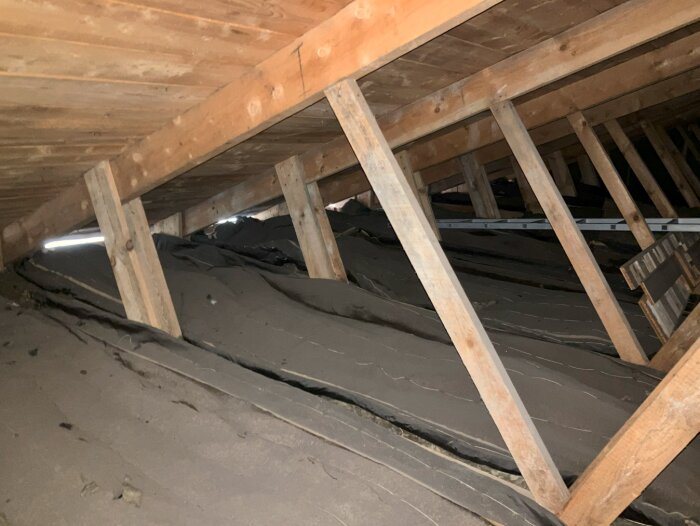
Sorry, I meant the beams up to the attic, such as those resting on load-bearing walls.
Sorry, I meant the beams towards the attic, the ones resting on load-bearing walls.
Thanks for the answer. Ah, floor beams like the attic floor beams, which could be said to be the underlying beams in each truss?
Unfortunately, I don't have a picture, but yes the beams that cross the wall lie flush against the upper wall plate, however, I don't know how I can assess or find out if they really "rest" on the wall.


Matti_75 said:

BirgitS said:
Have you checked if the municipality has more drawings?