Hello!
A kitchen sized for a housewife suits some people, but unfortunately not us. Therefore, a renovation is forthcoming, along with the usual plans to "open up". Currently, the kitchen is accessed via two doors, which we plan to remove along with 1-2 meters of wall on either side of each door.
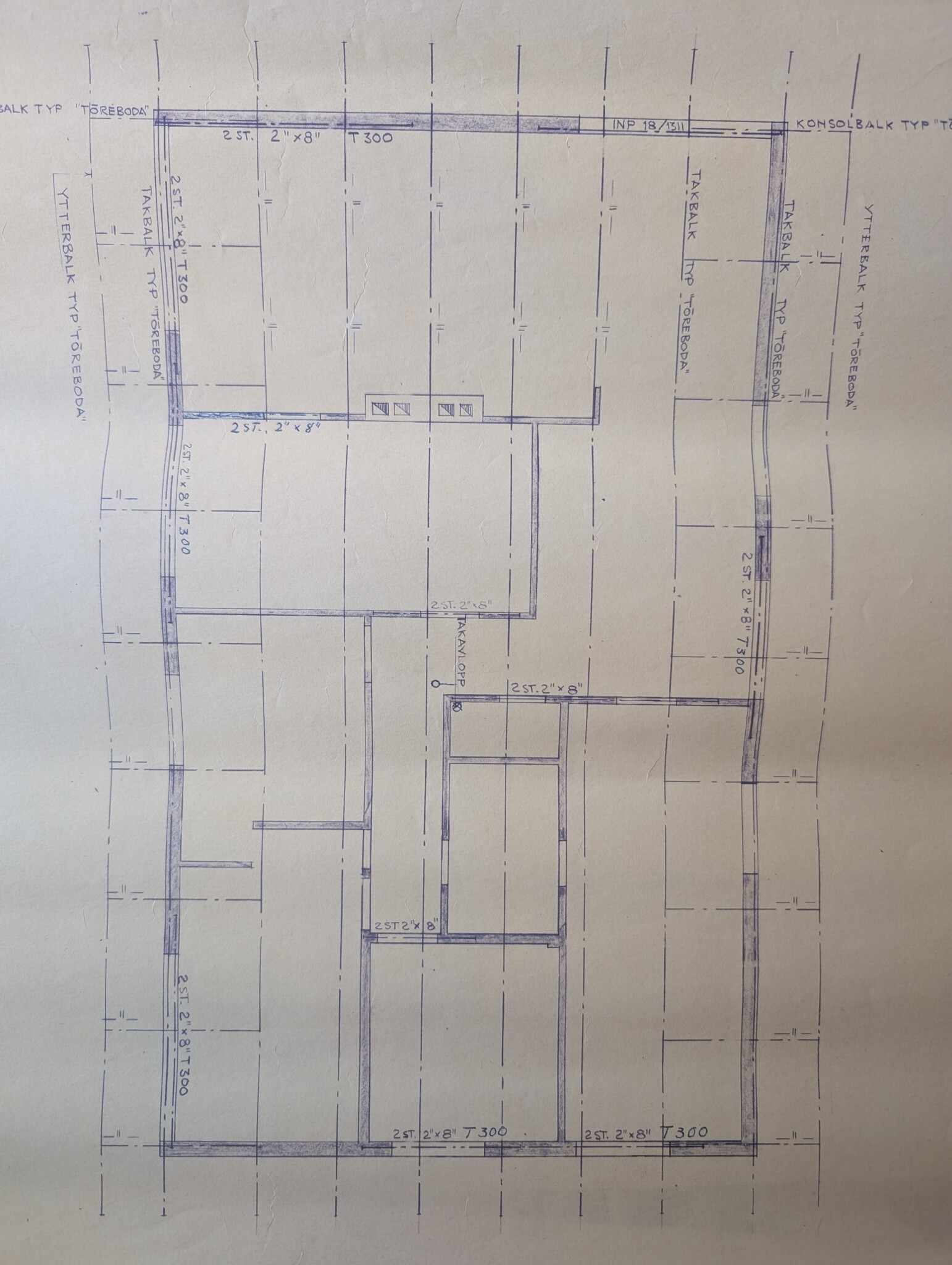
Above the kitchen is the house's flat (low-pitched) roof, whose roof structure is made up of sturdy glulam beams spanning the house's 15.6 meters plus an additional 90 cm roof overhang on each side. There are no structural drawings at the municipality; in 1964, they apparently settled for floor plans and sections for the house's layout. Perhaps it was more important to see that there was a roof than how it was built?
Fortunately, we acquired a couple of rolls of original drawings from the seller, who also grew up in the house. The same man also said when we signed the transfer agreement that "no interior walls are load-bearing." Peculiar, I thought - that's quite a span. I'm a civil engineer (not the structural track though; the last free-standing beam I calculated was in 2003) and vague memories from the steel and wood course about deflections and buckling risk crept out of the shadows. However, I thought, if the structure has been standing since '69 and they, according to them, never went up to shovel snow, it doesn't matter to me if the interior walls are load-bearing or not. Until now. Now it would be very interesting to know if the interior walls under the beams are load-bearing or if they "just prevent" deflection (or if that's the same thing), and if so, would it make a difference in how you design the renovation?
On the drawing (see image) of the roof structure, dated 1969, there are no dimensions on the beams, so it's difficult to do a calculation:
Roof beams c/c 1250 brand: AB Fribärande träkonstruktioner Töreboda.
/...Roof panel 23 mm raw board Construction timber T200 unless otherwise specified.../
/...Support beams of double planks for roof beams and cantilever beams over windows and doors are nailed together with 7 pcs. 4" no. 37 / m in a zigzag from each side.
In the wall under the beam support, double standing studs are applied, nailed together with 4" no. 37 in a zigzag
In outer wall: At least double 2"x4"
In interior wall: At least double 2"x3"