
2,301 views ·
12 replies
2k views
12 replies
What do you think I should use for material?

I am going to replace our "regular" low baseboard in the dining room with a high variant as shown in the pictures below.
We have planned to reuse the baseboard and have already selected a "chair rail" but do not know what material I should use for the panel between the rail and the baseboard.
I have considered gypsum, or maybe preferably a wood sheet such as plywood to achieve an authentic wood feel, as we live in an old house and want it to feel period-appropriate. But then I have a feeling that plywood might be too coarse instead...
Has anyone done something similar and has a good suggestion?
Here is a picture that probably explains better what I mean.

We have planned to reuse the baseboard and have already selected a "chair rail" but do not know what material I should use for the panel between the rail and the baseboard.
I have considered gypsum, or maybe preferably a wood sheet such as plywood to achieve an authentic wood feel, as we live in an old house and want it to feel period-appropriate. But then I have a feeling that plywood might be too coarse instead...
Has anyone done something similar and has a good suggestion?
Here is a picture that probably explains better what I mean.
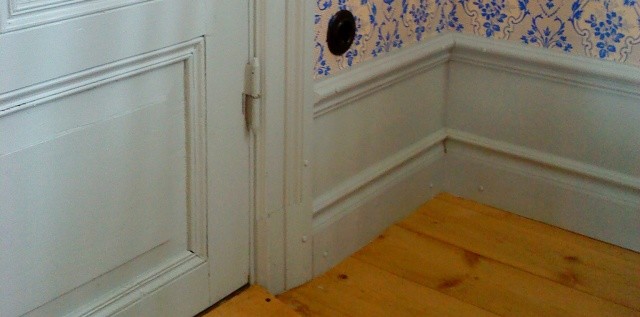


I haven't really considered MDF because I imagined that those boards are too thick, for example, Byggmax's variant is 19mm.
But a quick Google search shows that MDF actually comes as thin as 3mm.
Unfortunately, it seems that none of my retailers sell them thinner than 16mm, and for it to be a sensible alternative as a floor baseboard, 6-10mm is likely the maximum thickness.
Any more suggestions?
The entire finished baseboard will then be painted with linseed oil paint. I'm not sure how it would look if we used plasterboard, which we would have to patch the seams on before painting everything. (It does feel a bit like sacrilege in a house from 1923 with most of the original material intact).
-Andreas
But a quick Google search shows that MDF actually comes as thin as 3mm.
Unfortunately, it seems that none of my retailers sell them thinner than 16mm, and for it to be a sensible alternative as a floor baseboard, 6-10mm is likely the maximum thickness.
Any more suggestions?
The entire finished baseboard will then be painted with linseed oil paint. I'm not sure how it would look if we used plasterboard, which we would have to patch the seams on before painting everything. (It does feel a bit like sacrilege in a house from 1923 with most of the original material intact).
-Andreas
Yes, I had totally forgotten about that...
I actually had that in mind when I "designed" the dining room 3-4 years ago, how could I have forgotten it then...
Does masonite have any particular properties to consider if we are going to use it?
Does it swell or shrink in any way, for example?
It probably needs to be filled to look nice at the joints, but then we'll use wood filler...
I actually had that in mind when I "designed" the dining room 3-4 years ago, how could I have forgotten it then...
Does masonite have any particular properties to consider if we are going to use it?
Does it swell or shrink in any way, for example?
It probably needs to be filled to look nice at the joints, but then we'll use wood filler...


is masonite available in 6 mm thickness which is usually found in building stores
mmm.. but I still have to cut away the existing drywall about 40cm up on the wall to remove the old baseboard, there's just a plank wall behind the drywall.kamilenski said:
But therefore I had a thought at first, to just put up drywall and plaster and sand before painting directly on it...
I don't know if you'll be able to see any difference when the end result is covered with paint anyway...
Click here to reply