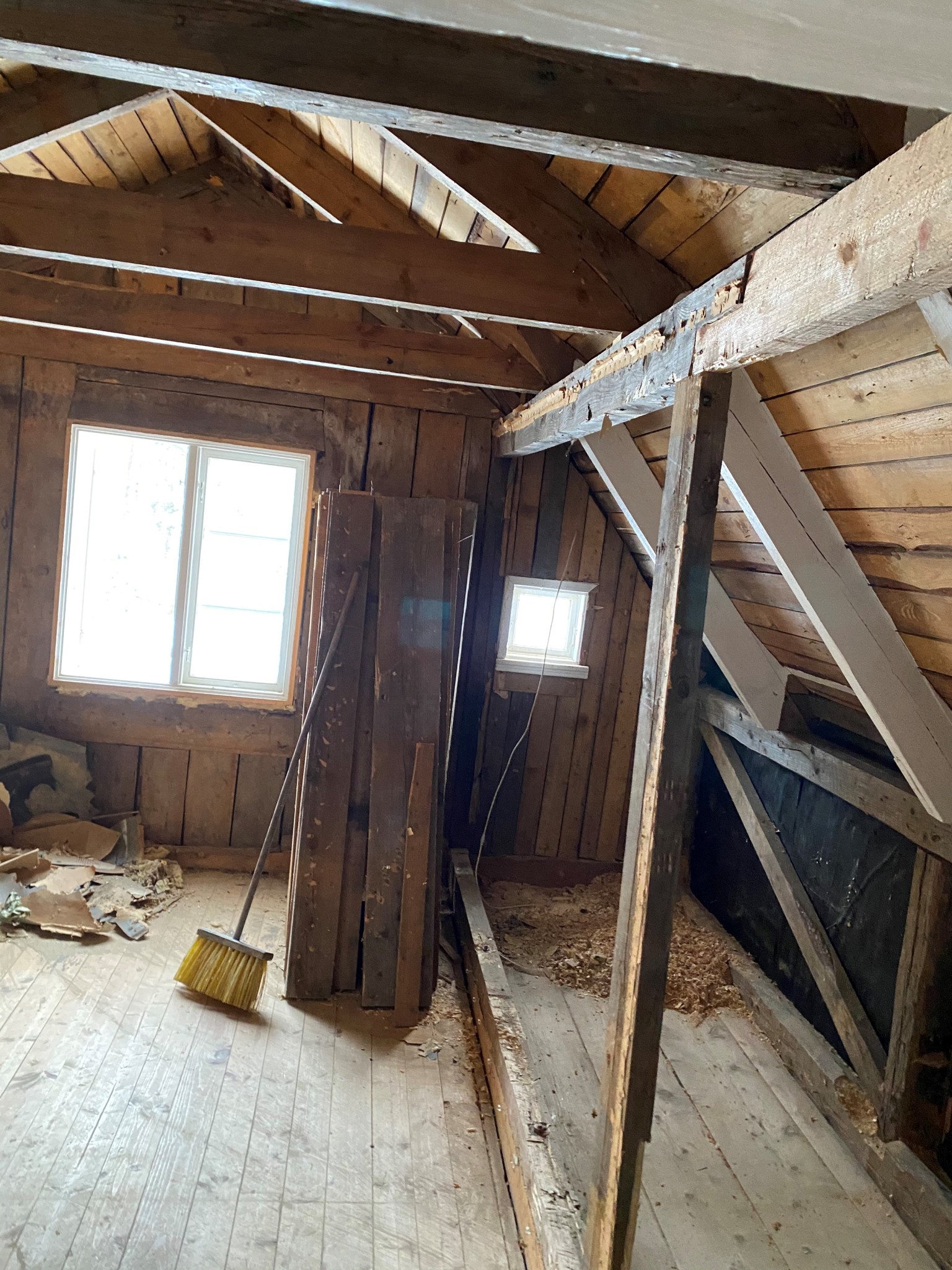
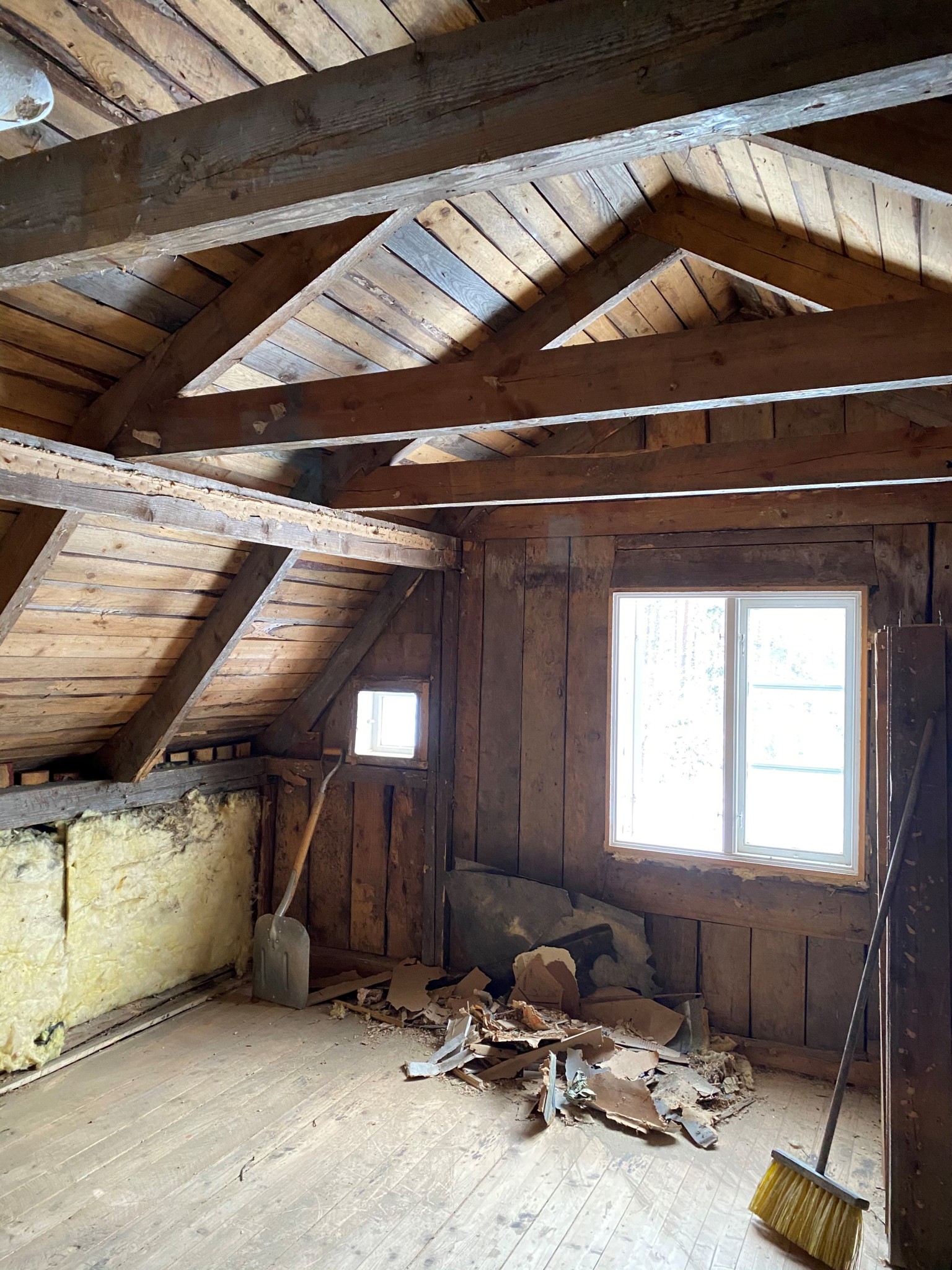
I have torn out the upper floor of a cottage from the 1920s. I also removed the interior wall to be able to build storage in that area. On the other side, the knee wall was already removed. Then two beams appeared that I don't understand the purpose of. Can any wise knowledgeable person provide an answer?
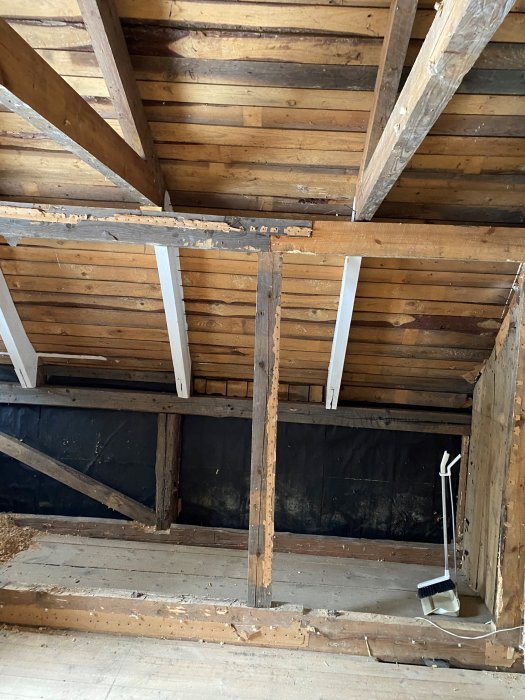
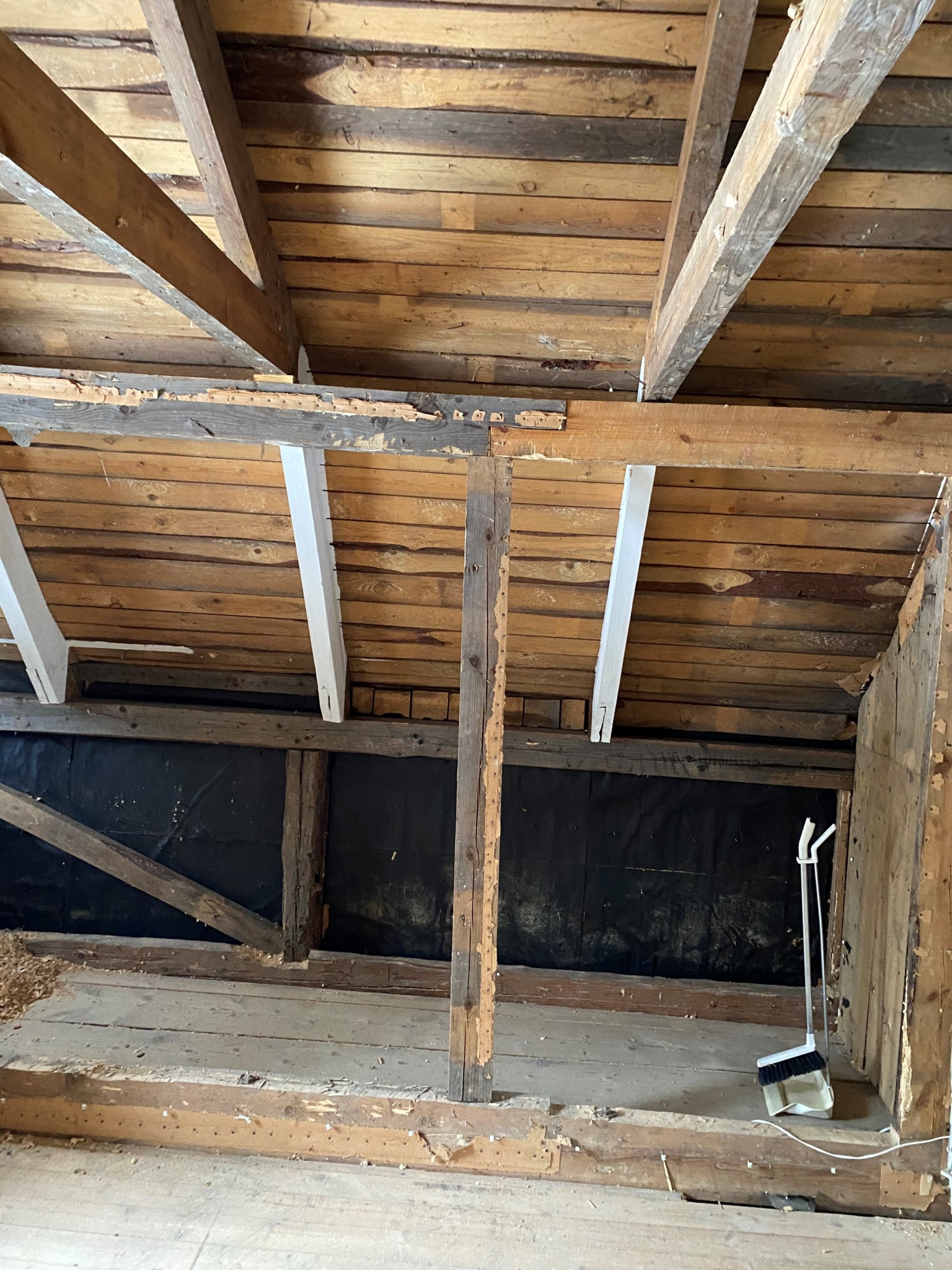
Under the roof trusses' tie beams runs a beam (80x160) in the longitudinal direction of the house. The roof trusses are supported at the outer wall and there are gaps under some of the roof trusses' tie beams. What is the purpose of this one?
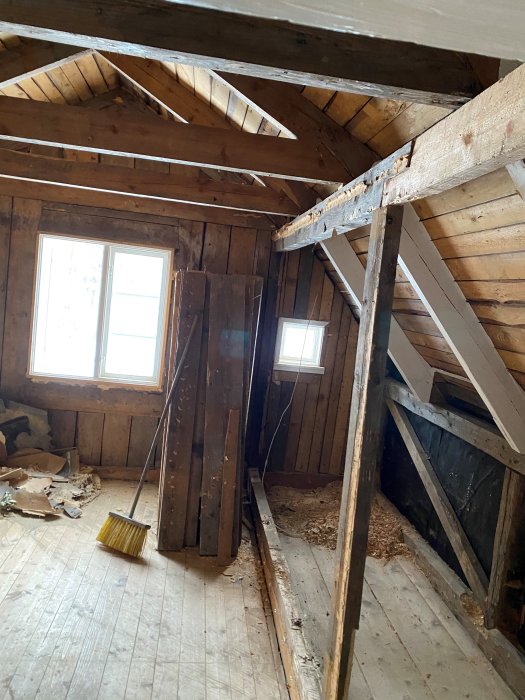
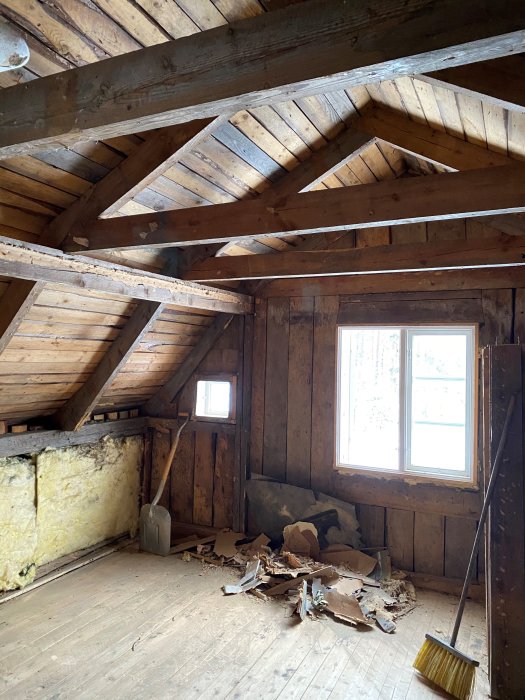
At the bottom of the previous interior wall, there is also a beam (80x200). It lies on top of the floor joists and seems to be anchored with through-bolts and nuts. I would really like to remove it, but I am very unsure. On the other side, there is no corresponding beam, I suppose it was removed when someone removed the knee wall. What purpose does this beam serve?
Do you have any tips that can help me further?
The beam under the collar beams supports and prevents the rafters from pushing the outer walls outward and also helps to keep and support the bend in the rafters where the collar beam meets. The beam on the floor joists is probably called different things, but I call it a rim beam, meaning it's meant to place support posts for the trusses on. As seen in the pictures, your elevated wall section is a post construction standing on the top log course. This construction is relatively sensitive to the trusses wanting to push the wall outward. Is there an internal wall that can serve the function of holding everything together? Otherwise, I wouldn't dare remove the beam just like that.
Yes, I don't see the rim joist in the floor, but the beam under the collar beams is there. I understood it as if that was also removed on one side, which I thought was strange, but that wasn't the case. Anyway, the support beam for the rafters is spliced as seen, and there must be a post there. If you can place that post directly over a floor joist in the intermediate floor or preferably over a log or load-bearing wall on the lower floor, then you can probably remove the rim joist. Otherwise, you'll need to replace the roof beam with something like glulam that can handle a longer span to the nearest support (it looks like there's a wall to the right in the first image?).
The beam under the ceiling beams supports and prevents the rafters from pushing the outer walls outward and helps hold together and support the bending of the rafters where you have an angle where the ceiling beam meets up. The beam on the floor beams is probably called different things, but I call it a remstycke, meaning it is meant to place support legs for the roof trusses on. As you can see in the pictures, your elevated wall is a post-construction that stands on the top log course. This construction is relatively sensitive as the roof trusses want to push the wall outwards. Is there an internal wall that can fulfill the function of holding it all together? Otherwise, I wouldn't dare remove the beam just like that.
Thank you for the detailed response. I think I understand now and I won't touch these beams, except to reinforce the previous joint/repair that doesn't feel 100. I've temporarily supported it for now. Then I should probably also put a sturdy post between the beams in the middle too, or what do you think? (there is currently a temporary support under the joint).
The beam under the collar beams supports and prevents the rafters from pushing the outer walls outward, as well as holding together and supporting the bending of the rafters where you have an angle where the collar beam meets. The beam on the floor joists is probably called different things, but I call it a saddle piece, meaning it is meant for placing support legs for the roof trusses on. As you can see in the pictures, your elevated wall is a post construction that stands on the top log layer. This construction is quite sensitive as the roof trusses tend to push the wall outward. Is there any partition wall that can fulfill the function of holding everything together? Otherwise, I wouldn't dare to remove the beam just like that.
Partition wall? Well, there's no other wall in that room. Picture 2 and 3 are taken from the doorway, with the chimney and then a partition wall to my left. Behind me, I have an equally large space (without knee walls). I haven't torn out that space (yet ).
I would think that even more supports have been placed under the beams. Probably why the beam has sagged and gaps have appeared up to the collar ties. This can probably be easily jacked up again before you put a post underneath. Alternatively, just put blocks in the gaps if you don't care about making it all straight.
Yes, I see that the strap in the floor is not there, but the beam under the collar ties is there. I understood that it too had been removed on one side, which I found strange, but that wasn't the case. In any case, the support beam for the trusses is spliced as you can see, and you must have a post there. If you can get that post directly over a floor joist in the intermediate floor, or ideally over a log or load-bearing wall on the lower floor, you can certainly remove the strap. Otherwise, you have to replace the roof beam with, for example, glulam that can handle a longer span to the nearest support (looks like there’s a wall to the right in the first picture?)
Thanks, I got answers to my follow-up questions before I could send them...
Would imagine that there were even more supports under the beams. Probably why the beam has sagged and gaps have appeared up to the collar ties. This can surely be easily jacked back up again before you put a post under it. Alternatively, just place shims in the gaps if you don't care about making the whole thing straight.
. Yes, the entire inner wall was indeed substantial, and one of the planks still serves as a support now. Shims are already in place on some. But I'll try jacking it up first.
Partition wall? I mean there is no more wall in that room. Images 2 and 3 are taken from the doorway, with the chimney and then a partition wall to my left. Behind me, I have an equally large area (without knee walls). I haven't torn out that area (yet ).
Yes, I assume that the beam on the side that doesn't have the rim joist in the floor is placed/spliced on the wall by the chimney (that's what I call the partition wall). Or what is the wall you see on the right in the first picture?
The most common feature of a gambrel roof is that there is a vertical support post precisely at the "bend," tasked with transferring the roof load. Since the trusses and the attic floor joists do not typically have the same spacing, the lower longitudinal beam helps distribute the roof loads onto the floor joists. In your case, the upper longitudinal beam replaces the support posts. The column in the middle (or wherever it is located) eases the load on the upper beam.
In a house with a gambrel roof, most of the snow load ends up on the upper part. The steep sections of the roof often have such a pitch that snow load does not need to be considered. Removing these features will eventually result in the roof settling. How quickly this occurs depends, among other things, on the snow zone in which the house is located. Snow loads are calculated based on 50-year intervals. In Skåne, it might take time before the construction is tested.
Click here to reply
Vi vill skicka notiser för ämnen du bevakar och händelser som berör dig.


 ).
).