
20,243 views ·
35 replies
20k views
35 replies
Weld your own staircase from an H-beam?
Unless you were being ironic with the suggestion to weld in the apartment...
Now, I don't want to be a killjoy, but welding in the apartment might not be something I would do just like that,
For several reasons, primarily the safety aspect, you have neighbors who also become homeless when you burn down the place,
If you don't burn it down, there will be significant smoke development when welding of that caliber,
The welding sparks leave ugly marks on everything around,
On American TV, you can weld however you want, in real life, there’s a bit more to consider,
The simplest solution is probably not just to borrow the welder but also the garage...
Unless you choose limträ.
Now, I don't want to be a killjoy, but welding in the apartment might not be something I would do just like that,
For several reasons, primarily the safety aspect, you have neighbors who also become homeless when you burn down the place,
If you don't burn it down, there will be significant smoke development when welding of that caliber,
The welding sparks leave ugly marks on everything around,
On American TV, you can weld however you want, in real life, there’s a bit more to consider,
The simplest solution is probably not just to borrow the welder but also the garage...
Unless you choose limträ.

After a bit more googling, I found a guy on this site who made just the kind of staircase we're talking about, awesome! Check page 2 later, there are more pictures:
http://www.byggahus.se/forum/byggmaterial-byggteknik/73214-svetsa-trappa-av-fyrkantroer.html
Laminated wood seems cheaper than H-beam, but this guy used square tubes, which I think are cheaper than the beams. Square tubes seem lighter, nicer, and more workable.
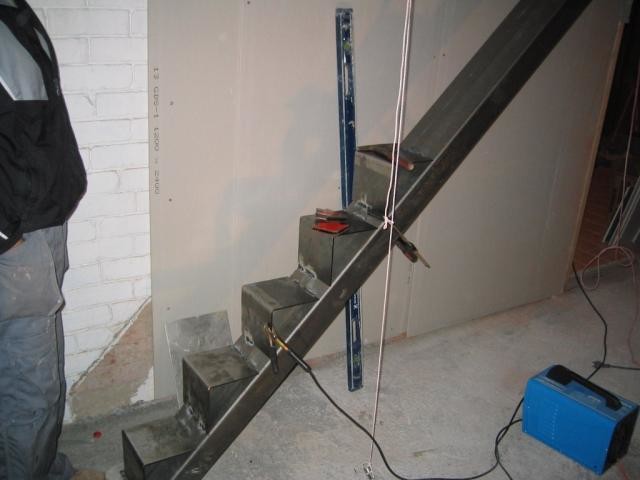
Here is an image from the guy's staircase. And an image of 2 different sketches that are relevant in my case, because I have such a steep staircase so I have to make the steps a bit differently.
http://www.byggahus.se/forum/byggmaterial-byggteknik/73214-svetsa-trappa-av-fyrkantroer.html
Laminated wood seems cheaper than H-beam, but this guy used square tubes, which I think are cheaper than the beams. Square tubes seem lighter, nicer, and more workable.
Here is an image from the guy's staircase. And an image of 2 different sketches that are relevant in my case, because I have such a steep staircase so I have to make the steps a bit differently.
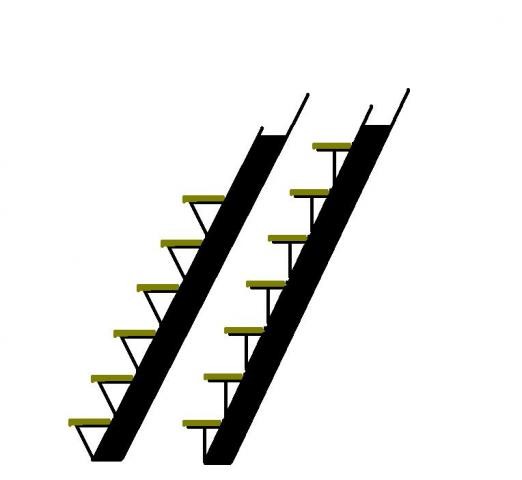

I mean that the beam is on its edge, opposite to the steel profile you posted an image of.nattugglan11 said:
And that is what makes it not look as sleek, the wooden beam sticks out quite a bit under the steps.
The measurements I gave are mm ...


Square tubes are probably, as you mentioned, a better solution, lighter beam=cheaper beam.
If you have any concerns about welding (and definitely if you plan to weld inside an apartment), it might be easier if you make the steps screwable.
A bit more work but you'll avoid both the fire risk and smoke.
You can get help with sheet metal bending at a mechanical workshop; if you buy the beam at the same place, you can have it cut to the right angle at once.
You also have the advantage of being able to surface treat the staircase before you assemble it. galvanized, painted, etc...
If you have any concerns about welding (and definitely if you plan to weld inside an apartment), it might be easier if you make the steps screwable.
A bit more work but you'll avoid both the fire risk and smoke.
You can get help with sheet metal bending at a mechanical workshop; if you buy the beam at the same place, you can have it cut to the right angle at once.
You also have the advantage of being able to surface treat the staircase before you assemble it. galvanized, painted, etc...
Good there, not a bad idea to screw the steps instead, I hadn't thought of that, as you said, a bit more work but maybe saves me some money on a welder :-D ...though it would have been fun to have one :-Dblackadder said:Square tubing is probably a better solution as you mentioned, lighter beam=cheaper beam.
If you have thoughts about welding (and definitely if you plan to weld inside an apartment), it might be easier if you make the steps screwable.
A bit more work, but you'll avoid both fire risk and smoke.
You can get help bending the sheet metal at a mechanical workshop, if you buy the beams at the same place, you'll get them cut at the correct angle at once.
Then you also have the advantage that you can surface treat the staircase before you screw it up. Galvanized, painted, etc......
Yes, I actually thought of turning to a sheet metal workshop for the bent steps, a thicker perforated sheet seems convenient, then I have the holes in the step at least, just the ones in the beam I'll have to drill myself. The trick will be to use long screws and drill through the entire beam, so I can attach a nut and have the screw heads accessible. Drilling straight through and getting it aligned will be difficult, but possible.
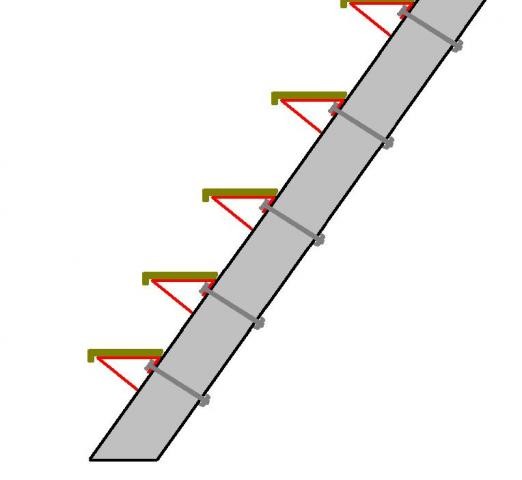
For me to succeed with this, the steps should look like this, maybe easier still with welding :-D
If you are going to have thicker material than 3mm in the beam, it is probably better to tap the beam.
Otherwise, there are popnuts, which work like a blind rivet but have a thread in the middle, they work great for 2mm and thinner.
Otherwise, there are popnuts, which work like a blind rivet but have a thread in the middle, they work great for 2mm and thinner.
If I were to do it with screw joints, I would at least probably use 4 or 5 mm material in the beam, drill 4 mm holes (or actually 4.2 mm) and thread M5. Attach 6 or 8 M5 screws with Loctite to each step (3 or 4 screws on each side). Maybe only 2-3 screws are needed on each side, an M5 screw joint can hold several hundred kilos each. It should be possible to find information about this...
Then I wouldn't use perforated metal plate either, but drill 5.5 mm holes for the screws instead.
Perforated metal plate is both weaker and more expensive (I think). But above all, smooth plates and no visible nuts or hex heads on the backside would make a much nicer staircase.
edit:
I started a response, got interrupted, so blackadder got in between ...
Then I wouldn't use perforated metal plate either, but drill 5.5 mm holes for the screws instead.
Perforated metal plate is both weaker and more expensive (I think). But above all, smooth plates and no visible nuts or hex heads on the backside would make a much nicer staircase.
edit:
I started a response, got interrupted, so blackadder got in between ...
An M5 in grade 8.8 seems to have 1.1 tons in tensile strength.
11350N according to the table on page 29 of this document.
http://www.exx.se/techinfo/docs/bultens_teknikhandbok.pdf
Then you shouldn't design against breakage but rather against a suitable selected yield strength, right?
Finally, there's shear strength to keep track of.
But an M5 is quite strong anyway ...
11350N according to the table on page 29 of this document.
http://www.exx.se/techinfo/docs/bultens_teknikhandbok.pdf
Then you shouldn't design against breakage but rather against a suitable selected yield strength, right?
Finally, there's shear strength to keep track of.
But an M5 is quite strong anyway ...

Thanks for all the responses!
It immediately feels like welding is much easier, I look with horror at the thought of drilling all those holes, sigh!! Not only do they have to be drilled but measured to the millimeter.
It'll be welding down in the basement/"workshop", it looks like I can get the stairs out from there too, I think :-D
It immediately feels like welding is much easier, I look with horror at the thought of drilling all those holes, sigh!! Not only do they have to be drilled but measured to the millimeter.
It'll be welding down in the basement/"workshop", it looks like I can get the stairs out from there too, I think :-D
New rules.. You have to weld to the millimeter, bolted joints give you a bit of play and adjustment room,
When it looks straight, you tighten it as hard as you can,
With a quality drill bit, it’s quickly drilled,
Weld or drill, whichever... you should measure...
When it looks straight, you tighten it as hard as you can,
With a quality drill bit, it’s quickly drilled,
Weld or drill, whichever... you should measure...
Hmmm, wonder what the plåtverkstaden will charge to build my staircase :-D
the stairs I made took about 8h at 400+VAT and then the material on top of that.......