I am in the process of leveling a floor and have encountered a problem with the last two floor joists.
They are 100x150mm and are embedded in the lightweight concrete frame on the long sides. They are twisted more than 30 degrees on one side and were like that when the house was built, as there is mortar all around the end in that position.
I want to avoid making holes in the concrete and doing any major interventions. For the remaining beams, I screw a batten on each side, which I use to align them (on each side so that they are less than 600mm between the joists).
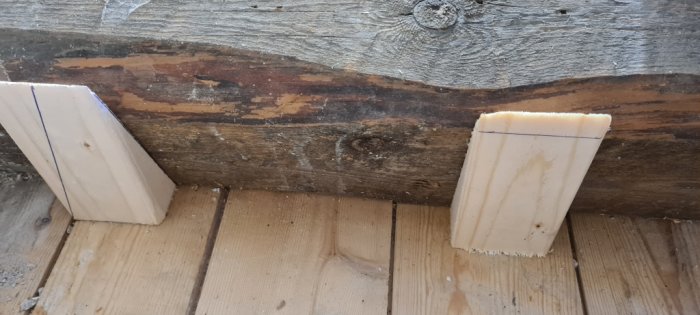
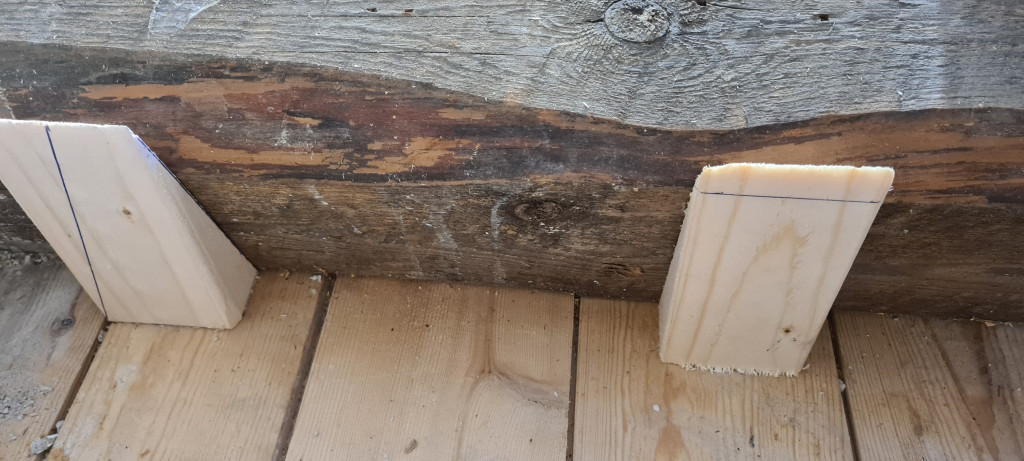
My strategy as it stands now is to make blocks of 45x70 which I glue and screw in place with say 30cm intervals on each side of the entire part of the ridge that is twisted. It will be about halfway before it is sufficiently plumb for me to be able to screw on the side.
Not a bad solution. I also usually place a beam on each side to reduce the cc-measurements.
If you're going to add chipboard flooring, it doesn't matter if the beams/floor joists aren't perfectly vertical. The important thing is that the "corner" (if it's slightly twisted, it will be a corner and not a flat surface meeting the chipboard flooring) is leveled with the other joists as usual. My experience is that it's not a problem to glue-screw chipboard flooring to such a "corner." If you're not stingy with the glue, it will still be a strong joint.
This is how it all ended. I had to cut wedges that I glued and screwed in place for about 3 meters. Placed them with a 30cm center-to-center. At the worst spot, the wedge was 55mm wide (on a 150 high stud).
Now you have solved it admirably, but for future readers, a tip is to place the rule flat against the beam even if it's sloped and then plane it level. When you level the rule, you do it against the edge that is lowest. Then you plane until the higher edge reaches the same level. I did it recently and it went smoothly with an electric planer. Had slightly more modest angles, maybe 10°, but it should work well even with 30°.
Now you've solved it admirably, but for future readers, a tip is to place the beam flat against the joist even if it tilts, and then plane it level. When leveling the beam, you do it against the edge that is lowest. Then you plane until the higher edge reaches the same level. I did this recently and it went smoothly with an electric planer. I had slightly more modest angles, maybe 10°, but it should work well even with 30°.
In my case, the twisting started at half the floor joist, so one half was straight and the other half heavily twisted. If it had been possible to force my beams to match the twist, it would have been a heck of a lot more troublesome than how I solved it. But with less twisting, your solution is much smoother.
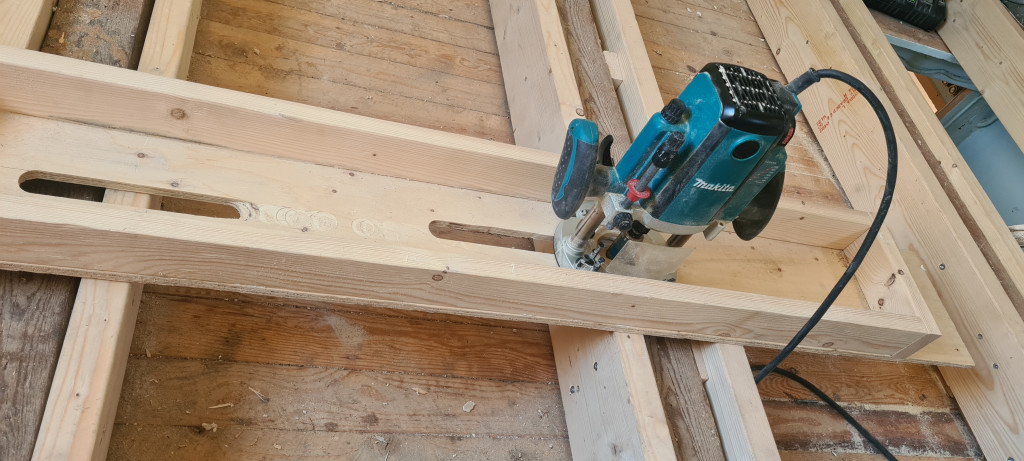
An addition is that to plane down the top edge, you can build an electric planer jig. I had one for the plunge router that I used in some places, but I am going to make one for an electric planer for future use.
This guy has made an example of the principle for an electric planer jig:
Click here to reply
Vi vill skicka notiser för ämnen du bevakar och händelser som berör dig.



Bernieberg said:
Now you've solved it admirably, but for future readers, a tip is to place the beam flat against the joist even if it tilts, and then plane it level. When leveling the beam, you do it against the edge that is lowest. Then you plane until the higher edge reaches the same level. I did this recently and it went smoothly with an electric planer. I had slightly more modest angles, maybe 10°, but it should work well even with 30°.