
Planning to nail up vertical ship paneling on the sloping ceiling. From the knee wall to the ridge, it's 1800 to 2600 mm. My first thought was to buy lengths so I wouldn't need to splice anything.
My question is whether it needs splicing to minimize potential movements in the paneling. It could reduce the risk of that if you don’t use full lengths throughout the ceiling. The paneling will run the entire length of the house, 17m.
My question is whether it needs splicing to minimize potential movements in the paneling. It could reduce the risk of that if you don’t use full lengths throughout the ceiling. The paneling will run the entire length of the house, 17m.
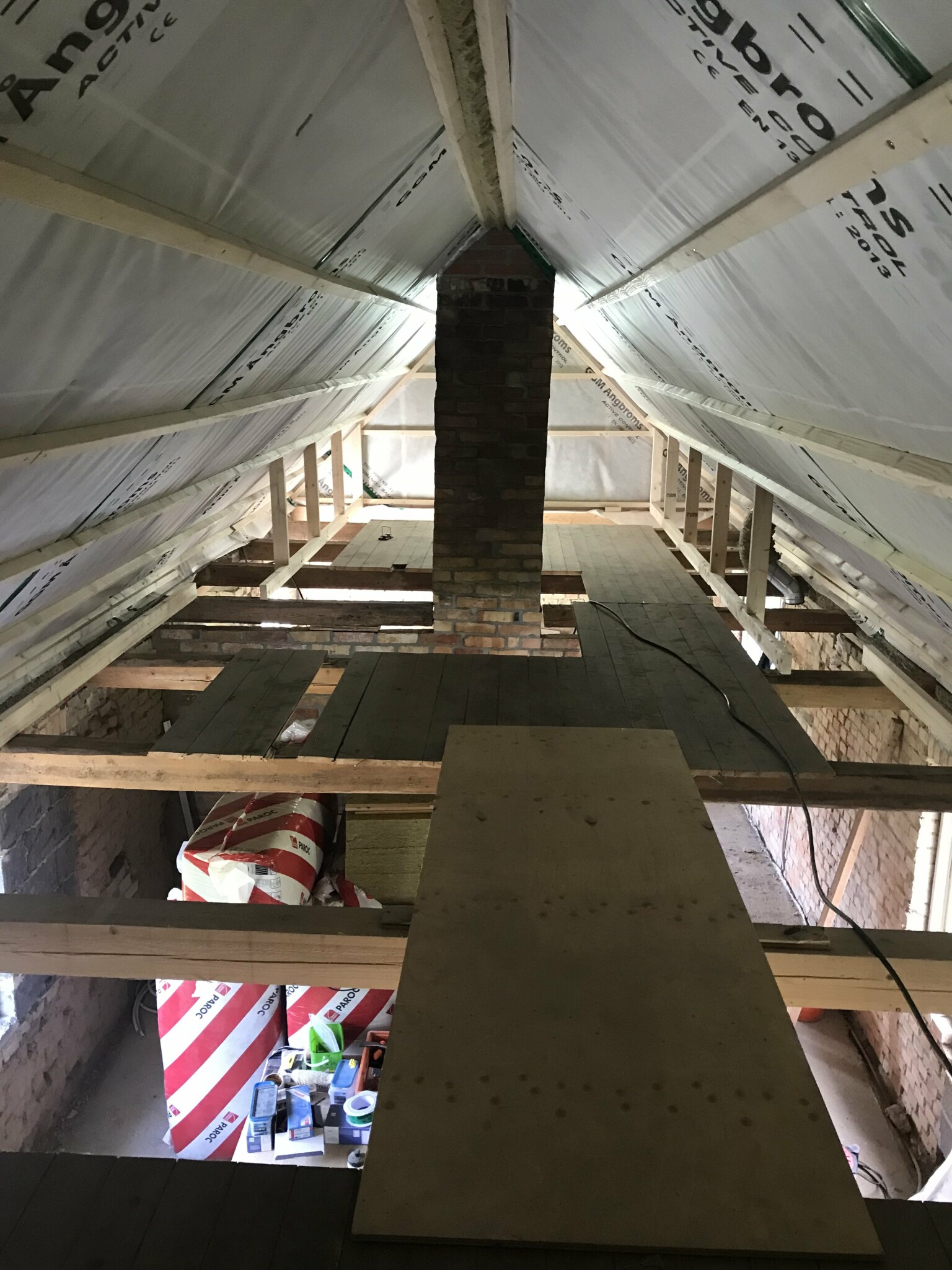
hmm. if what I suspect is a chimney shaft, it should be plastered (all the way up and through the roof) before you cover it too much if you plan to use a stove/fireplace or wood stove in the future. It is usually a requirement during fire inspection before you can use built shafts, and the plaster is meant to seal any gaps in the masonry so that flames and hot smoke gases cannot reach the exterior and potentially ignite materials.
now is the time to tackle such work - it will be more expensive and troublesome later on...
now is the time to tackle such work - it will be more expensive and troublesome later on...
No requirement according to the fire safety inspector I spoke with.X xxargs said:hmm. if it is as I suspect a chimney stack then it should be plastered (all the way up and through the roof) before you cover it too much if you plan to use a stove/fireplace or wood stove in the future. It is usually a requirement at the fire inspection before you are allowed to use masonry stacks, and the plaster is then used to seal any gaps in the masonry so that flames and hot flue gases cannot reach the outside and potentially ignite materials.
this is now when you should tackle such work - later it will be more expensive and troublesome...

Sure, but do the inspection and get the paper before you build again, my tip...
It's a perfect time to actually conduct a fire protection inspection and get documentation on it so you know if you need to polish the chimney or not, and perhaps also receive some advice on how the chimney's passage between the floors (and possibly the roof) should be done so you don't face setbacks on this later when it's put into 'active operation' after another fire protection inspection.
The reason I mention passages is that the chimney looks quite narrow and thus has relatively little thermal mass, which means it can get quite hot if you use it extensively and for long periods. It can reach temperatures considered risky for materials that are in contact with it if material choices don't account for the potential heat.
Chimneys I've encountered (which have always been plastered gray—never bare brick) are often quite substantial with brackets carrying ceiling beams, etc., and narrow only at the connection to the actual chimney through the roof.
The reason I mention passages is that the chimney looks quite narrow and thus has relatively little thermal mass, which means it can get quite hot if you use it extensively and for long periods. It can reach temperatures considered risky for materials that are in contact with it if material choices don't account for the potential heat.
Chimneys I've encountered (which have always been plastered gray—never bare brick) are often quite substantial with brackets carrying ceiling beams, etc., and narrow only at the connection to the actual chimney through the roof.
Will check how the passages should be.X xxargs said:It's an excellent opportunity to actually conduct a fire safety inspection and get the paperwork for it so you know if you need to plaster the chimney or not, and perhaps also get some advice on how the chimney's passage between floors (and possibly the roof) should be done so that you don't face setbacks later when it's put into 'sharp operation' after an additional fire safety inspection.
The reason I mention the passages is that the chimney looks quite narrow and thus has relatively little thermal mass, which means it can get quite warm if you burn a lot and for a long time in it and can reach temperatures that might be considered a risk for materials against it unless the material selection takes this heat into account.
Chimneys I have come in contact with (and they've always been plastered gray - never bare brick) are often quite sturdy entities with brackets supporting the roof structure, etc., and only narrow at the connection to the chimney through the roof.
But when it came to plastering the chimney, it was not something that is required anymore according to the person I spoke with.
I don't know why it was so important before, because if there are movements and cracks in the chimney, the plaster won't hold either. The crack will go straight through the plaster as well.
That is why fire protection inspections are conducted every 6, every 3 years, and perhaps even more often depending on how frequently fires are lit, and if the plaster had come loose and fallen, there was an automatic fire ban until it was addressed.
Now you say it may have changed, but previously the plastering was an extra protective barrier and indicator layer that was relatively easy to inspect, and if there were major cracks and fallen pieces, one could suspect more damage deeper in the brick that over time could become a real fire hazard if the fireplaces continued to be used.
Now you say it may have changed, but previously the plastering was an extra protective barrier and indicator layer that was relatively easy to inspect, and if there were major cracks and fallen pieces, one could suspect more damage deeper in the brick that over time could become a real fire hazard if the fireplaces continued to be used.
Click here to reply