
13,493 views ·
74 replies
13k views
74 replies
Switch a joist system 8x8 meters.

Hello! I'm considering building a larger garage/workshop. I need some help on how to think and proceed with the design.
The idea is a garage section with an internal dimension of about 8x8 meters. In addition, there will be a workshop section of 8x? meters.
Anyway, I'm thinking of having an upper floor above the garage section.
The wall height will be 3.5-4 meters, still a bit unclear.
I'm considering using scissor trusses.
Now to the actual question:
The floor for the upper floor is desired to be like the garage, 8x8 meters.
I will need a glulam beam that spans the middle.
BUT can I install a beam without having a post in the middle?
I've used the Swedish wood guide and determined the dimension I need for the floor, but I can't make sense of the glulam beam.
I've looked at calculations for supporting a mid-wall in a 1&1/2 story house where the maximum length is 5000mm, but it's not quite the same since the trusses will be self-supporting in my case.
So, can I hang an 8-meter free-hanging glulam beam in the middle of the garage without a mid-post and then attach joist hangers or similar on each side of the beam and lay my floor on it? The floor will then be attached to the walls, 4 meters in both directions.
The idea for the upper floor is for use as "living space," "youth den," "guest room," you name it ♂️
Floor joists 45x245 c24 cc600.
Thanks in advance!
The idea is a garage section with an internal dimension of about 8x8 meters. In addition, there will be a workshop section of 8x? meters.
Anyway, I'm thinking of having an upper floor above the garage section.
The wall height will be 3.5-4 meters, still a bit unclear.
I'm considering using scissor trusses.
Now to the actual question:
The floor for the upper floor is desired to be like the garage, 8x8 meters.
I will need a glulam beam that spans the middle.
BUT can I install a beam without having a post in the middle?
I've used the Swedish wood guide and determined the dimension I need for the floor, but I can't make sense of the glulam beam.
I've looked at calculations for supporting a mid-wall in a 1&1/2 story house where the maximum length is 5000mm, but it's not quite the same since the trusses will be self-supporting in my case.
So, can I hang an 8-meter free-hanging glulam beam in the middle of the garage without a mid-post and then attach joist hangers or similar on each side of the beam and lay my floor on it? The floor will then be attached to the walls, 4 meters in both directions.
The idea for the upper floor is for use as "living space," "youth den," "guest room," you name it ♂️
Floor joists 45x245 c24 cc600.
Thanks in advance!

8x8 m is quite a lot without pillars. It's better with two support beams, otherwise, you'll need glue-laminated timber for the floor joists as well. Even then, you will have significant stability issues. However, I think you first need to develop the concept. It's better to make a hall with proper ceiling height and then a separate two-story part with lower ceiling height. A hall can be built with three-hinged frames that can handle substantial spans at moderate costs. Consider the plan dimensions in relation to the functional requirements. What is it you want to be able to do, and what space will it take?
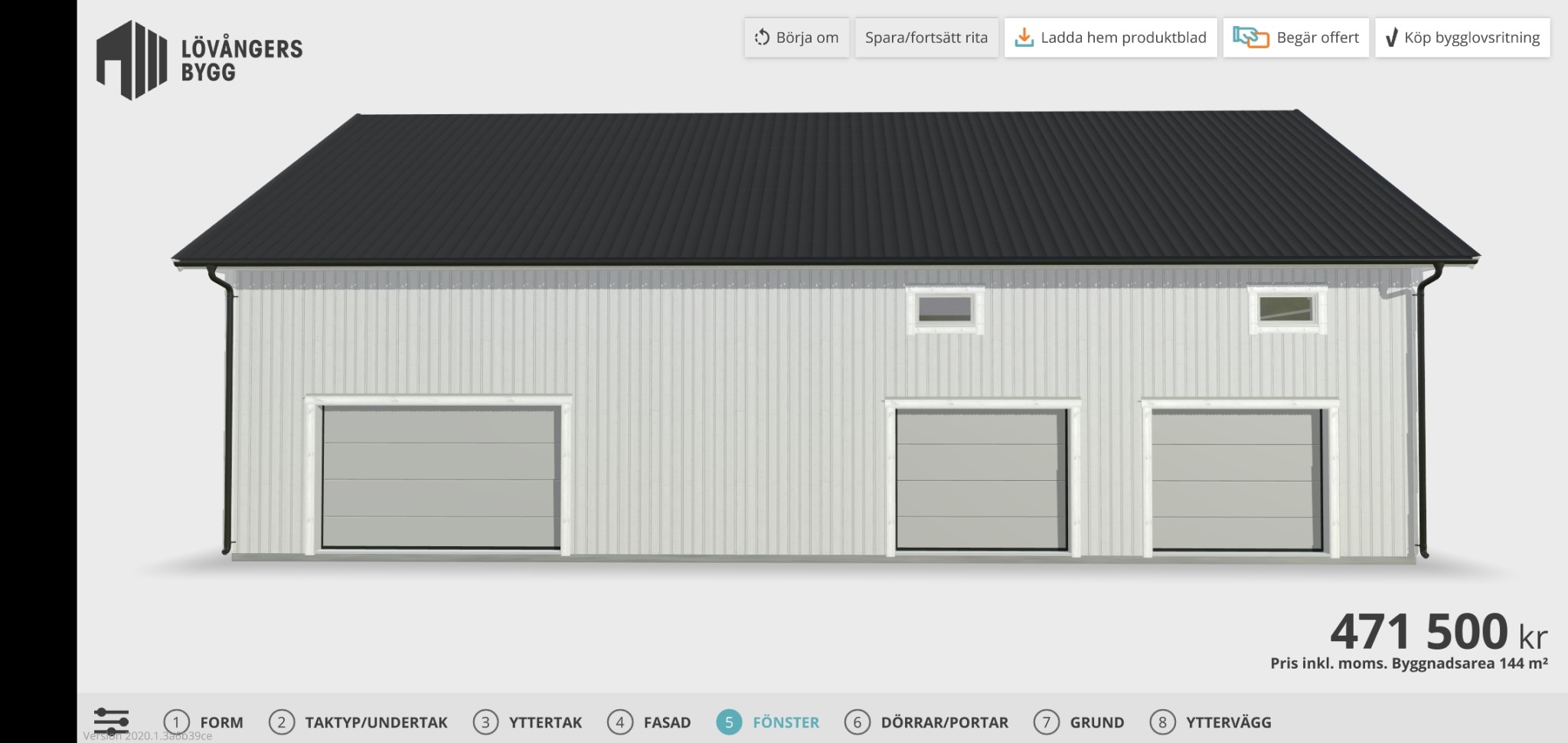
One idea is like the picture "type". "Open to suggestions" as I am still in the dream phase...
The structure in the picture is 8.4 x 16.8 m. 4 m in wall height.
On the right, the idea is a double garage 8x8m internally, about 2.2-2.4m in ceiling height where the floor for the upper floor is intended to take over. The glulam beam is then thought to be between the doors. But it can also be laid lengthways in the middle for that part. If you are to have a central pillar, it ends up in the middle anyway.
Double beams as you mentioned could be a bit awkward for the overhead garage doors, I think.
So a beam in the middle would be good, but the question in itself was whether there is a beam that can support the floor without a central pillar. It will be 64 m2 of floor area that needs to be supported by the outer wall (right end), glulam beam 4 meters in and then an inner wall which will be 8 meters from the right end.
After this inner wall, you enter the workshop section.
Inside the door on the left, I want 4m in ceiling height for a car lift. So from the left end and maybe 3.6-4.8 m in, one could use regular roof trusses to get a smooth ceiling. Then I'm thinking about having some kind of loft there too, up to the central wall against the garage area for storing various workshop items/car parts, etc. So there you typically use scissor trusses like in the other loft.
If I go with a 4m wall height, I get around 1.3 meters in the lowest wall height in the lofts, which is quite nice, I think. But it all hinges on how big that glulam beam will be and whether to lay the floor ON the beam or if you can hang the floor using joist hangers on the beam to lower the floor height by about 25 cm.
Wow, that was a lot to read, but I hope you understand how I am thinking.
Under the loft in the workshop section, you also have plenty of space for a toilet, changing room, and lots of other things you want.
The structure in the picture is 8.4 x 16.8 m. 4 m in wall height.
On the right, the idea is a double garage 8x8m internally, about 2.2-2.4m in ceiling height where the floor for the upper floor is intended to take over. The glulam beam is then thought to be between the doors. But it can also be laid lengthways in the middle for that part. If you are to have a central pillar, it ends up in the middle anyway.
Double beams as you mentioned could be a bit awkward for the overhead garage doors, I think.
So a beam in the middle would be good, but the question in itself was whether there is a beam that can support the floor without a central pillar. It will be 64 m2 of floor area that needs to be supported by the outer wall (right end), glulam beam 4 meters in and then an inner wall which will be 8 meters from the right end.
After this inner wall, you enter the workshop section.
Inside the door on the left, I want 4m in ceiling height for a car lift. So from the left end and maybe 3.6-4.8 m in, one could use regular roof trusses to get a smooth ceiling. Then I'm thinking about having some kind of loft there too, up to the central wall against the garage area for storing various workshop items/car parts, etc. So there you typically use scissor trusses like in the other loft.
If I go with a 4m wall height, I get around 1.3 meters in the lowest wall height in the lofts, which is quite nice, I think. But it all hinges on how big that glulam beam will be and whether to lay the floor ON the beam or if you can hang the floor using joist hangers on the beam to lower the floor height by about 25 cm.
Wow, that was a lot to read, but I hope you understand how I am thinking.
Under the loft in the workshop section, you also have plenty of space for a toilet, changing room, and lots of other things you want.
My suggestion is that you split it into two volumes. The garage section with the loft doesn't need to be larger than 6x6 m, maybe even 5x6 m is enough. 8x8 m is also not a good size for a "lya". However, you need a substantial ridge height in the residential section.
Mnjaa. A car is about 2m wide. I want to be able to open the doors fully without hitting either the other car or the walls, meaning that 7m is the absolute minimum I see. A fully open car door is around one meter.J justusandersson said:
A car is around 5 meters long. A parked station wagon with the tailgate open is almost 6 m. Then I want to be able to move around without problems with cars in the garage, so soon another meter in front of the cars = 7 meters. And at the very back, you might want some shelves and stuff, so then you're soon up to 8 m in depth. That's how I think...
Regarding the "lya," the ridge height (with 4m walls and a 25-degree internal roof slope) will be around 3150 mm. This is with a floor structure calculated at 600 mm (as I still don't know how the floor structure with the beam should look)..
So at the outer wall, the height is about 1300mm 1400mm in, the ceiling height is 2000mm 2600mm in, the ceiling height is 2500mm And the ridge height then about 3150mm.
These dimensions will change depending on how much the flooring builds.
These are measurements I've come up with using a ruler and protractor.
I operate an excavator daily, so they might not be accurate at all

I have great respect for those who operate excavators. I wouldn't be able to do that. Additionally, I have seen enough excavator operators to know that the difference in skill level is significant.
Of course, it's nice to have plenty of space, but if you're not willing to compromise, it can be difficult to construct the creation. In my old handbook, the recommended size for a one-car garage is 3.4x6 meters. That allows for car maintenance but no workbench. A two-car garage without a partition wall should be 6x6 meters, but it doesn't hurt if it's 6.8x6 meters. It's not difficult to build a hall measuring 8x16 meters with a substantial ceiling height. Problems arise when you want to incorporate a loft without walls or pillars on the ground floor. Then it's better to build the residential section separately on the ground.
Of course, it's nice to have plenty of space, but if you're not willing to compromise, it can be difficult to construct the creation. In my old handbook, the recommended size for a one-car garage is 3.4x6 meters. That allows for car maintenance but no workbench. A two-car garage without a partition wall should be 6x6 meters, but it doesn't hurt if it's 6.8x6 meters. It's not difficult to build a hall measuring 8x16 meters with a substantial ceiling height. Problems arise when you want to incorporate a loft without walls or pillars on the ground floor. Then it's better to build the residential section separately on the ground.
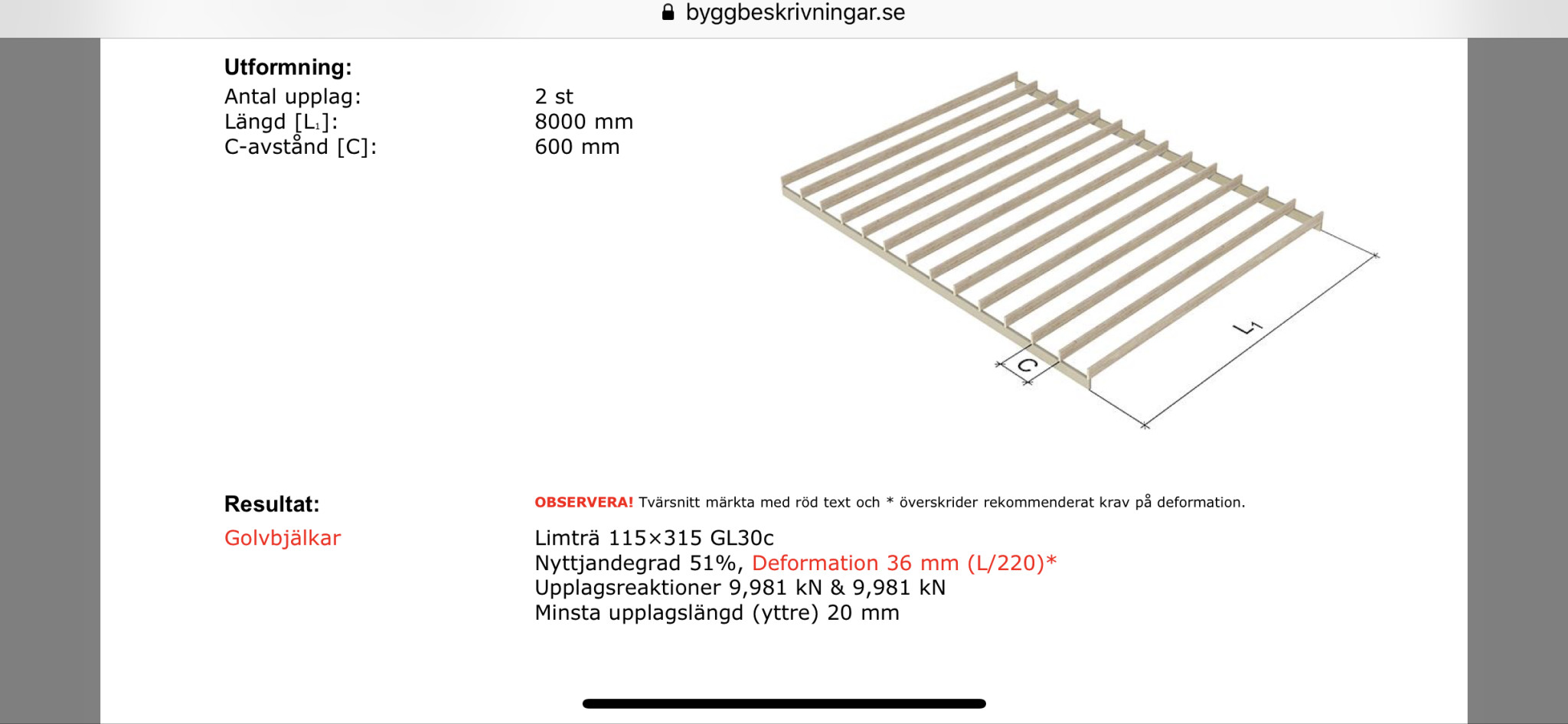
An 8 m long glulam beam without columns needs to be 215x540 mm (minimum height), with a column in the middle 90x360 mm. If you want everything in a single volume, it's better to give the loft its own load-bearing structure rather than attaching it to the hall's.
First, you build a shell 8x16 m. Within this shell, you construct a separate structure with beams and columns as the floor for the loft.
You're thinking like 3 beams and 9 posts? So it stands completely on its own? In what way would it be better, do you mean?J justusandersson said:
I'm curious about your thinking, but I don't understand the purpose.
Please explain if you don't mind
When I wrote the post, I was hoping you would respond. After reading various threads, you seem to have a solid grasp on most things
Large halls require a different way of thinking. By using, for example, three-hinged frames (google it) or similar technology, it is easy to construct large spans at relatively low costs. In that case, it is advantageous if you don't have to involve the support of a loft on part of the area. It becomes much cheaper.
J justusandersson said:Large halls require a different way of thinking. With the help of, for example, treledsramar (google it) or similar technology, it is easy to build large spans at relatively low prices. Then it's an advantage if you don't have to involve the support of a loft on part of the surface. It becomes much cheaper.
Alright, now I understand what you mean. But no, I don't knowJ justusandersson said:Large halls require a different way of thinking. With the help of, for example, treledsramar (google it) or similar technology, it is easy to build large spans at relatively low prices. Then it's an advantage if you don't have to involve the support of a loft on part of the surface. It becomes much cheaper.