
13,486 views ·
74 replies
13k views
74 replies
Switch a joist system 8x8 meters.

No, I have abandoned that idea because you are not going to have a hall, and the construction has thus become smaller.
Ideally, the supporting beams made of laminated wood should rest on "independent" pillars, which can be built into the walls. Note that the c/c distance of the supporting beams in my latest example will be 2 meters. You may then need to have your garage doors on the gable end?
Mjaa, it will still be a workshop hall as originally planned, but you could say that the garage is its "own" part. On the other side of the wall will be the workshop, which might be deeper now when the garage part is not so deep.J justusandersson said:
I agree that the beams should stand on their own pillars.
However, you previously mentioned that I should use 3 beams, but you mean that from the outer beams, the floor joists would be directly attached to the walls then? Then it aligns with three pieces at 2000 cc.
Yes, it gets a bit tricky with garage doors on the long side this way... that's not good either.
Yes, the outer walls are also used for fastening the floor joists.
That's what's difficult, to align all the functional dimensions with different frame systems. 3 meters align poorly with most measurement systems. Most start from 0.3 meters, then you double it, 0.6, 1.2, 2.4, and so on. If you're used to designing houses, you have that in the back of your mind all the time.
That's what's difficult, to align all the functional dimensions with different frame systems. 3 meters align poorly with most measurement systems. Most start from 0.3 meters, then you double it, 0.6, 1.2, 2.4, and so on. If you're used to designing houses, you have that in the back of your mind all the time.
Can't you have a wall between the two sections, for example, at 8 meters?Rooth07 said:
One thought is as in the picture "kind of". "Open to suggestions" as I'm still in the dreaming phase..
The build in the picture is 8.4 x 16.8 m. 4 m in wall height.
To the right, the idea is a double garage, internally 8x8m, about 2.2-2.4m in ceiling height, where the floor for the upper floor will take over. The glulam beam is then thought of between the doors, but it can also be placed lengthwise in the middle. If you want a center post, it ends up in the middle anyway.
Double beams as you mentioned can be a bit troublesome for the overhead doors, I think.
So one beam in the middle would be good, but the question itself was whether there is a beam that can handle the floor without a center post. It will be 64 m2 of floor area to be supported by the outer wall (right gable), glulam beam 4 meters in, and then an internal wall that will be 8 meters from the right gable.
After this internal wall, you enter the workshop section.
Inside the door to the left, I want 4m in ceiling height for a car lift. So from the left gable and maybe 3.6-4.8 m in, you could use regular trusses to get a flat inner ceiling. Then I'm considering creating some kind of loft there as well, up to the center wall towards the garage section for storage of various workshop items/car parts, etc. So basically you use scissor trusses like in the other loft.
With 4m wall height, I get around 1.3 meters at the lowest wall height in the lofts, which is quite nice, I think. But everything depends on how large that glulam beam will be and whether to place the floor ON the beam or if the floor can be hung in beam shoes to reduce the floor height by about 25 cm.
That's a lot to read, but I hope you understand how I'm thinking.
Under the loft in the workshop section, you also get plenty of space to make a toilet, changing room, and lots of other things you want.
Then you'll have a span of 8 meters per side, and you can alternate these with a glulam beam at 220 or 3 joined together 45x220 at 4 meters.
Yes, that's been the idea all along. Garage 8 meters. - wall - workshopGrizzlybjörnen123 said:

Yes, that's trueJ justusandersson said:Yes, you also use the outer walls for attaching the floor joists.
That's what makes it difficult, to fit all the functional dimensions with different framing systems. 3 meters doesn't align well with most measurement systems. Most things start from 0.3 meters, then double it, 0.6, 1.2, 2.4, etc. If you're used to designing houses, you have that in the back of your mind all the time.
Lövångers bygg, how have they done?One thought is like in the picture "typ". "Open to suggestions" since I'm still in the dream phase..
The construction in the picture is 8.4 x 16.8 m. 4 m in wall height.
To the right, the idea is for a double garage 8x8m internally about 2.2-2.4m in ceiling height where the floor joists for the upper floor will take over. The glulam beam is then intended between the gates. But it can also be placed lengthwise in the middle for that matter. If you have a middle post, it ends up in the middle anyway.
Double beams you mentioned might be a bit tricky for the sliding roof doors, I think.
So a beam in the middle would be good, but the question itself was whether there is a beam that can support the floor joists without a middle post. It will be 64 m2 of floor space to be supported by the outer wall (right gable), glulam beam 4 meters in, and then an inner wall which will then be 8 meters from the right gable.
After this inner wall, you enter the workshop section.
Inside the gate to the left, I want 4m in ceiling height for a car lift. So from the left gable and maybe 3.6-4.8 m in, one could use standard roof trusses to achieve a flat ceiling. Then I'm thinking of creating some form of loft up to the middle wall towards the garage section for storing various workshop tools/car parts, etc. So there you use sort of scissor trusses like in the other loft.
Using 4m wall height, I'd get around 1.3 meters in the lowest wall height in the lofts, which is quite nice, I think. But everything depends on the size of that glulam beam and whether to place the floor joists ON the beam or if one can hang the floor joists in something like joist hangers on the beam to reduce the floor height by about 25 cm.
Wow, that's a lot to read, but I hope you understand how I think.
Under the loft in the workshop section, there will be plenty of space to create a toilet, dressing room, and lots of other things you want
Check out Mellby garage with
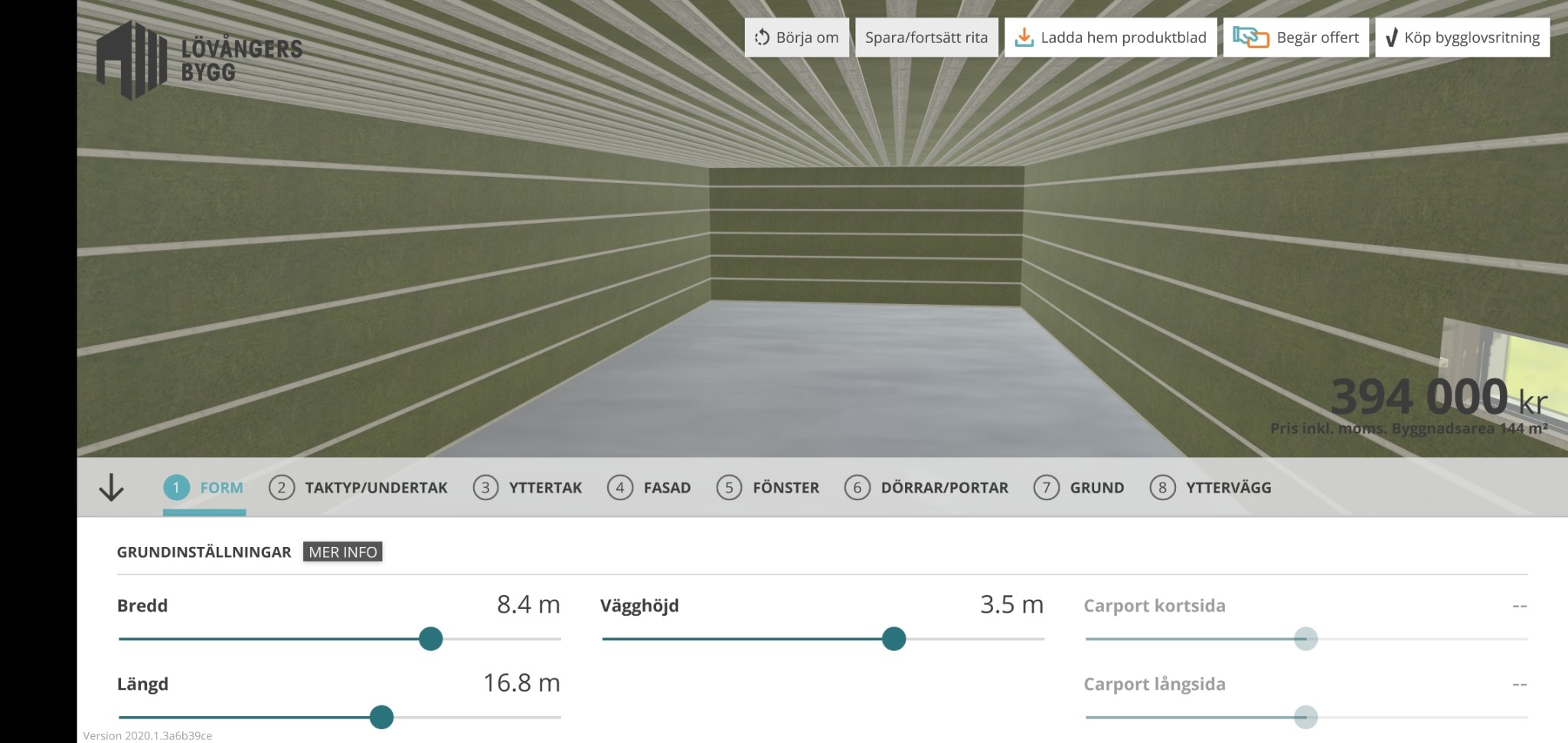

As far as I can see, the finished halls from Lövångers Bygg have trusses made of lattice. Frame trusses don't work on those widths without support underneath in the middle. In that case, you have to use scissor trusses. If you buy an 8.4x16.8 m hall from Lövångers with scissor trusses and place an intermediate floor as I previously sketched at one end, you will come quite close to your requirements at a very good price.
Yes, when you go to a 38 degree roof pitch, it becomes a framework in their sketch program according to the attached imageJ justusandersson said:Lövångers Bygg's finished halls, as far as I can see, have trusses made of truss frameworks. Frame trusses don't work for such widths without support underneath in the middle. In that case, you have to use scissors trusses. If you buy an 8.4x16.8 m hall from Lövångers with scissors trusses and place an intermediary floor beam as I previously sketched on one end, you will come quite close to your requirements at a very good price.

Yes, I saw that when I tested it, but I don't believe it in reality. Without a middle support, the subframe must be made of glulam, e.g., 42x540 mm for it to have an acceptable deflection.
Yeah, I agree that it sounds a bit too good to be trueJ justusandersson said:
But as you mentioned there with trussed rafters and the floor joists, that's kind of what I've been thinking all along. But sure, it does get a bit tricky with doors on the long side as mentioned
The principle I demonstrated in post #31 might not be so bad after all. Three-hinged frames "the wrong" way with larger gables than the long sides. You can have as many doors as you want, and you get a very cheap frame system, which is as stable as it gets. You can get light from two directions to the loft. The most common form of three-hinged frames has sharp corners.