I have read many threads on similar topics but still don't feel that any match my scenario well, hence I'm creating a new thread.
I am building an attached garage to our new house in the Stockholm region. The slabs are connected and cast at the same time.
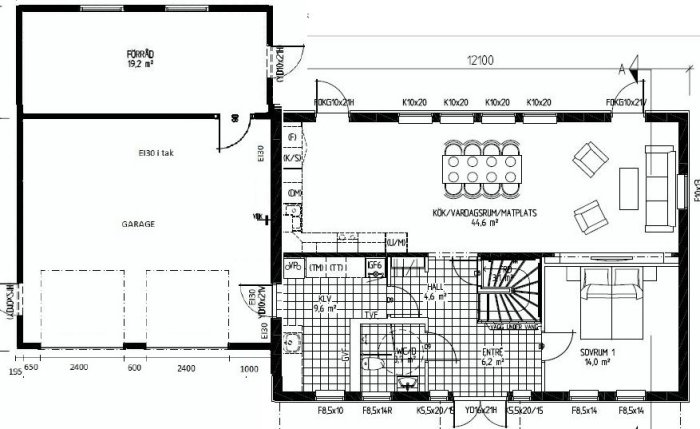
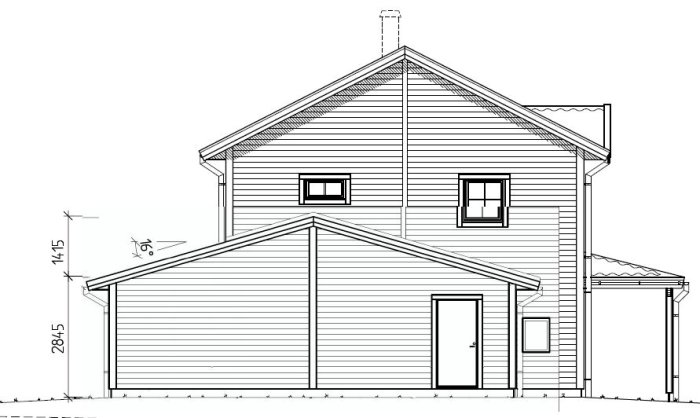
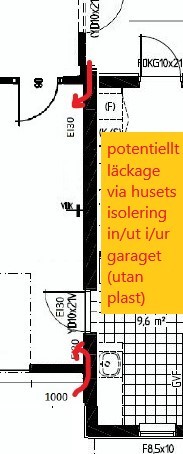
See floor plan and facade drawing:
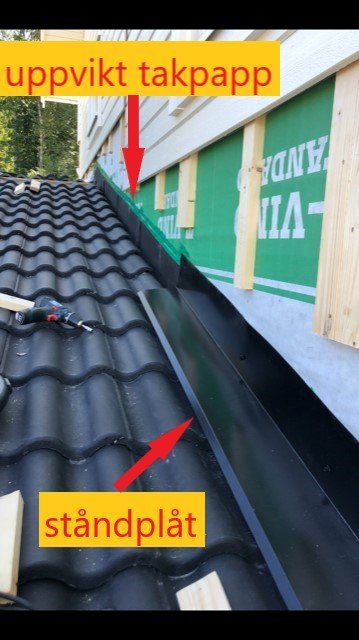
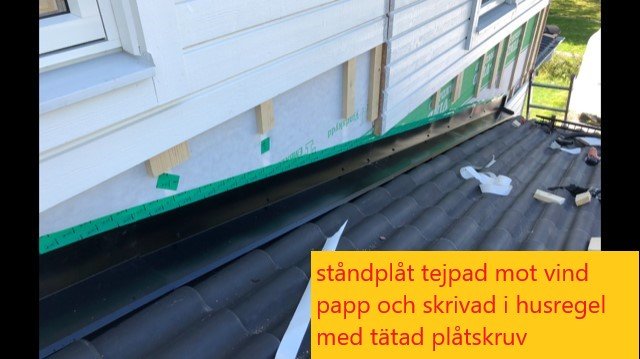
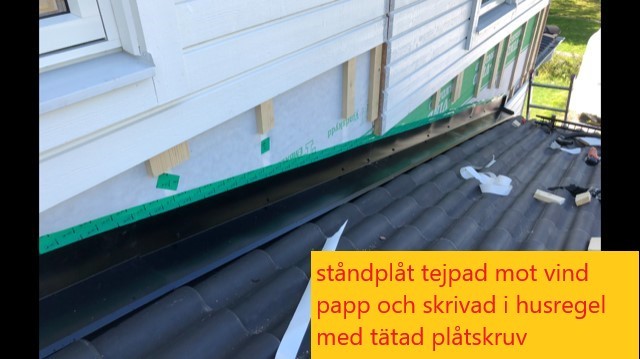
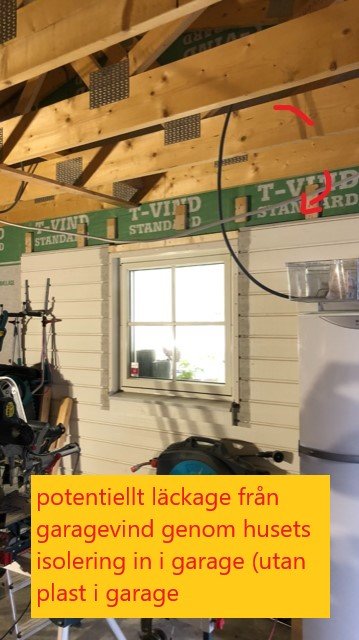
I have removed the facade where the garage meets the house body and have a rise of roofing felt along the wind barrier on the house. On that rise, there are standing sheets that direct the water to flow onto the roof tiles of the garage. Both felt and standing sheets have been taped. Over the standing sheets, I have put a new facade, with about 10cm between the lower edge of the panel and the standing sheet's "projection". See pictures:
I am missing a picture from when the panel is back, but you understand the underlying work.
The house has 220mm insulation in the walls and, of course, has an age-resistant plastic towards the house, known as a vapor barrier.
The garage slab has coils connected to the house's exhaust air heat pump, so my wish is to have about 15-20 degrees in wintertime so that you can have cars or floorball goals there. If this proves too heavy for our Nibe F730, it's sufficient just to avoid sub-zero temperatures in winter.
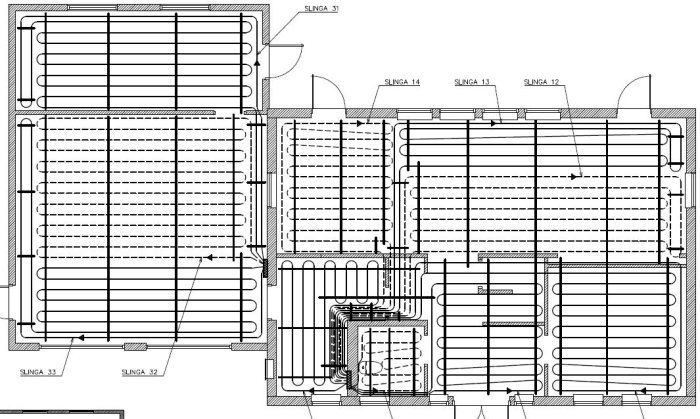
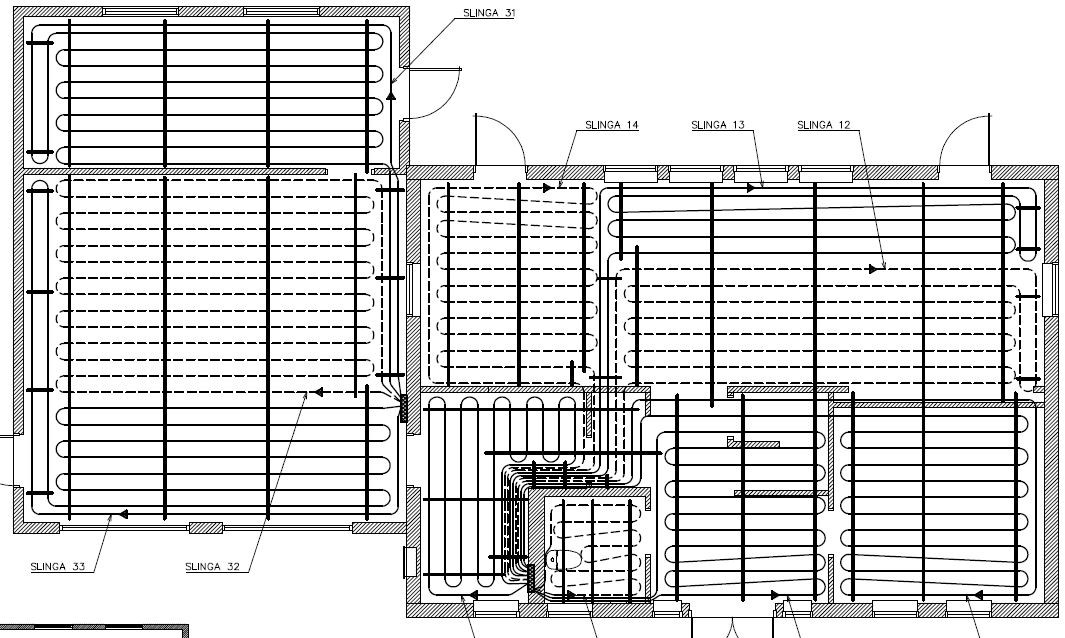
Both floors of the house have underfloor heating (2 x 90 sqm), and there is a separate distributor in the garage:
The garage walls have 145+45mm insulation (installation layer), and the ceiling will have 400mm loose fill.
I have installed age-resistant plastic in the ceiling and all walls except for the wall that is the "house's exterior wall."
All walls will have plywood + gypsum cladding. The ceiling will have gypsum cladding.
Ventilation:
The two windows at the back of the garage have free air gap.
Otherwise, I have three main tracks;
1) Assume that the garage doors (Isomatic from Hornbach (I think it's a cheaper Hörmann variant)) leak somewhat and thus consider that "inflow" is resolved with this leakage and the windows at the back.
Install an exhaust vent in the garage wall and through self-draft (convection) get some air circulation.
2) Same idea with inflow as option 1 but also install a bathroom fan in the garage with humidity sensor control to boost the exhaust, especially when a cold wet car is present.
3) Bathroom fan with humidity sensor for active exhaust according to option 2 and install an open vent low at the front of the garage for extra inflow.
Now to my questions;
Question 1:Should I also install plastic against the house wall? Or do you introduce risks when you have plastic on that wall from both sides? (inside from the house factory, and outside = in the garage). I would create two cells... the house = one cell which is plastic-wrapped. The garage as another plastic-wrapped cell, and the insulation of the house wall in between.
My own thoughts;
For:
There is less risk of moisture in the garage migrating into the house wall. Preventing warm moist air from condensing in the insulation, I understand this is the primary function of this plastic.
One could ask if this plastic serves any function when the air on the "other side" is the indoor air and is warm? Is the risk of condensation in this wall perhaps non-existent?
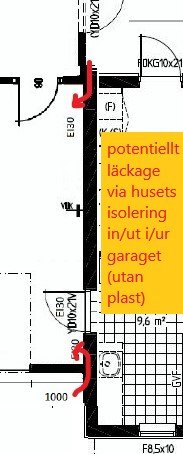
Or is there a risk that air leaks in from outside through the house's insulation and into the garage? See two pictures:
Against:
If I install plastic against the house wall, then the insulation of that wall becomes plastic-wrapped from both sides. If I get a leak in the roof joint between house and garage, it risks going unnoticed longer than if there is no plastic in the garage.
Trying to make the house + garage one cell by removing the insulation in the house wall and trying to get the garage's plastic taped together with the house's plastic seems unreasonably complicated... every wall stud in the house wall would become a problem to navigate around to reach the house's plastic.
Question 2:
What do you think about the ventilation?
One option is to go with option 1 above and prepare with power to later possibly connect a bathroom fan and possibly air intake.
I can also consider a unit and exhaust in the ceiling via a duct fan. There is plenty of space in the attic, and I have not yet placed the loose fill there. I would then mount the outlet on the gable of the house in the attic section.
Thank you for your feedback.
What do you think about the risk of air/moisture moving between the garage and the outdoor environment through the house's insulation? And thereby getting trapped in the insulation?
Or is this risk negligible in this context? Is any small moisture that gets trapped ventilated out since it is open?
I have no experience of the ability of air/moisture to move through wind barrier/insulation.
You mention having 15-20 degrees in the garage, there must be greater differences for you to have problems.
What do you mean by "the difference should be greater"?
Are you saying I could have problems if I have +23 in the garage when it's -10 outside?
Or what difference are we talking about here?
I would certainly prefer 23 degrees if our F730 can handle it.
How do you mean that "the difference should be greater"?
Do you mean that I could have problems if I have +23 in the garage when it's -10 outside?
Or what difference are we talking about here?
I do like having 23 degrees if our F730 can handle it.
How did your solution turn out and has everything worked well?
I am facing a similar issue 🙂
Click here to reply
Vi vill skicka notiser för ämnen du bevakar och händelser som berör dig.