
6,731 views ·
7 replies
7k views
7 replies
Urgent advice needed regarding tiles in hallway by stairs
Hello!
Tomorrow a tiler will come to lay tiles in my hallway.
The floor is 22mm chipboard and on top of that will be 13mm floor gypsum and then tiles.
The person helping me says that it's enough to just screw the floor gypsum, but I think we should glue it as well. I also believe that the staircase "legs" should be sawed off and tiles laid underneath, but he says to lay around them instead.
What do you think?
Pictures coming soon...
Tomorrow a tiler will come to lay tiles in my hallway.
The floor is 22mm chipboard and on top of that will be 13mm floor gypsum and then tiles.
The person helping me says that it's enough to just screw the floor gypsum, but I think we should glue it as well. I also believe that the staircase "legs" should be sawed off and tiles laid underneath, but he says to lay around them instead.
What do you think?
Pictures coming soon...
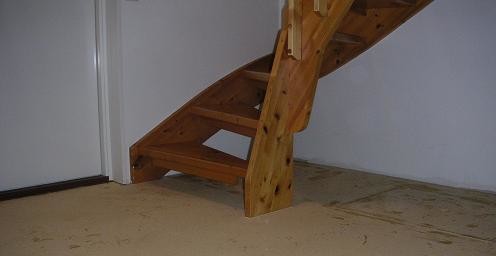
Whether it works to screw or you must glue is determined by the substrate you don't mention. What is under the particleboard? If there are joists at c/c 300, it works to screw (then the gypsum is just there to be an inert material to lay tiles on), for joists with larger c/c, it must be glued since the floor particleboard should then have a bending stiffness-reinforcing function. It should be glued with a special type of adhesive, not PL400 or similar, but a dimensionally stable, mineral-bound adhesive that is combed out with a six-millimeter comb. Something like Ardex Ardurit S48 or similar.
And, of course, you lay it under the staircase legs as well, partly if you ever change the staircase, and partly because it will simply look sloppy if you don't.
And, of course, you lay it under the staircase legs as well, partly if you ever change the staircase, and partly because it will simply look sloppy if you don't.
How do you saw off the stairs most smoothly then? Place a piece of drywall and a tile on top of each other and place the saw on it? It's important that there are no gaps when it's done, right?
I'm not so familiar with what you write about studs (c/c 300) but under the chipboard there are studs with 60cm spacing... The house has a crawl space.
I'm not so familiar with what you write about studs (c/c 300) but under the chipboard there are studs with 60cm spacing... The house has a crawl space.
c/c 600 means that the studs are spaced 60 centimeters apart. Then the floorboard should be glued. There is a high risk of problems with tiles coming loose after a number of years otherwise.
Yes, as you described, it's reasonable to do, although it will be gypsum plus three millimeters of adhesive plus a tile plus about 5 millimeters of mortar. Perhaps try to lift the staircase a few millimeters with a jack or similar, so that the tile can be placed underneath, and the staircase will rest on the tile when you lower it again. Ideally, you would want to wait to lower the staircase until the mortar has set for about a day.
If the staircase becomes too cumbersome, you can lay around as he planned if you're not picky. But make sure the gypsum is glued. And as mentioned, it should be the expensive adhesive spread across the entire surface, not glue from a tube.
Yes, as you described, it's reasonable to do, although it will be gypsum plus three millimeters of adhesive plus a tile plus about 5 millimeters of mortar. Perhaps try to lift the staircase a few millimeters with a jack or similar, so that the tile can be placed underneath, and the staircase will rest on the tile when you lower it again. Ideally, you would want to wait to lower the staircase until the mortar has set for about a day.
If the staircase becomes too cumbersome, you can lay around as he planned if you're not picky. But make sure the gypsum is glued. And as mentioned, it should be the expensive adhesive spread across the entire surface, not glue from a tube.
Thanks for the quick responses!
It's probably difficult to lift the inner leg of the staircase, it must be detached from the wall then. The outer one is easier. We'll see tomorrow how we'll do it. I'd prefer to have tiles under the legs. Unsure how it will look if you lay around... I have access to S48 glue so with the help of your arguments, I'll explain to the tiler that we should use it.
Welcome any more tips regarding staircase cutting if anyone knows.
It's probably difficult to lift the inner leg of the staircase, it must be detached from the wall then. The outer one is easier. We'll see tomorrow how we'll do it. I'd prefer to have tiles under the legs. Unsure how it will look if you lay around... I have access to S48 glue so with the help of your arguments, I'll explain to the tiler that we should use it.
Welcome any more tips regarding staircase cutting if anyone knows.
Yes, you can explain to him that it's about handling shear forces, that is, the same type of forces as when you rub your hands together. If you lay a gypsum floorboard without fastening it at all to the chipboard, the floor becomes stiffer. When the floor is loaded, there will be a slight give, and then the boards will move slightly against each other. It's that movement you need to prevent, which screws cannot handle. After a couple of years, the screws have been stressed and loosened in their holes, so they don't handle the shear forces at all, and you only have the equivalent stiffness as if the gypsum was lying loose. If you glue instead, all the shear forces are absorbed, and the chipboard and gypsum together form a completely homogeneous slab with much higher stiffness than if the gypsum was just lying loose on top.
Click here to reply