
1,267 views ·
5 replies
1k views
5 replies
Underfloor heating basement options
Hello,
We have a prefab house from the early 60s where we use a room of about 20 sqm in the basement as an office/extra bedroom. The floor gets quite cold, especially in winter, and since the room is used quite frequently, some comfort heating would be nice.
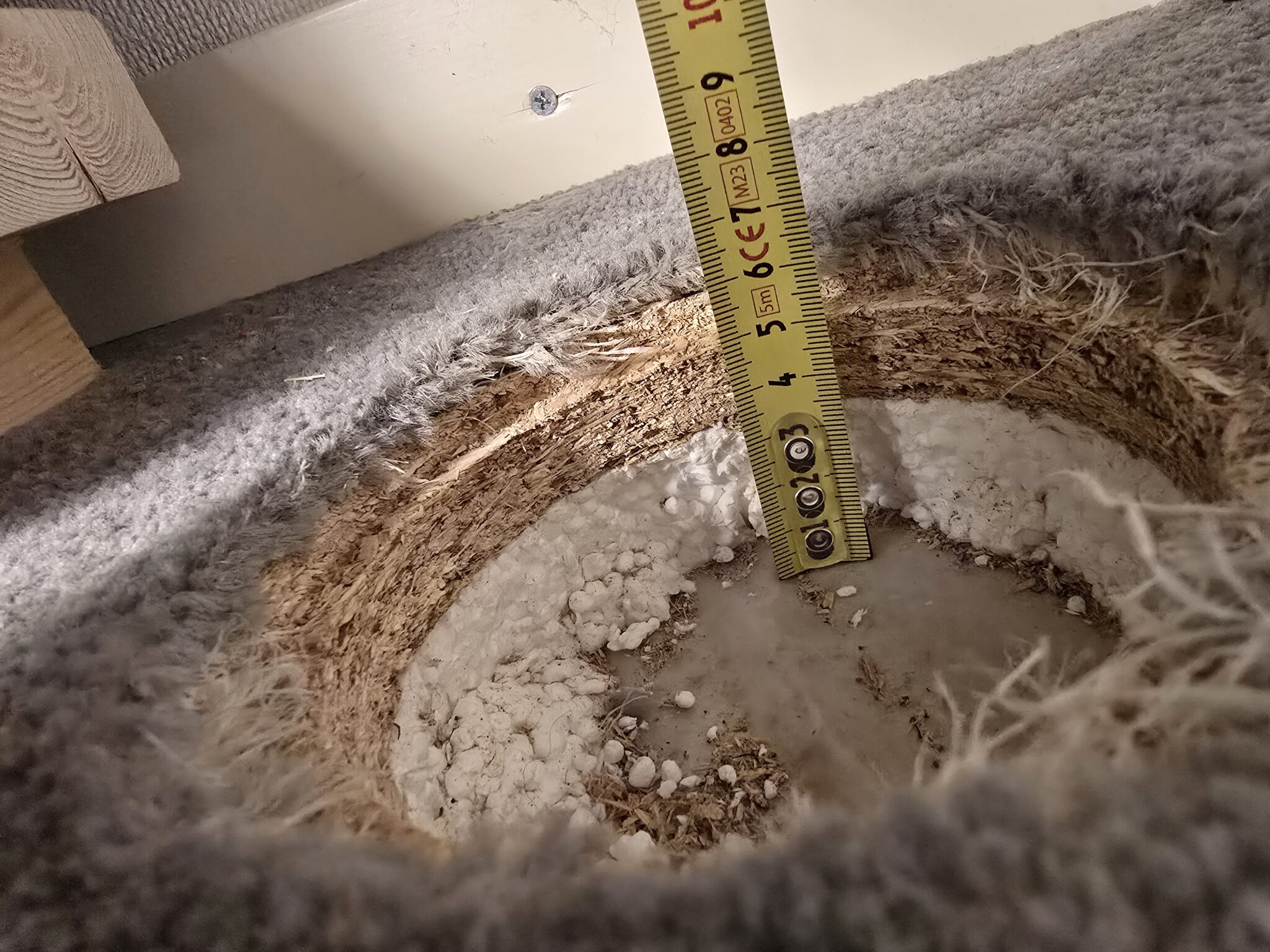
The floor is currently covered with wall-to-wall carpet, which we want to replace with something simple like laminate. Beneath the carpet is an approximately 30 mm thick chipboard on top of about 30 mm of styrofoam, and under the styrofoam, there is a plastic film on top of concrete. It is unclear how thick the concrete slab is. In one corner, a moisture measurement was done before we bought the house, so there is an "inspection hole," see the picture.
Is the existing insulation sufficient to lay underfloor heating without increasing the risk of moisture damage more than desirable?
We are considering electric coils for convenience, but is it unwise not to opt for water-based if it's an option?
Appreciate some input, total novice.
/Gustav
We have a prefab house from the early 60s where we use a room of about 20 sqm in the basement as an office/extra bedroom. The floor gets quite cold, especially in winter, and since the room is used quite frequently, some comfort heating would be nice.
The floor is currently covered with wall-to-wall carpet, which we want to replace with something simple like laminate. Beneath the carpet is an approximately 30 mm thick chipboard on top of about 30 mm of styrofoam, and under the styrofoam, there is a plastic film on top of concrete. It is unclear how thick the concrete slab is. In one corner, a moisture measurement was done before we bought the house, so there is an "inspection hole," see the picture.
Is the existing insulation sufficient to lay underfloor heating without increasing the risk of moisture damage more than desirable?
We are considering electric coils for convenience, but is it unwise not to opt for water-based if it's an option?
Appreciate some input, total novice.
/Gustav

Underfloor heating should have at least 25 cm of insulation underneath to prevent significant heat loss downwards. In newly built houses, 30 cm of styrofoam is cast under the concrete as insulation. What you have is a risk construction.
So forget the idea of underfloor heating there then?J Josth said:
I understand. There's a radiator in the room, but I don't think it's quite enough, but it's probably no problem to add an additional one, I guess.J Josth said:
Chiseling and such doesn't seem relevant.
Possibly, one can insulate extra under laminate/parquet and get a slightly more comfortable floor temperature?
Replacing with a larger/thicker radiator that emits higher heat output should not normally be a problem.
Adding more insulation on top of the concrete is a real gamble. Before everyone wanted a basement den and started laying plastic sheeting and insulation on top, they used to build so-called hobby rooms in basements with wooden studs slightly embedded in coarse concrete and a substantial air gap to the chipboard on top. Then, flooring material that breathes, i.e., is diffusion-open, on top of that. Absolutely no plastic or other airtight material. It seems to hold up over the years and the moisture coming up from beneath the house can be vented out with ventilation without causing damage.
Adding more insulation on top of the concrete is a real gamble. Before everyone wanted a basement den and started laying plastic sheeting and insulation on top, they used to build so-called hobby rooms in basements with wooden studs slightly embedded in coarse concrete and a substantial air gap to the chipboard on top. Then, flooring material that breathes, i.e., is diffusion-open, on top of that. Absolutely no plastic or other airtight material. It seems to hold up over the years and the moisture coming up from beneath the house can be vented out with ventilation without causing damage.
Click here to reply