
Hello,
I'm having the roof replaced, and my task is to paint the fascia boards and bargeboards, most of which is already done. However, nothing has been cut yet, so I have only oiled the end grain. What I can reach, I will prime and paint, but how do you handle surfaces you can't reach, like where fascia boards meet each other or where bargeboards meet?
I'm having the roof replaced, and my task is to paint the fascia boards and bargeboards, most of which is already done. However, nothing has been cut yet, so I have only oiled the end grain. What I can reach, I will prime and paint, but how do you handle surfaces you can't reach, like where fascia boards meet each other or where bargeboards meet?
Yes, I know you don't like plastic paint. As we probably discussed before, I'm using the Beckers system, which is plastic paint, but the backside is not painted so it can breathe. The boards came primed from the start, so it's probably not Beckers' own primer.
The end wood is oiled with Beckers Grundolja Plus, but not painted. The idea is that some of it will be installed today by the roofers. The question is whether to smear primer on the ends as well, but it needs 24 hours to cure.
The end wood is oiled with Beckers Grundolja Plus, but not painted. The idea is that some of it will be installed today by the roofers. The question is whether to smear primer on the ends as well, but it needs 24 hours to cure.
They're called windboards.I Ironside said:Well, I know you don't like plastic paint. I use, as we probably talked about before, Beckers system, which is plastic paint, but the back is not painted just so it can breathe. The boards came primed from the start, so it's probably not Beckers' own primer.
The end grain is oiled with Beckers Grundolja Plus, but not painted. The idea is that some of it will be installed today by the roofers. The question is whether to smear primer on the ends too, but it needs 24 hours to cure.
This is what Beckers writes about wood façades, so it should be applicable to windboards as well.
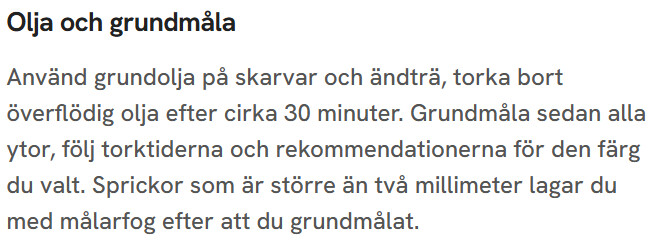
Why not use Beckers' trim paint instead on the windboards? That way, you can paint both sides with a clear conscience.
Okay, it will have to be primer on the end grain then. It dries on the surface quite quickly even though it needs 24 hours to fully cure.
It was the paint store that thought facade paint was the way to go, but they didn't mention leaving the back unpainted; I had to find that out on my own. So you start to wonder how good their advice really is.
It was the paint store that thought facade paint was the way to go, but they didn't mention leaving the back unpainted; I had to find that out on my own. So you start to wonder how good their advice really is.
The most important thing for the store is to sell a lot of paint (often), that's probably why they sell plastic paint instead of Swedish linseed oil paint for fascia boards, ridge tiles, and similar outdoor woodwork.I Ironside said:
Now I'm no expert, but as I understand it, Fasad Plus from Beckers is a modern acrylic paint that forms a protective film on the surface. It is partially diffusion-open, but not as open as older paint types like linoljefärg. The paint fades slowly, the surface chalks less, and it is said to withstand UV light and weather well without needing to be repainted as often.
High-quality acrylic paint is very weather-resistant, easy to maintain, and rarely peels if the preliminary work is done correctly. Typically, only the front of the board is painted to allow the back to release any moisture, which is standard on new facades today.
Linoljefärg penetrates the wood and provides a more vibrant, almost shimmering gloss. However, it requires regular maintenance in the form of thin repaintings before the paint dries out or starts to chalk. If maintained carefully, it can last for many decades, but if neglected, it fades and peels faster than acrylic.
In short, linoljefärg requires more care and time but can last for a very long time, while acrylic paint retains its color longer and requires less maintenance.
High-quality acrylic paint is very weather-resistant, easy to maintain, and rarely peels if the preliminary work is done correctly. Typically, only the front of the board is painted to allow the back to release any moisture, which is standard on new facades today.
Linoljefärg penetrates the wood and provides a more vibrant, almost shimmering gloss. However, it requires regular maintenance in the form of thin repaintings before the paint dries out or starts to chalk. If maintained carefully, it can last for many decades, but if neglected, it fades and peels faster than acrylic.
In short, linoljefärg requires more care and time but can last for a very long time, while acrylic paint retains its color longer and requires less maintenance.
Click here to reply