Have been following this interesting site for some time and thought about writing my first post here. We are living in the archipelago in Finland and are thoroughly renovating a relatively old house (built in 1948). We have always liked the Swedish interior style and therefore I also wanted to ask for tips and ideas here.
We plan to install beadboard paneling in the ceiling throughout the house (the total area of the ceilings is just over 110 sqm + sloped ceilings). My first question concerns the width of the paneling. What width of paneling have you used in the ceilings? 95 mm or 120 mm? Our first thought was to use 95 mm, but now we are starting to rethink and wonder if the narrower paneling would be too "busy." In the rooms on the lower floor, the ceiling is high (280 cm), but on the upper floor, the ceiling height is only 215 cm. Additionally, the rooms on the upper floor are quite wide.
Our second question concerns painting the paneling. Have you bought pre-painted paneling or painted it yourself? My personal opinion is that the paneling you paint yourself might even look better than factory-painted, which I think resembles MDF quite a bit. But what do you think? Is it worth the effort to paint it yourself?
My third and last question concerns the low-ceiling but wide rooms on the upper floor. How would you handle the sloped ceilings in these rooms? Unfortunately, I don’t have the ability to upload pictures right now and don’t know how well I can explain, but on the upper floor, there are two large rooms and a hall/staircase. In each room, there is a sloped ceiling between the ceiling and the wall. The height of the sloped ceilings is about 60 cm in one room, and in the other room, there is a straight wall without a sloped ceiling, and on the other side, the sloped ceiling almost reaches the floor (the wall is about 1 m high). We also plan to install paneling on these sloped ceilings. Naturally, the paneling would go in the same direction as the ceiling paneling, but is it a completely foolish idea to install the paneling vertically on the sloped ceilings (i.e., so it goes in the opposite direction of the ceiling paneling)? Our thought with this was that as the rooms are wide but have low ceilings, it might potentially look better if the paneling was vertical on the sloped ceilings (at least on the higher sloped ceiling).
As I said, I don’t know how well I managed to explain our situation, but we are grateful for any answers and tips we can get. I also want to wish everyone a pleasant continuation of the spring.
If you are interested in building preservation and following how the house might have originally looked, beadboard is actually incorrect because it was out of style in the 1940s. If you want to do what is most period-appropriate, it's the narrow one that applies because the wider one belongs to older houses.
Beadboard was used in simpler rooms like kitchens, halls, and bathrooms, but not in formal rooms where smooth ceilings were more common.
I recommend that you paint it yourself because, as you mentioned, it otherwise looks very factory-made. Paint the paneling while it's down and then put it up. Feel free to use linseed oil paint, which is the type of paint used earlier; it's also environmentally friendly and free from solvents. Don't forget to shellac all the knots.
Regarding the sloped ceiling, I think you should choose wallpaper (or whatever you plan to have on the walls) there. The sloped walls are not part of the ceiling but the walls and should be treated as such. Otherwise, it can easily become too much ceiling area. 😊
Thank you for your response, Sophie. Our idea is not to follow how the house might have originally looked. Unfortunately, too many changes have been made for that to even be possible. According to the original drawings, for example, there were six wood stoves in the house right from the beginning and when we bought it, not a single one was left (we have now installed one). I personally love old wood stoves and think old is more beautiful than new, but for example, in our house, Haltex boards were originally used in the ceiling (I don't know what these are called in Sweden or if they are used at all) and although I know many appreciate them, I honestly think they are ugly. In similar types of houses, I also know that very narrow paneling has been used in the ceiling (the Finnish name is sisarpaneeli) and I think it is nice, but maybe a little too "busy" on large areas.
Regarding sloped ceilings, I actually think paneling looks nicer than wallpaper. Of course, it's a matter of taste, but at least according to the pictures I find online, paneling is just as common as wallpaper.
Thanks for the tip about painting ourselves. Right now, we're leaning towards doing that.
I must take the opportunity to ask what type of panel you would put in a house from the 1940s. Smooth or beaded? Wide or narrow? According to what I've read on Finnish forums, both are used. The worst part about renovating is that there are so many options, and when you finally think you've found what you want, you change your mind the next minute .
I must start by saying that nothing is impossible... It is possible to restore even completely renovated houses! 😉😊
😂😂
Of course, it's a matter of taste with the paneling in the slanted ceilings and entirely up to you how you want to do it. It's my opinion that it becomes a lot of ceiling area.
I would definitely choose narrow beadboard or completely smooth ceilings if I'm only going after the ideals of the 1940s, but it's difficult when you don't know what the house looks like and what style it has. It can vary a lot from house to house built at the same time. 😊
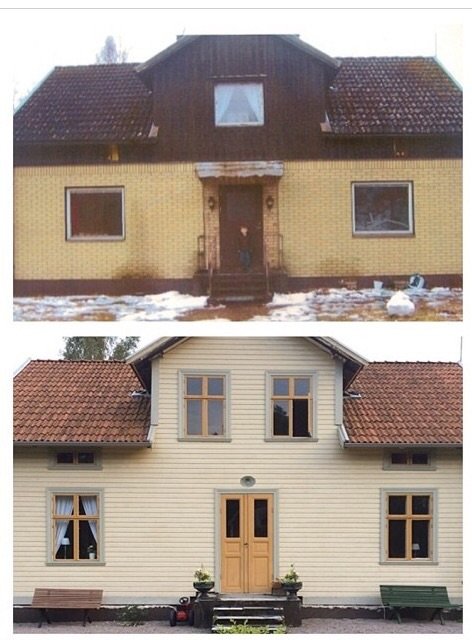
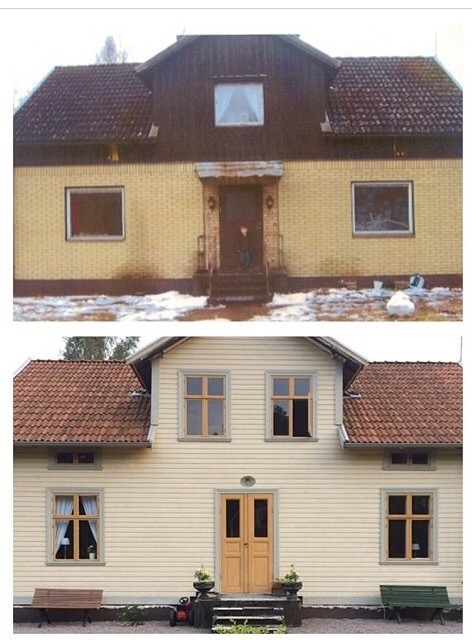
True. Nothing is impossible, and when I look at the pictures, I can't help but think how much nicer the restored version is .
In our case, the house is more or less original from the outside. However, we and the previous owners have changed quite a bit inside. If I started the renovation today, I would have chosen completely different materials, and instead of modern solutions, I would have rebuilt according to how it was done previously. Today, for example, we have waterborne underfloor heating (with geothermal and solar panels), mechanical air conditioning, etc., and even though these are hopefully practical and functional solutions, they do not align with how it was done and looked before.
I understand that it's difficult to get an overall impression without pictures, and unfortunately, I can't upload any images from this computer. At least my impression is that it would look a bit strange if we didn't put panels on the slanted roofs (as if the roof ended halfway).
For me, it's quite difficult to form an idea of how the roof would look with 95 mm or 120 mm panels. You seem to be quite knowledgeable in this, and I wonder if there is any rule of thumb for choosing narrower versus wider panels? For instance, in our case, where the rooms on the upper floor are wide but have low ceilings.
My advice is also 95 width. That's what's "normal," meaning unless you have a particular reason otherwise. Especially in a newer house, a narrower panel seems to fit in better. Even floorboards and facade panels had become narrower at that time than before.
Slanted ceilings can be at different angles, have different heights on the wall they connect to, and make up different portions of the room's total area. Depending on how the room is perceived, it might feel more like a ceiling or a wall, and perhaps it also matters how the space will be used and furnished. My spontaneous feeling is that treating it as a ceiling has been the usual approach (hence the name "slanted-ceiling"), and slanted walls are more common in modern houses (perhaps from the 60s onward?). Then there's always a degree of personal taste in the assessment... If you feel confident in your perception that it is a ceiling, you should definitely treat it as part of the ceiling!
And then the panel should be aligned the same as the rest of the ceiling to give the impression of unity. Changing direction would rather be a "concern" of the type you want to avoid. I also think there's nothing to worry about in any case. Straight, beautiful lines with a moderately soft shape of the bead. Keep in mind that it becomes uniform with the white paint when painting.
Normally, the panel is laid in the length direction of the room so the lines are as long as possible, but it's also good if it goes from door to window because exceptions might be made sometimes depending on how the light works. But if it's gable windows and slanted ceilings, it seems obvious that it should be laid lengthwise with the slanted ceiling. I have never seen other executions in traditional style, at least.
If you choose linseed oil paint, remember that it should be slightly tinted to give a pleasant shade. 1-2% green umber is common and gives a warm impression but still looks just "white." At least the final coat should be done with the panel up to hide nail heads.
If you want suggestions for an alternative panel, could v-joint paneling be an option? It depends on your choice of cornice, window/door casings as well. The combination might look a bit odd if these are smooth (1940s or "modern") with beadboard, as it has usually been used together with milled profiles. In this case, if the house is relatively changed in the interior, what provides the best overall impression might be more important than how it might have originally been. Unless you intend to change more and then strive for a certain style.
Hope this can help you somewhat in your continued consideration.
Very grateful for your response. We have now ordered the paneling and our choice was 95 mm tongue and groove spruce that we plan to paint ourselves. We also plan to install the paneling exactly as you described and not change direction at the sloped ceilings (I choose to call them sloped ceilings as they resemble ceilings more than walls in our house).
We also ordered paint for the paneling (Tikkurila's panel ceiling paint - not sure if it's available in Sweden) and according to the salesperson (according to him, he had consulted their "paint experts"), we do not need to use knot sealer since the material is spruce and the quality is good (i.e., few or no knots). Can this be correct?
I also apologize if some of the terms I use are misleading, but it's not always easy to translate words from Finnish to Swedish that one barely knows or has never used before.
I wouldn't dare take the chance of not shellacking. If there are only a few knots, it also goes very quickly. It's not fun to find out after a year that he was wrong, we should have done it.
But I don't know anything about the paint you mentioned, so I can’t comment on that.
Click here to reply
Vi vill skicka notiser för ämnen du bevakar och händelser som berör dig.

 . I also want to wish everyone a pleasant continuation of the spring.