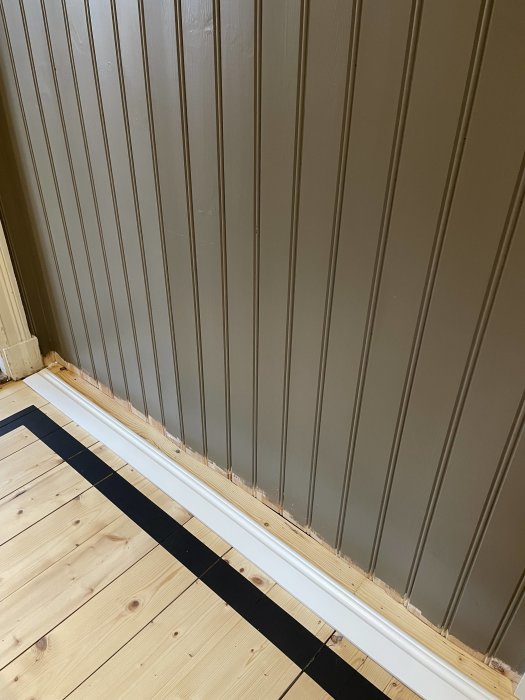
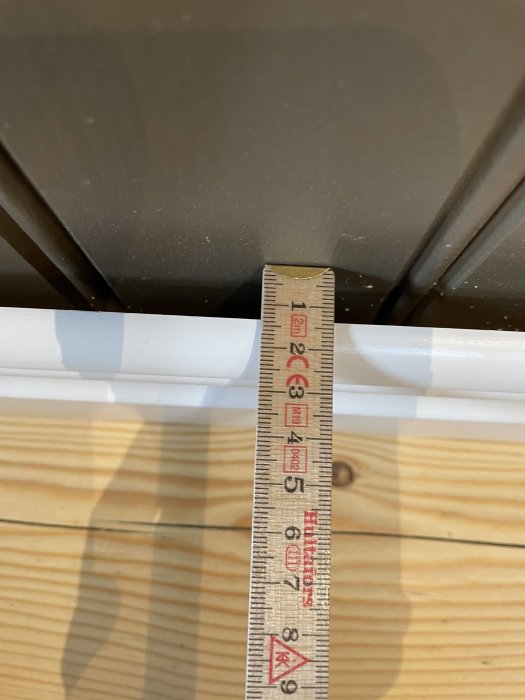
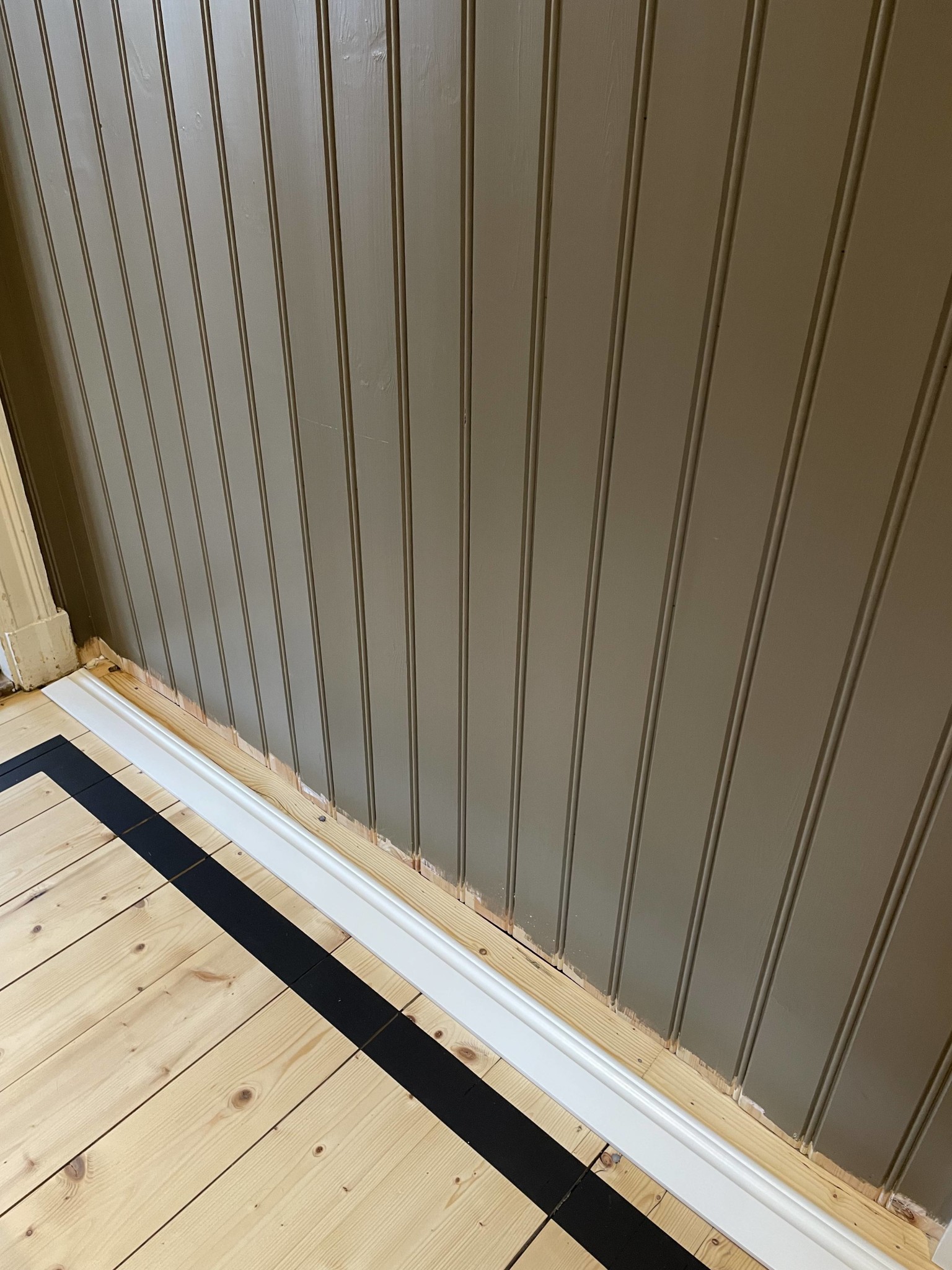
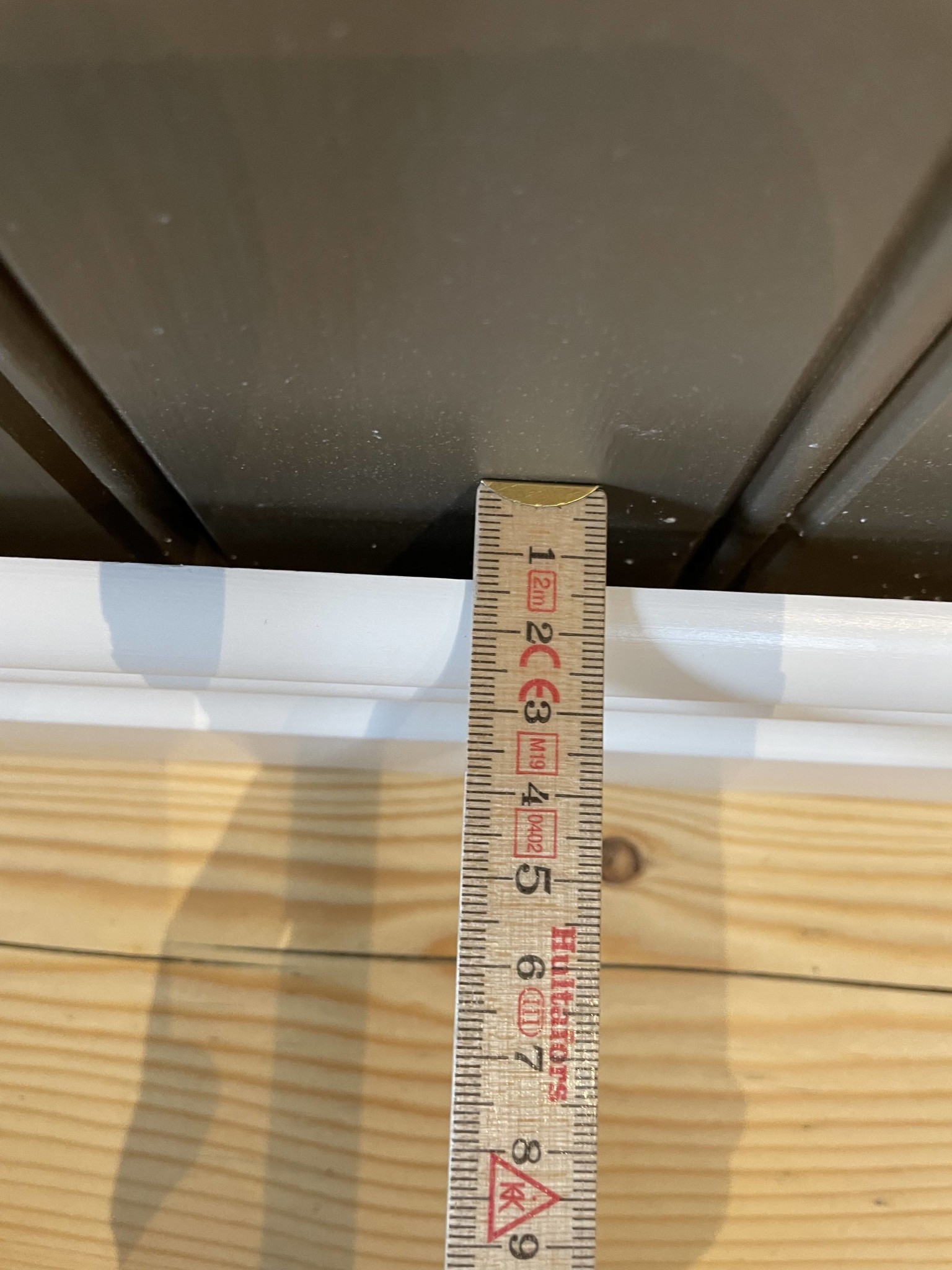
When I installed the panel, I didn't think ahead and tried to make them straighter at the bottom by the baseboard. The wall is a bit wavy since it's an older house, but here it was extreme.
Does anyone have any tips on what I can do?
They are nailed in the tongue-and-groove so they are not fastened too much. I'm considering drilling holes where the baseboard will cover and spraying foam to make it expand outward. But I'm thinking there might be a risk that it expands too much and causes a bump instead ^^
I don't have a good tip in hindsight.
Is it easy to remove without damaging the panel or paint?
If the wall is uneven, my tip is to first install horizontal battens/spar paneling. Set them at the height of your nail rows. That should make it completely straight even if the wall is a bit uneven.
I had taken down the panel and straightened the wall behind it. That is too wavy, and 1.5cm is too much to fix with tricks, I feel spontaneously. A couple of mm is no problem, but 1.5 cm just doesn't work. It won't look good.
If you do it the way you're thinking, there's a significant risk that it will become very noticeable.
But that's just me, I tend to notice large gaps or bad angles on moldings in corners of hotel rooms, at work, and so on. Others might not see such things?
I have installed paneling and really don't want to take it down as I have pressure from all sides to get it done. The last thing in that room now is painting some trim around a door and then putting up all the baseboards.
So I've left perfection behind because otherwise, I'll reach a breaking point with this. I really just want to wrap up this part so I can take a break from all the renovations and escape the stress and pressure from various directions.
The wall behind is solid, and if I hadn't been rushing everything, I might have thought a step further and not forgotten about the lower part of the panel to make it straight.
But I understand that the best thing would have been to remove and redo it, but too much time has already been spent on this project, and I am completely exhausted from renovations since 2019.
This might be more information than needed, but it feels good to write it down.
If you place a distance of maybe 10 - 11 mm against the panel at the farthest point, the baseboard will be fairly straight in relation to the floor. Then pull the baseboard in at the top with screws so it follows the panel?
If you place a spacer of maybe 10 - 11 mm against the panel at the farthest, then the skirting board will be relatively straight in relation to the floor. Then pull the skirting board in at the top with screws so that it follows the panel?
The skirting board, I would say, is straight at this stage if you look at it against the floor. But there are 2 sections on the wall about 20 cm each that go more inward, creating a gap of 0.5-1.2 cm.
So where the wall goes in, I would need to manage to push it out. Otherwise, I'm considering cutting away a piece of the lower panel and then trying to push up masonite or narrower pieces from underneath to try to feel the wall.
The best option, of course, is to redo it and first align the wall behind before installing the panel.
Another option is to "align the panel," i.e., nail some wooden blocks on the panel's worst indentations at the bottom, which are then used to support and attach the baseboard. Fill the gaps with fine lime mortar, which is white. Paint over if needed. Lime mortar is easy to handle and remove. Clay can also be used, but it needs to be painted. It might even look best if the lime/clay is the same color as the wall.
To make the worst gaps a little smaller, the baseboard can slightly follow the wall's curves; you have to experiment a bit to see what fits best.
I had tried something similar to Kurtivan. Try screwing in the smallest screws possible into the trim that still have the strength to pull out the panel/join trim/panel. You will probably need to countersink them a bit to avoid damaging the trim. If the panel is quite loose, it might work. The trim/panel will likely have a slight bowing, but overall it will look much nicer than having a gap of 1.5 cm. I don't think it would look good to caulk/fill that much... There will also be some fiddling with filling/caulking/painting over the screws in the trim.
Click here to reply
Vi vill skicka notiser för ämnen du bevakar och händelser som berör dig.