
144,542 views ·
80 replies
145k views
80 replies
Tips for pouring a concrete staircase needed! See pictures.
I wrote cheaper than the fantasy prices that were above....of course, you won't get down to the same prices as when you do it yourself, but instead, you get a staircase that is guaranteed to be made according to all the rules of art and above all with concrete that lasts. Check that you get concrete with a VCT below 0.40.
Stainless reinforcement is indeed used. But perhaps not in a staircase at home
Areas of Use
Infra-objects; bridges, tunnels, parking decks, etc.
Marine environments; harbor facilities, power plant dams, etc.
Chemical industry, process industry, treatment plants.
Manufacturing industry and laboratory environments sensitive to magnetic reinforcement
Areas of Use
Infra-objects; bridges, tunnels, parking decks, etc.
Marine environments; harbor facilities, power plant dams, etc.
Chemical industry, process industry, treatment plants.
Manufacturing industry and laboratory environments sensitive to magnetic reinforcement
We build countless parking garages every year, we build tunnels for the railway authority and more, we've even built marine structures for underwater use as well as in splash zones at ports, and stainless reinforcement is never used (a different steel than standard B500 is used instead). It would require an incredibly aggressive environment to use any stainless reinforcement (we are talking about unstressed reinforcement now; it is completely different if we talk about prestressed reinforcement). However, many other stainless steel details are used in the environments you mentioned above, but that's because they are details not hidden in the concrete (welding plates and such to connect the concrete elements). The only part I can accept from the above is if there must not be any magnetic reinforcement...byggare henke said:stainless reinforcement is indeed used. but maybe not in a staircase at home
Areas of Application
Infra objects; bridges, tunnels, parking decks, etc.
Marine environments; port facilities, power plant dams, etc.
Chemical industry, process industry, treatment plants.
Manufacturing industry and laboratory environments sensitive to magnetic reinforcement
Of course, you can use stainless reinforcement, but it is never done in practice...
correct. too expensive. don't understand why people get scared with a little rust attack on reinforcement.
I'm actually just a carpenter. not a reinforcement worker.
What do you think, have they used stainless steel in the nuclear power plants?
I'm actually just a carpenter. not a reinforcement worker.
What do you think, have they used stainless steel in the nuclear power plants?
I can't answer for the reactor containment, but in other structures there is no stainless reinforcement, I know that (since I have been involved in manufacturing parts of Ringhals). But I cannot see any reason why they would have any stainless reinforcement in the reactor containment. It's not a corrosion-sensitive environment. It's the concrete and more concrete that's important.byggare henke said:
Feels like we're starting to go a bit OT now, right?
---> Pinebar: How's it going for you? Casting tomorrow, or? I would love to hear your thoughts on ordering from a concrete truck: if it gets stressful, for example, or other positive/negative experiences.
---> Pinebar: How's it going for you? Casting tomorrow, or? I would love to hear your thoughts on ordering from a concrete truck: if it gets stressful, for example, or other positive/negative experiences.

Your form looks great now too, knicklas!
Yes, we're casting tomorrow. I'll try to take some photos as well. I don't know what the VCT of our concrete will be, but we had to choose a slightly looser mix than what Betongindustri actually recommends for stairs so that it can be delivered with a 9 m chute. (Because the chute is necessary so that we don't have to move all the concrete to one of the stairs with a wheelbarrow.)
Yes, we're casting tomorrow. I'll try to take some photos as well. I don't know what the VCT of our concrete will be, but we had to choose a slightly looser mix than what Betongindustri actually recommends for stairs so that it can be delivered with a 9 m chute. (Because the chute is necessary so that we don't have to move all the concrete to one of the stairs with a wheelbarrow.)
A bit off-topic on this Wednesday evening regarding reinforcement:
Concrete passivates the reinforcement because it is an alkaline environment. Regular carbon steel rusts quickly in acidic environments but not at all in alkaline ones. However, when concrete deteriorates, the reinforcement is at risk. The only reason it's not used in the nuclear power industry might be that some alloying elements are quite activatable and can damage the material. Therefore, they probably choose another alloy.. (but not for corrosion reasons).
So. Beautiful stairs, I'm tempted to cast my own. More pictures!
Concrete passivates the reinforcement because it is an alkaline environment. Regular carbon steel rusts quickly in acidic environments but not at all in alkaline ones. However, when concrete deteriorates, the reinforcement is at risk. The only reason it's not used in the nuclear power industry might be that some alloying elements are quite activatable and can damage the material. Therefore, they probably choose another alloy.. (but not for corrosion reasons).
So. Beautiful stairs, I'm tempted to cast my own. More pictures!

Here are a couple of pictures of the stairs we cast. It can be good to have a stabilizing rule in the middle because otherwise, the formwork can sag.
First form.
Here we renovated the entrance stairs. We chipped away parts of the stairs and then renovated it.
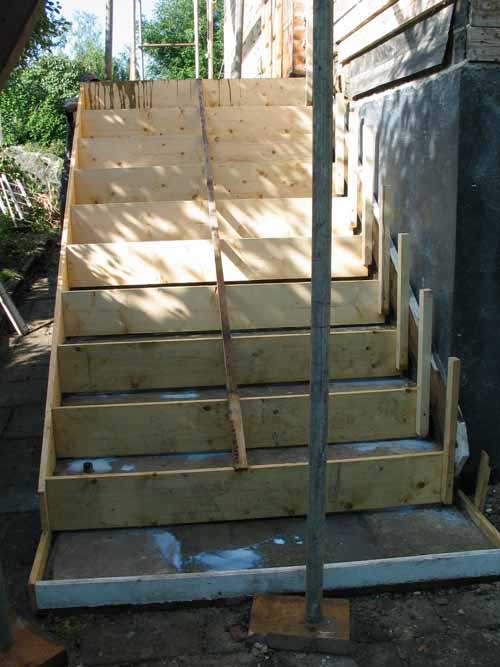
Second form:
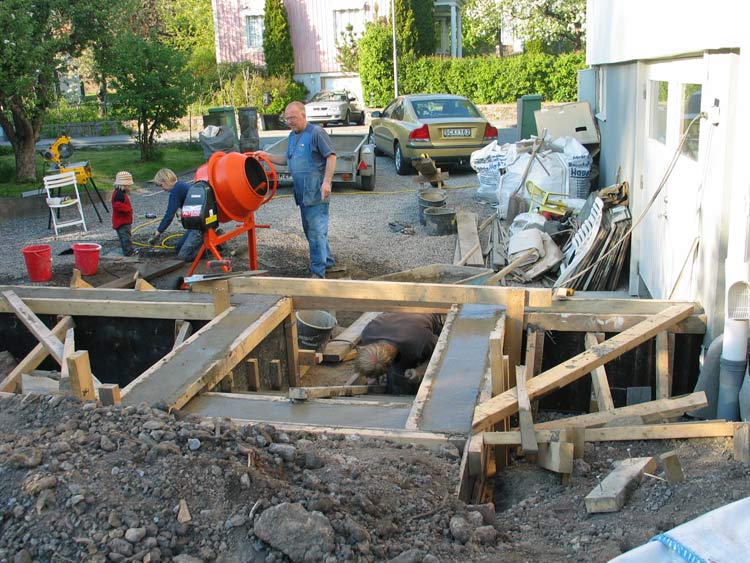
Here we built a terrace with lecablock and a generous portion of concrete...I believe it was 9 cubic meters.

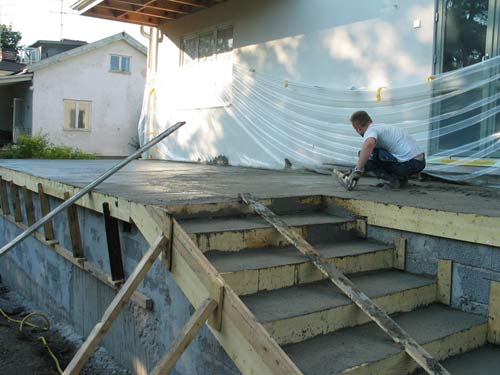
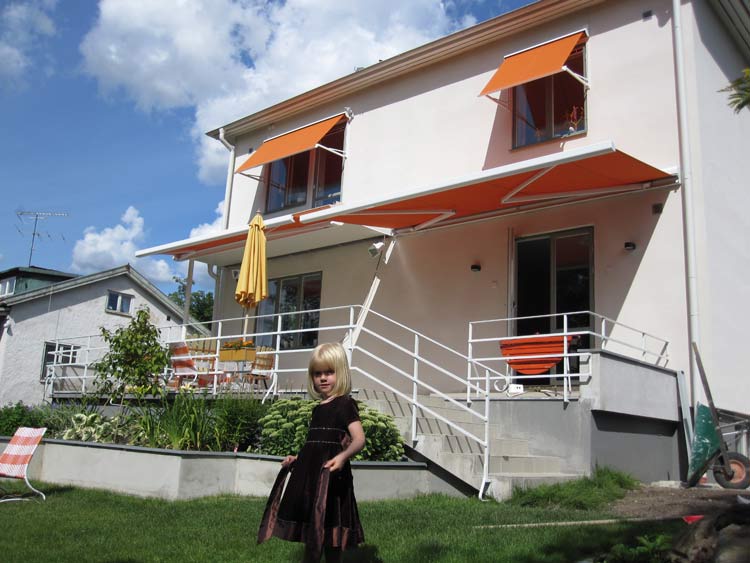
Third form:
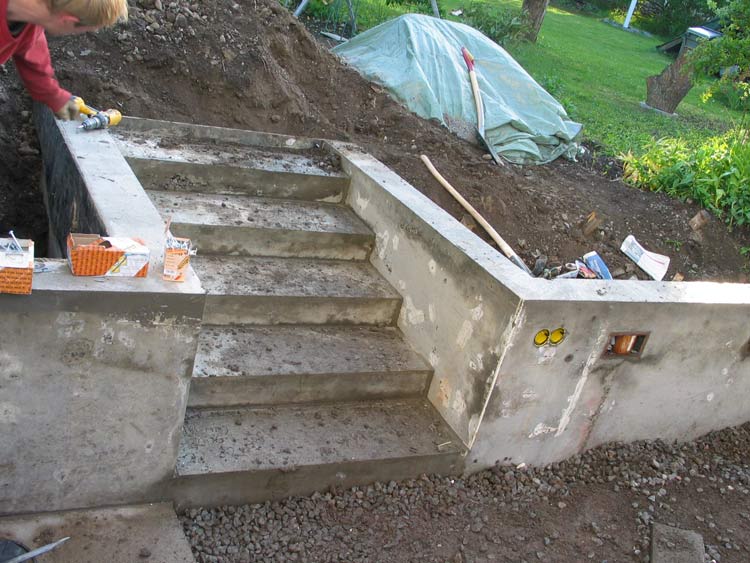
Here we cast a retaining wall and stairs in one casting. Building the form took a little time, but the end result was really good. The form held, and the casting was straight. I think it took about 2 cubic meters of concrete. We mixed it ourselves.
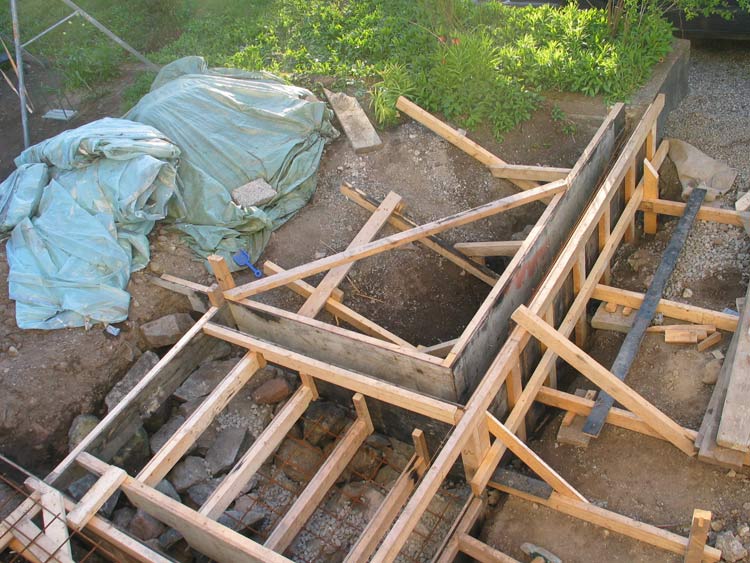
Fourth form:
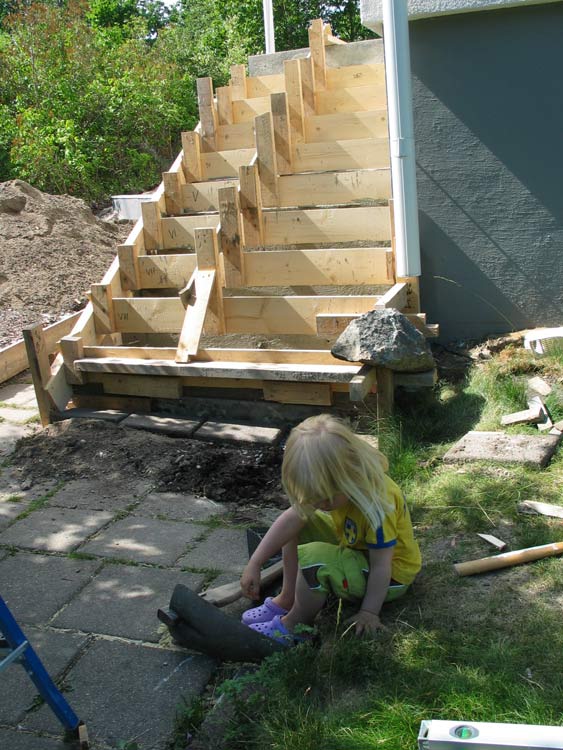
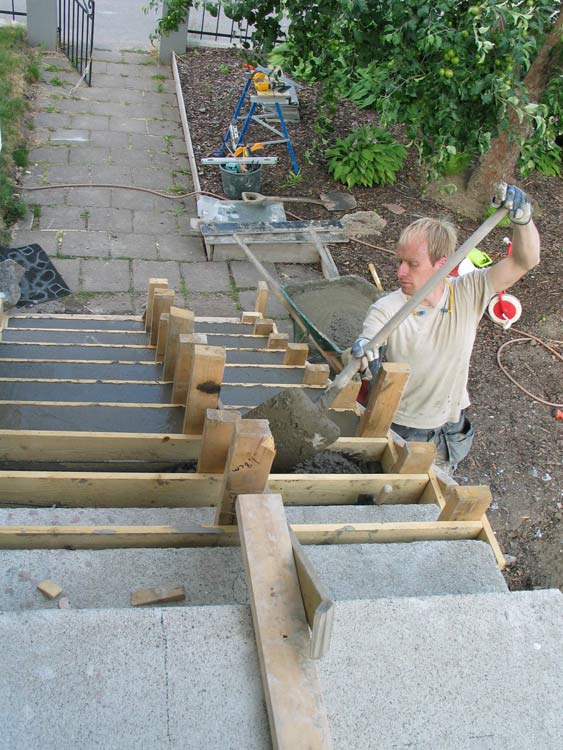
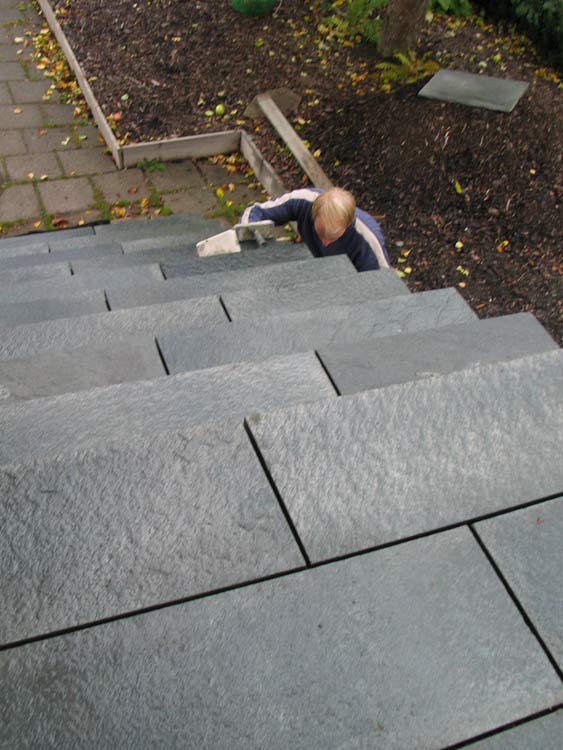
Now it's the entrance stairs' turn again (same as the First form). The stairs have been too steep, so I decided to rebuild it....The top step became 3 cm deeper, the next step 6 cm and then 9, 12, and so on... At the bottom, there were completely new steps.
Then slate ended up on the stairs:
First form.
Here we renovated the entrance stairs. We chipped away parts of the stairs and then renovated it.
Second form:
Here we built a terrace with lecablock and a generous portion of concrete...I believe it was 9 cubic meters.
Third form:
Here we cast a retaining wall and stairs in one casting. Building the form took a little time, but the end result was really good. The form held, and the casting was straight. I think it took about 2 cubic meters of concrete. We mixed it ourselves.
Fourth form:
Now it's the entrance stairs' turn again (same as the First form). The stairs have been too steep, so I decided to rebuild it....The top step became 3 cm deeper, the next step 6 cm and then 9, 12, and so on... At the bottom, there were completely new steps.
Then slate ended up on the stairs:
Last edited:
Oh, wonderful to have some more pictures - a thousand thanks Fasting65! 
I have long dreamed of building a patio like the one you've done, constructing with masonry and casting a floor. Our house is a functionalist house from '36 and that would be the absolute most stylish compared to wooden decking. What can one expect in terms of cost to construct something similar? Is there another forum thread that discusses such a patio construction?
Yes, when the form is fixed, I will add a beam in the middle of the riser, which will then be anchored to a support further out on the lawn below the stairs.
Today, hopefully, the wrought iron railing will be welded in place, so that it can then be cast into the concrete at the bottom.
I have long dreamed of building a patio like the one you've done, constructing with masonry and casting a floor. Our house is a functionalist house from '36 and that would be the absolute most stylish compared to wooden decking. What can one expect in terms of cost to construct something similar? Is there another forum thread that discusses such a patio construction?
Yes, when the form is fixed, I will add a beam in the middle of the riser, which will then be anchored to a support further out on the lawn below the stairs.
Today, hopefully, the wrought iron railing will be welded in place, so that it can then be cast into the concrete at the bottom.
The patio was done on a running account. I don't know what got into us, but we had just decided to build the patio. In retrospect, I probably don't want to calculate the exact price, because it turned out to be quite expensive probably.
However, I can give a quick estimate:
approx 2 pallets of leca = 96 x 19.90 = 2000
A couple of cubic meters of concrete for the foundation hand-mixed = 2000 ?
A tub of concrete approx 10,000
Lots of reinforcement = 5000 ?
35 sqm tiles at 300 each + laying (yes, we hired someone for that...) = 10500 + x
Slate above the walls = 2500
Water cutting of holes in slate = 1500
Plastering of walls including plaster = 3000 ?
Labor costs = 10,000 (low estimate probably)
Iron railing = 25,000
72,000 plus tile laying... 8000 ?
Well, should we guess that we ended up around 80-100 thousand to give an indication.
Oops, I've "forgotten" formwork and groundwork...
However, I can give a quick estimate:
approx 2 pallets of leca = 96 x 19.90 = 2000
A couple of cubic meters of concrete for the foundation hand-mixed = 2000 ?
A tub of concrete approx 10,000
Lots of reinforcement = 5000 ?
35 sqm tiles at 300 each + laying (yes, we hired someone for that...) = 10500 + x
Slate above the walls = 2500
Water cutting of holes in slate = 1500
Plastering of walls including plaster = 3000 ?
Labor costs = 10,000 (low estimate probably)
Iron railing = 25,000
72,000 plus tile laying... 8000 ?
Well, should we guess that we ended up around 80-100 thousand to give an indication.
Oops, I've "forgotten" formwork and groundwork...
VCT does not need to affect the slump of the concrete... but it sounds like you're getting concrete that doesn't come close to meeting the requirements, unfortunately. If that's the case... whatever you do, NEVER USE DE-ICER on the stairs.pinebar said:Your form looks really nice now, knicklas!
Yes, we're casting tomorrow. I'll try to take some photos too.
I don't know what the VCT of our concrete will be, but we had to choose a slightly looser mix than what Betongindustri actually recommends for stairs so that it can be delivered with a 9 m chute. (The chute is necessary so we don't have to move all the concrete for one of the stairs with a wheelbarrow.)
Last edited:
---> Fasting65: Ouch!!! That sounded pretty juicy! I guess we'll have to make do with boring decking it seems...!
---> jhenrikj: Have I understood this correctly - VCT indicates the quality of the concrete? But it doesn't necessarily affect the fluid class? If even "pinebar" doesn't know what VCT he's going to get - how do you know that he'll likely get concrete that's far from the requirements? And what are the requirements you mentioned? My original staircase, cast in 1936 with (presumably) worse concrete, lasted for 74 years - I'm satisfied if the new one lasts the same lifespan, and without de-icing salt this time, I hope for a little more...
---> jhenrikj: Have I understood this correctly - VCT indicates the quality of the concrete? But it doesn't necessarily affect the fluid class? If even "pinebar" doesn't know what VCT he's going to get - how do you know that he'll likely get concrete that's far from the requirements? And what are the requirements you mentioned? My original staircase, cast in 1936 with (presumably) worse concrete, lasted for 74 years - I'm satisfied if the new one lasts the same lifespan, and without de-icing salt this time, I hope for a little more...
Yes, now we have poured and it went well I think, but it was tiring.
The concrete truck arrived just before 14, and we were done by 21:30. Many steps to level out.
Our concrete was called GDS-BETONG C32/40 16 S3 - S4 LU VCT0,45 - S3.
Whether it was good or bad, right or wrong will probably show up after a few years I guess.
At least it worked well to work with and stayed nicely in the molds while we worked.
A few observations:
It would have been better to have double sets of all tools when making two stairs; it would have gone faster.
The molds worked. But our reinforcement struts on the steps were a bit in the way when working on the surface of the steps. We tried removing one and immediately realized they are needed for the mold to hold its shape.
It would have been better to get the concrete early in the morning, as it got dark before we were finished. (But we couldn't influence that.)
I could imagine that our concrete was somewhat too loose for knicklas' carriage sections. But as mentioned, if we had opted out of the chute, we could have gotten thicker concrete.
And finally - if I could have found a craftsman who could look me in the eyes and say that he knows how to do this and who could give satisfied references, he would have gotten to do it. But we found no one. And what's stated in this thread also suggests that both the craftsmanship and quality of the concrete vary quite a bit even among those who call themselves pros. That was also the case when we talked to our neighbors who have had stairs built. No one wanted to recommend their craftsmen, and one had to force their craftsmen to chip away, redo, and do it right.
So now time will tell whether our stairs turned out well or not.
The concrete truck arrived just before 14, and we were done by 21:30. Many steps to level out.
Our concrete was called GDS-BETONG C32/40 16 S3 - S4 LU VCT0,45 - S3.
Whether it was good or bad, right or wrong will probably show up after a few years I guess.
At least it worked well to work with and stayed nicely in the molds while we worked.
A few observations:
It would have been better to have double sets of all tools when making two stairs; it would have gone faster.
The molds worked. But our reinforcement struts on the steps were a bit in the way when working on the surface of the steps. We tried removing one and immediately realized they are needed for the mold to hold its shape.
It would have been better to get the concrete early in the morning, as it got dark before we were finished. (But we couldn't influence that.)
I could imagine that our concrete was somewhat too loose for knicklas' carriage sections. But as mentioned, if we had opted out of the chute, we could have gotten thicker concrete.
And finally - if I could have found a craftsman who could look me in the eyes and say that he knows how to do this and who could give satisfied references, he would have gotten to do it. But we found no one. And what's stated in this thread also suggests that both the craftsmanship and quality of the concrete vary quite a bit even among those who call themselves pros. That was also the case when we talked to our neighbors who have had stairs built. No one wanted to recommend their craftsmen, and one had to force their craftsmen to chip away, redo, and do it right.
So now time will tell whether our stairs turned out well or not.