
144,578 views ·
80 replies
145k views
80 replies
Tips for pouring a concrete staircase needed! See pictures.

Yes, we actually considered it.Marlene Eskilsson said:
 One of the quotes we got was for 168,000:- for the work of casting the slab, the stairs, and building the walls. Then material would be extra. That made us quite motivated to do this ourselves. So I started researching on the Internet with my usual approach, how hard can it really be?
We have now cast the slab ourselves, with relatively few hours of work actually. Now we have also almost finished building the forms for the stairs. It has taken a few hours, but not incredibly much. And building the walls should, for someone who knows how, just take a couple of days, considering how it went when the foundation for our extension was built up.
So say that the stair constructions in that quote are worth about 80,000:- in labor time according to their estimation. That's VERY well paid in our opinion. We could build like one staircase a month with that cost and live quite well, both of us.
So maybe one should change branch?
We have not used stainless steel reinforcement. But as I understand, it is not a problem if it stays a few centimeters inside the concrete all the time and does not protrude anywhere.
Last edited:
Knicklas, can't you maybe cast the stairs first with purchased concrete and then drill in rebar and cast the side pieces with hand-mixed concrete afterwards? It will be much less to mix then and probably a bit easier to build the forms as well.
(If mine don't break when we remove them, they are for sale when we are done.
They have 8 steps each and are 1300 mm wide. The template for the step height and width on them has been our old entrance stairs from 1938.)
(If mine don't break when we remove them, they are for sale when we are done.
They have 8 steps each and are 1300 mm wide. The template for the step height and width on them has been our old entrance stairs from 1938.)
Yes, that's a solution, but perhaps a last resort nonetheless. The strength will likely be better if everything is cast in one piece? I want to explore every possibility to make everything in one casting first. Please come up with more ideas, they are gratefully received! It would be fun to see your form reinforced and ready before casting too!?
Unfortunately, I have slightly different dimensions for my stairs, otherwise your form would have been interesting.
Speaking of pricing, that's exactly what made me do the job myself. They wanted 42,000:- to cast 5 steps... I would get to deduct 17,500:- in ROT and thus pay 24,500:-. ROT deduction is a goldmine primarily for the craftsmen, and secondly for the consumer... A bit OT...
It would be fun to see your form reinforced and ready before casting too!? Unfortunately, I have slightly different dimensions for my stairs, otherwise your form would have been interesting.
Speaking of pricing, that's exactly what made me do the job myself. They wanted 42,000:- to cast 5 steps... I would get to deduct 17,500:- in ROT and thus pay 24,500:-. ROT deduction is a goldmine primarily for the craftsmen, and secondly for the consumer... A bit OT...


Administrator
· Skåne
· 8 751 posts
We paid 40,000 kr including VAT for the staircase we poured in 2001, 6 steps. It was the one that cracked last winter. Our current mason, whom we consider to be professional, said it cracked partly because there was too much sand in the concrete and partly because the reinforcement had rusted. The reinforcement did not stick out anywhere that I could see. When we tried to invoke the 10-year guarantee, the craftsman we bought it from had retired...
When we built an extension, we needed to pour 3 staircases, and they cost 31,000 kr each. One of the staircases was crooked, and they had to chisel it away and pour a new one. But we didn't pay for that. The contractor (who is the same one who built our foundation) sent a Pole here to do the work on the staircases, and I strongly suspect he paid him a little on the side. But we paid in full and legitimately. There is a lot of money to be made in staircase pouring, so I think you'll do excellent business if you venture into that industry, pinebar. What I have seen so far of your forms is much more professional than those that were made for us.
When we built an extension, we needed to pour 3 staircases, and they cost 31,000 kr each. One of the staircases was crooked, and they had to chisel it away and pour a new one. But we didn't pay for that. The contractor (who is the same one who built our foundation) sent a Pole here to do the work on the staircases, and I strongly suspect he paid him a little on the side. But we paid in full and legitimately. There is a lot of money to be made in staircase pouring, so I think you'll do excellent business if you venture into that industry, pinebar. What I have seen so far of your forms is much more professional than those that were made for us.
Thank you very much for all the positive comments!
I guess it's the combination of some fine carpentry and precision when making the mold and the rough work of casting concrete that is the difficult combination to find from the same supplier.
We have now looked at two castings of slabs and cast our last slab ourselves. We imagine that it's not more difficult to fix the concrete for the stairs than it was for the slab once the concrete is poured into the mold. But we'll see. Building the molds is, of course, much more complicated for stairs than for a slab. Whether the staircase then remains intact and doesn't crack, you don't know until a few years later. But I believe that if we order ready-made, frost-resistant concrete from a reputable supplier, we've at least done what we can on that front as well.
I guess it's the combination of some fine carpentry and precision when making the mold and the rough work of casting concrete that is the difficult combination to find from the same supplier.
We have now looked at two castings of slabs and cast our last slab ourselves. We imagine that it's not more difficult to fix the concrete for the stairs than it was for the slab once the concrete is poured into the mold. But we'll see. Building the molds is, of course, much more complicated for stairs than for a slab. Whether the staircase then remains intact and doesn't crack, you don't know until a few years later. But I believe that if we order ready-made, frost-resistant concrete from a reputable supplier, we've at least done what we can on that front as well.
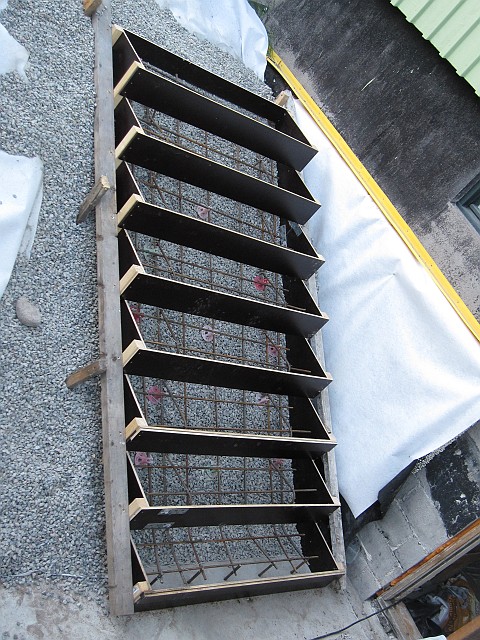
There are now a couple of additional pictures. Here everything is ready for casting except for beams that we will place along the steps as support so that they do not bend. (And we will make a couple of small boxes for the top step on them so that we can have a recessed scraper grid at the top of each staircase.)


Diversearbetare
· Göteborg
· 11 362 posts
Checked with Skanska Prefab (a relative who is a structural engineer and site manager) a while ago regarding the thing with frost-resistant concrete. She firmly claimed that this additive is not needed at all unless you intend to salt for de-icing. It is also practically impossible to dose this additive correctly in the small volumes in question for us private individuals. Temperature, humidity, dry matter in the concrete, etc., affect the dosing, which is on a ppm scale.
I plan to cast my staircase as individual steps in a reusable mold.
I plan to cast my staircase as individual steps in a reusable mold.
pinebar said:
I would recommend adding more reinforcement in the steps themselves.
In the picture, it looks like you only have a stirrup at each end?
I've made a bunch of staircases at work and there's always a lot of reinforcement.
Personally, I would place stirrups maybe every 20 cm and some rods along the step inside the stirrups.
It seems a bit penny-wise to skimp on that small amount for an otherwise fine staircase that you surely want to last many times longer than a wooden one.
Good luck with the casting, it's always a bit interesting with staircases and slopes.
Now the shape is starting to "take shape" (he-he) and I've rented an XL size compactor. I can't get much further without removing the old one.
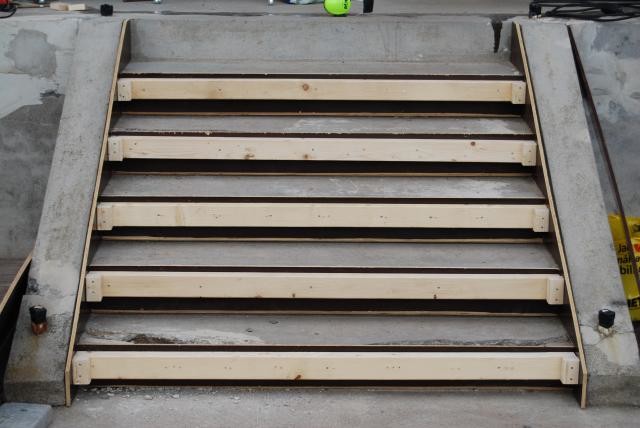
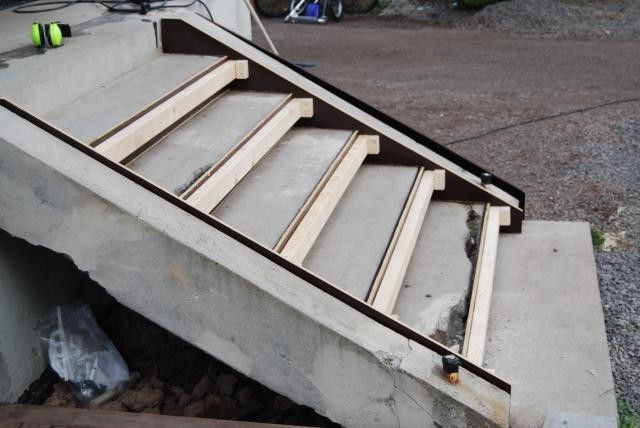
Here's what the form looks like - crafted by a complete beginner. I'm considering possibly adding small angle irons under the short studs to fasten the stair risers and stringers even better. Do you think it's necessary?
Here's what the form looks like - crafted by a complete beginner. I'm considering possibly adding small angle irons under the short studs to fasten the stair risers and stringers even better. Do you think it's necessary?
According to Concrete Technology, the additive is ordinary air that is mixed into the concrete. So it's true that you can't do it yourself, but it's no problem to order concrete from a truck with that feature.Johan Gunverth said:
If you look at the staircase from above, we have 6 longitudinal reinforcement bars throughout the staircase and two horizontal in each step. I see the stirrups only as something that holds the horizontal reinforcement in place. The density between the reinforcement is about equivalent to a mat with 20 cm squares. Do you really need more than that?Atenza said:
Diversearbetare
· Göteborg
· 11 362 posts
Ok. It can vary. I could "get a little bottle" if I wanted and therefore assume that it wasn't air.pinebar said:
However, I got a 5-liter of form oil of the highest quality, which according to the relative will last a lifetime.
The bottle is for what I understand to allow casting when it is cold.
The air is for ensuring what has been cast can withstand cold temperatures.
And we decided yesterday to follow the advice about more reinforcement, so now there will be some mesh in each step as well. On Thursday the concrete truck is coming.....
The air is for ensuring what has been cast can withstand cold temperatures.
And we decided yesterday to follow the advice about more reinforcement, so now there will be some mesh in each step as well. On Thursday the concrete truck is coming.....
A lot of myths in this thread....Stainless steel reinforcement is not used. The only important thing is what type of concrete you cast with. Unfortunately, those who sell concrete have very poor knowledge of what they are selling. The concrete must be "frost-free," meaning it should have about 5% air (it should also have a certain type of aggregate). It must not have a water-cement ratio (w/c) exceeding 0.40 (and this is likely where most issues arise). W/c ratio and strength class go hand in hand, change one and the other changes. For a w/c ratio of 0.40, you need to go up to around C45/50. The usual C25/30 used in most standard castings simply isn't good enough, it will carbonate too quickly.
More reinforcement does not make the stairs last longer (rather the opposite). And the absolutely most important thing is that the reinforcement is not too shallow in the concrete. Main reinforcement should have at least 30mm coverage and mesh at least 20mm.
When concrete is exposed to carbon dioxide in the air, a process called carbonation begins. This deteriorates the concrete and allows water to penetrate it. This leads to two problems, when it freezes, the concrete risks bursting. That's why we mix air into the concrete so there is space for the water to expand when it freezes. When delivering concrete by truck, it's important to measure the air content upon delivery as the air pores in the concrete can disappear during transport. The second problem is that the water penetrating the concrete is both acidic and contains chloride ions which, when penetrating to the reinforcement, attack the steel. Over time, the steel is consumed, and the reinforcement's load-bearing capability is impaired. The attack on the steel also causes the concrete to weather faster. This is guaranteed what happened to Marlene, and is almost certainly due to poor quality concrete.
Now it is too late, if I had seen this thread earlier, I would have recommended the original poster to contact Strängbetong in Norberg (Forselsstrappan) for a prefabricated staircase instead, it would definitely have been better and probably much cheaper than the fantasy prices I've seen so far in the thread.
More reinforcement does not make the stairs last longer (rather the opposite). And the absolutely most important thing is that the reinforcement is not too shallow in the concrete. Main reinforcement should have at least 30mm coverage and mesh at least 20mm.
When concrete is exposed to carbon dioxide in the air, a process called carbonation begins. This deteriorates the concrete and allows water to penetrate it. This leads to two problems, when it freezes, the concrete risks bursting. That's why we mix air into the concrete so there is space for the water to expand when it freezes. When delivering concrete by truck, it's important to measure the air content upon delivery as the air pores in the concrete can disappear during transport. The second problem is that the water penetrating the concrete is both acidic and contains chloride ions which, when penetrating to the reinforcement, attack the steel. Over time, the steel is consumed, and the reinforcement's load-bearing capability is impaired. The attack on the steel also causes the concrete to weather faster. This is guaranteed what happened to Marlene, and is almost certainly due to poor quality concrete.
Now it is too late, if I had seen this thread earlier, I would have recommended the original poster to contact Strängbetong in Norberg (Forselsstrappan) for a prefabricated staircase instead, it would definitely have been better and probably much cheaper than the fantasy prices I've seen so far in the thread.
I have seen various prefab stairs, but I don't think they look particularly exciting at all. Additionally, I find it extremely hard to believe that it would be a more cost-effective solution, as I want the stairs to be identical to the original—not some standard solution.
Expenses so far:
Rental of drill: 500:-
2 sheets of form plywood (already had 2): 720:-
Various dimension studs: about 500:-
Screws: 200:-
Upcoming expenses will be:
Rebar: not sure here but maybe around 500:-
Concrete: 3000:-
Total: roughly 5500:-
I think Strängbetong would probably want more than that—just transport and lifting assistance would probably cost a couple of thousand...
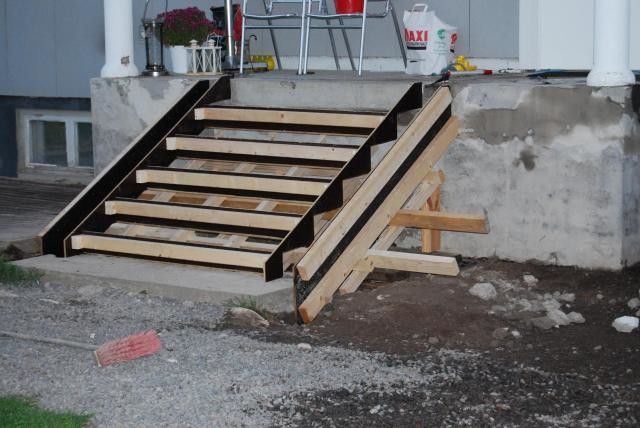
Yesterday's progress in pictures... The bottom plywood will be cut to size, and the form will be fixed. Then it's time for reinforcement and pouring!
Expenses so far:
Rental of drill: 500:-
2 sheets of form plywood (already had 2): 720:-
Various dimension studs: about 500:-
Screws: 200:-
Upcoming expenses will be:
Rebar: not sure here but maybe around 500:-
Concrete: 3000:-
Total: roughly 5500:-
I think Strängbetong would probably want more than that—just transport and lifting assistance would probably cost a couple of thousand...
Yesterday's progress in pictures... The bottom plywood will be cut to size, and the form will be fixed. Then it's time for reinforcement and pouring!
Last edited: