
144,548 views ·
80 replies
145k views
80 replies
Tips for pouring a concrete staircase needed! See pictures.
Well, maybe congratulations are in order for a successful job!? 
How many steps did you cast in total? Before our casting, our 5 steps don't seem like an impossible task, and it will be exciting (I hope).
I will try to plan the placement of the reinforcement battens so they "disrupt" as little as possible. Since I don't have a wall or similar to attach the risers to, it is this part that will hold the entire piece with the risers, so this part is important for my mold.
How long does the actual concrete pumping take? In other words, how long does it take to fill one step, for example? Did you experience any "concrete chills" and stress, or did it feel calm? I will discuss this with Färdig Betong before delivery so I know what to expect. I pay 1500:- for the delivery regardless of the amount, and since 1 cubic meter naturally empties faster than a full truck, I should be able to get some margin... Worst case scenario, I'll have to pay an extra five hundred for half an hour or so - just to buy some peace of mind...
I will probably request the stiffest concrete possible for this purpose. I will definitely discuss my ideas with FB to get their viewpoints. For the stringers, I will prefabricate (!) covers that are easy to quickly screw on (or perhaps clamp with some clamps) as soon as I have filled the sloped parts with concrete. Like you, Pinebar, I think it will be difficult to do this without covers unless you have a soil-moist mix.
How many cubic meters did your stairs require, Pinebar? Dare we ask for some pictures...?
For my part, the wrought iron railings were welded back in place yesterday after being sandblasted and lacquered. The lowest mounts will be cast into the stringers in the same way as the original. Pictures will come on this...
Another question: How many people do you think are needed for the casting? If there are too many, you might be stepping on each other's toes. I probably want one person whose sole task is to put the covers on the stringers, one person with the hose, and one who chops with a spade or uses the vibrator. What's reasonable? Do you vibrate while you pump, or is it done afterward?
How many steps did you cast in total? Before our casting, our 5 steps don't seem like an impossible task, and it will be exciting (I hope).
I will try to plan the placement of the reinforcement battens so they "disrupt" as little as possible. Since I don't have a wall or similar to attach the risers to, it is this part that will hold the entire piece with the risers, so this part is important for my mold.
How long does the actual concrete pumping take? In other words, how long does it take to fill one step, for example? Did you experience any "concrete chills" and stress, or did it feel calm? I will discuss this with Färdig Betong before delivery so I know what to expect. I pay 1500:- for the delivery regardless of the amount, and since 1 cubic meter naturally empties faster than a full truck, I should be able to get some margin... Worst case scenario, I'll have to pay an extra five hundred for half an hour or so - just to buy some peace of mind...
I will probably request the stiffest concrete possible for this purpose. I will definitely discuss my ideas with FB to get their viewpoints. For the stringers, I will prefabricate (!) covers that are easy to quickly screw on (or perhaps clamp with some clamps) as soon as I have filled the sloped parts with concrete. Like you, Pinebar, I think it will be difficult to do this without covers unless you have a soil-moist mix.
How many cubic meters did your stairs require, Pinebar? Dare we ask for some pictures...?
For my part, the wrought iron railings were welded back in place yesterday after being sandblasted and lacquered. The lowest mounts will be cast into the stringers in the same way as the original. Pictures will come on this...
Another question: How many people do you think are needed for the casting? If there are too many, you might be stepping on each other's toes. I probably want one person whose sole task is to put the covers on the stringers, one person with the hose, and one who chops with a spade or uses the vibrator. What's reasonable? Do you vibrate while you pump, or is it done afterward?
As long as you have enough cover on the reinforcement, that concrete should last for quite a few years. You should have a cover of about 35mm. But avoid salting the steps in the winter.pinebar said:Yes, now we have poured and I think it went well, although it was tiring. The concrete truck came just before 2 PM and we were finished by 9:30 PM. There were many steps to flatten it. Our concrete was called GDS-BETONG C32/40 16 S3 - S4 LU VCT0,45 - S3. Whether it was good or bad, right or wrong probably won't be clear for a few years. It worked well to work with and stayed nicely in the molds while we were at it.

Sounds hopeful. And we don't salt. We've been tempted a few times to do it on our entrance steps, which are from the year 1938, but we've refrained because we don't think the concrete would handle it well. And these new steps we've built now will likely be used sparingly in the winter, so it shouldn't be a major problem.


Administrator
· Skåne
· 8 742 posts
There are many nice molds in this thread. Ours are embarrassing in comparison, so I won't show them. Regarding stainless reinforcement, it sounds reasonable, as one has never really seen such. When our staircase crumbled, it was surely just the fault of the bad concrete mix, plus the fact that we had salted the staircase.
The salt was certainly a major reason why our [object] crumbled. I have now learned an expensive lesson... :blushing: The stairs were of course in bad shape before, but salt is a "big no no"...
----> Pinebar: Any pictures from your casting perhaps? Would you like to share a bit about how you went about it - how many of you there were, how long the different stages took, etc. I'm trying to plan for our casting.
----> Pinebar: Any pictures from your casting perhaps? Would you like to share a bit about how you went about it - how many of you there were, how long the different stages took, etc. I'm trying to plan for our casting.
Hello again!
Now we've had a rest. As mentioned, it was tiring. And we got a bit of a chill at the end. But as mentioned, we had 16 steps and only one set of tools. That was, as mentioned, wrong. We should have had two of the tools. Five steps should be fine. We were two people. It's quite manageable. Sometimes it's good to help each other out, like when you're using the board to smooth things over, and usually, it's suitable for one person to work with the concrete while the other helps with lifting, moving, fetching, etc.
The emptying itself didn't take too long. We had ordered 45 minutes of unloading time, and I think that's about what it was. I didn't look at the clock right then, but it feels reasonable. He filled while we vibrated with a vibro stick we rented. But it was still a bit exciting. I had calculated the volume of the stairs to be a total of 1.45 m3 and ordered 1.6 m3 of concrete. It ran out while the second staircase wasn't quite filled. But we solved it by scraping off the first one and transferring the concrete in buckets. A bunch of buckets is good to have.
We then scraped with a board and smoothed with a plastic trowel. I had to saw off a bit of the handle to reach the innermost steps. And we had a regular mason's trowel and one of those called something with sword, I think. Like a very long, slightly pointed mason's trowel. It was these stages that took a long time and got a bit stressful in the end. At the end, the concrete was quite hard. But five steps are significantly fewer than 16.
We also built a plank that could be placed on the steps to stand or sit on while working; it was useful. With it, you could work from top to bottom without standing in the concrete.
And of course, having a water hose handy is good. And it gets dark at 19:30 now. So having lights ready is smart if needed.
Additionally, we pressed in a couple of molds we made on the top steps to get in some drainage grids. That also took some time, but went quite well.
For the concrete you scrape off and have left over, it's also good to have some rebar pieces you can insert as handles in the lumps that form. It's easier to lift them to throw away later. It's also good to make many small lumps if you're not super strong. They quickly become very heavy.
There were actually some pictures taken, but they're still in the camera. Tonight, we plan to remove the molds, so with a bit of luck, maybe I'll pull myself together and get some pictures in here within a few days.
--> MMR Yes, we intend to leave the stairs untreated. Our house is kind of functional-1940s, so we want an untreated surface if it seems to work. We think it aligns with that style. If it doesn't work, we'll probably paint something that's as inconspicuous as possible.
Now we've had a rest. As mentioned, it was tiring. And we got a bit of a chill at the end. But as mentioned, we had 16 steps and only one set of tools. That was, as mentioned, wrong. We should have had two of the tools. Five steps should be fine. We were two people. It's quite manageable. Sometimes it's good to help each other out, like when you're using the board to smooth things over, and usually, it's suitable for one person to work with the concrete while the other helps with lifting, moving, fetching, etc.
The emptying itself didn't take too long. We had ordered 45 minutes of unloading time, and I think that's about what it was. I didn't look at the clock right then, but it feels reasonable. He filled while we vibrated with a vibro stick we rented. But it was still a bit exciting. I had calculated the volume of the stairs to be a total of 1.45 m3 and ordered 1.6 m3 of concrete. It ran out while the second staircase wasn't quite filled. But we solved it by scraping off the first one and transferring the concrete in buckets. A bunch of buckets is good to have.
We then scraped with a board and smoothed with a plastic trowel. I had to saw off a bit of the handle to reach the innermost steps. And we had a regular mason's trowel and one of those called something with sword, I think. Like a very long, slightly pointed mason's trowel. It was these stages that took a long time and got a bit stressful in the end. At the end, the concrete was quite hard. But five steps are significantly fewer than 16.
We also built a plank that could be placed on the steps to stand or sit on while working; it was useful. With it, you could work from top to bottom without standing in the concrete.
And of course, having a water hose handy is good. And it gets dark at 19:30 now. So having lights ready is smart if needed.
Additionally, we pressed in a couple of molds we made on the top steps to get in some drainage grids. That also took some time, but went quite well.
For the concrete you scrape off and have left over, it's also good to have some rebar pieces you can insert as handles in the lumps that form. It's easier to lift them to throw away later. It's also good to make many small lumps if you're not super strong. They quickly become very heavy.
There were actually some pictures taken, but they're still in the camera. Tonight, we plan to remove the molds, so with a bit of luck, maybe I'll pull myself together and get some pictures in here within a few days.
--> MMR Yes, we intend to leave the stairs untreated. Our house is kind of functional-1940s, so we want an untreated surface if it seems to work. We think it aligns with that style. If it doesn't work, we'll probably paint something that's as inconspicuous as possible.
Last edited:
---> Pinebar: Very interesting and useful solution! I've read through a couple of times now and will glance through a few more times before I cast (and might come up with some more beginner questions perhaps...:blushing. Perfect for the planning! The unloading time can't be especially long for us - the concrete truck can be as close to the stairs as it wants and it's only 5 steps. On the other hand, there might be a bit of hassle with the vangstycken, but nothing I won't be prepared for!
In the pictures, you can see how the reinforcement work is progressing. Hard work with 10 mm reinforcing bars, but it's slowly moving forward. I had some difficulties fastening the reinforcing bars both at the top and bottom due to concrete/hole brick with poor strength, therefore the bars ended up lying diagonally in some places. Maybe not entirely by the book, but unfortunately, not much to do about it. Also nice that the railings are back in place - and in the right place!!
The reinforcement will be complemented with brackets and a few more 10 mm bars inside the vangstycken, will show with a picture when I get there. Fortunately, I'll get help bending the brackets...
I've read through a couple of times now and will glance through a few more times before I cast (and might come up with some more beginner questions perhaps...:blushing. Perfect for the planning! The unloading time can't be especially long for us - the concrete truck can be as close to the stairs as it wants and it's only 5 steps. On the other hand, there might be a bit of hassle with the vangstycken, but nothing I won't be prepared for! In the pictures, you can see how the reinforcement work is progressing. Hard work with 10 mm reinforcing bars, but it's slowly moving forward. I had some difficulties fastening the reinforcing bars both at the top and bottom due to concrete/hole brick with poor strength, therefore the bars ended up lying diagonally in some places. Maybe not entirely by the book, but unfortunately, not much to do about it. Also nice that the railings are back in place - and in the right place!!
The reinforcement will be complemented with brackets and a few more 10 mm bars inside the vangstycken, will show with a picture when I get there. Fortunately, I'll get help bending the brackets...
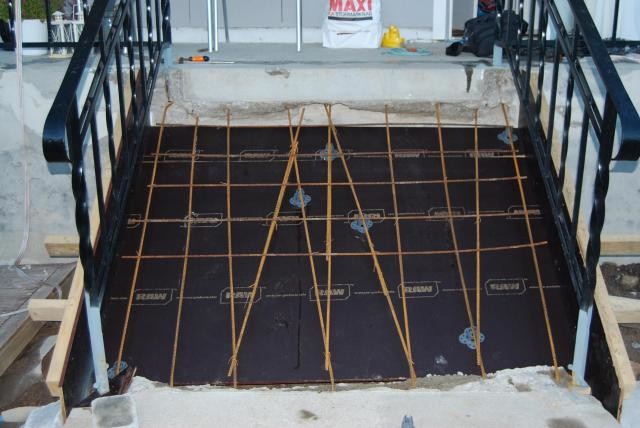
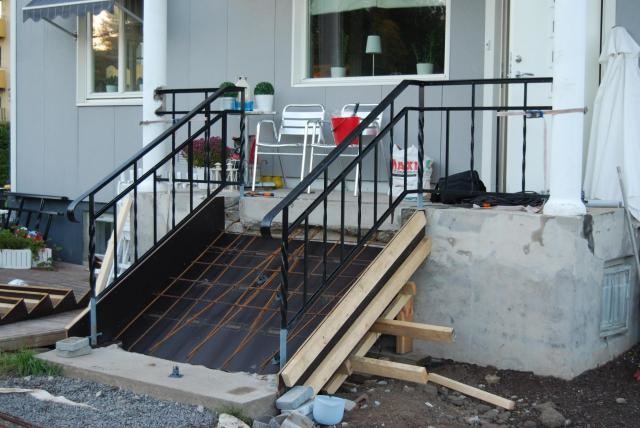
Last edited:
Yesterday we removed the molds and we are pleased with the results. A few small misses with leveling the steps properly and a few small holes from air in the vertical parts of the steps, but nothing catastrophic. We can likely fill the holes with filler or a bit of fine concrete, and if we are very meticulous, we might rent a sander and sand the steps a bit.
Here is a picture of the finished result. More pictures are available at pinebar.
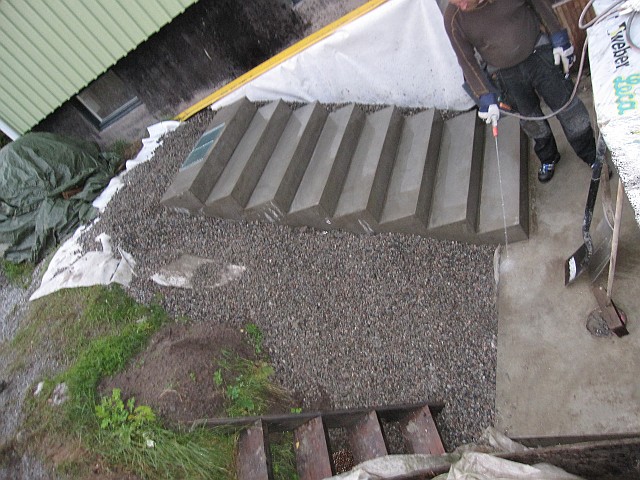 http://www.pinebar.com/DiaryImages/2010/slides/2010-09-21_Klar_trapp.jpg
Here is a picture of the finished result. More pictures are available at pinebar.
http://www.pinebar.com/DiaryImages/2010/slides/2010-09-21_Klar_trapp.jpgFinally, the stairs have been cast. I was pretty exhausted after 8 hours of work, but here's hoping it turns out reasonably well. We plan to coat our stairs with epoxy, and before that, the steps need to be sanded with a concrete grinder. In other words, there's room for some adjustments.
Unloading from the truck probably took almost an hour—the concrete was extremely thick, and since it wasn't possible to tilt the chute enough, it flowed poorly. I handled the vibrator, assisted by my father and uncle.
The stair stringers definitely DID NOT need any covers! It went surprisingly well to vibrate the concrete into the right place and then smooth upwards with a trowel—strangely enough, the most seamless task!?
I found the steps more challenging, leveling them and trying to get the right height while constantly battling the annoying stones mixed in with the concrete. This took a lot of time! In hindsight, I should have scheduled the truck to arrive at perhaps 10 AM instead of 2 PM. Time flew by, and it got dark and a bit too cold before I could use the wood float on the steps. I had to set up a tarp and a car heater—which actually provided quite good warmth!?
This morning before I left for work (at 5:15 AM to be exact, yawn), I watered a bit and then put the tarp and heat back on.
This afternoon, I'm going to remove the formwork on the sides; the support underneath will stay in place for a while. According to Ready Mix Concrete, the concrete reaches 70% strength in 1 week and 100% in 4 weeks. I've had a bit of contact with a construction teacher during this project, and I'll check with him about when I should remove the support under the stairs.
Of course, I'll come back with some pictures... "Didn't Happen Without A Picture..."
Unloading from the truck probably took almost an hour—the concrete was extremely thick, and since it wasn't possible to tilt the chute enough, it flowed poorly. I handled the vibrator, assisted by my father and uncle.
The stair stringers definitely DID NOT need any covers! It went surprisingly well to vibrate the concrete into the right place and then smooth upwards with a trowel—strangely enough, the most seamless task!?
I found the steps more challenging, leveling them and trying to get the right height while constantly battling the annoying stones mixed in with the concrete. This took a lot of time! In hindsight, I should have scheduled the truck to arrive at perhaps 10 AM instead of 2 PM. Time flew by, and it got dark and a bit too cold before I could use the wood float on the steps. I had to set up a tarp and a car heater—which actually provided quite good warmth!?
This morning before I left for work (at 5:15 AM to be exact, yawn), I watered a bit and then put the tarp and heat back on.
This afternoon, I'm going to remove the formwork on the sides; the support underneath will stay in place for a while. According to Ready Mix Concrete, the concrete reaches 70% strength in 1 week and 100% in 4 weeks. I've had a bit of contact with a construction teacher during this project, and I'll check with him about when I should remove the support under the stairs.
Of course, I'll come back with some pictures... "Didn't Happen Without A Picture..."

Fun to cast stairs, but you pinebar, shouldn't the scraper hole have been open at the front instead of the back? It will be a bit tricky to sweep clean in the hole, because at the back you will probably fill up, right?