
141,879 views ·
80 replies
142k views
80 replies
Tips for pouring a concrete staircase needed! See pictures.
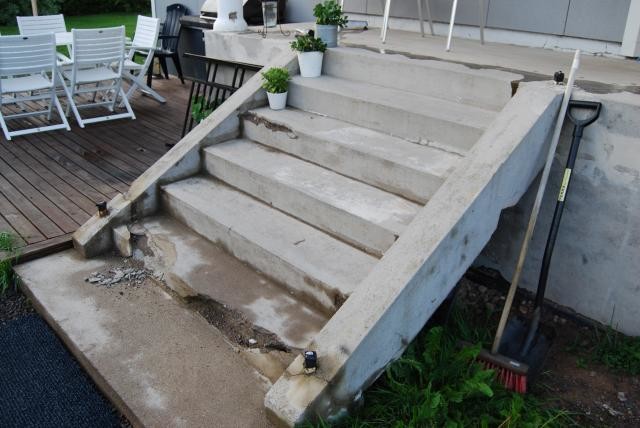
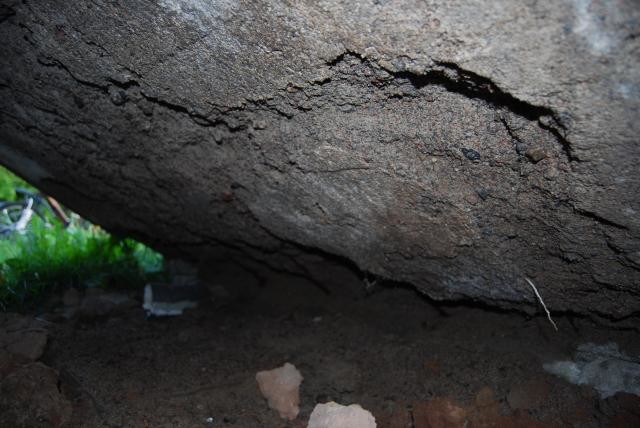
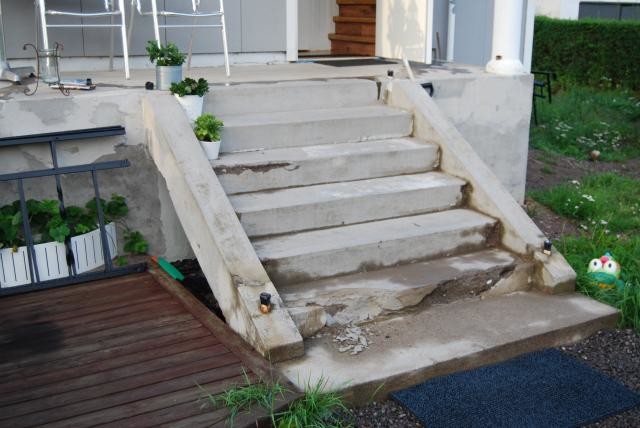
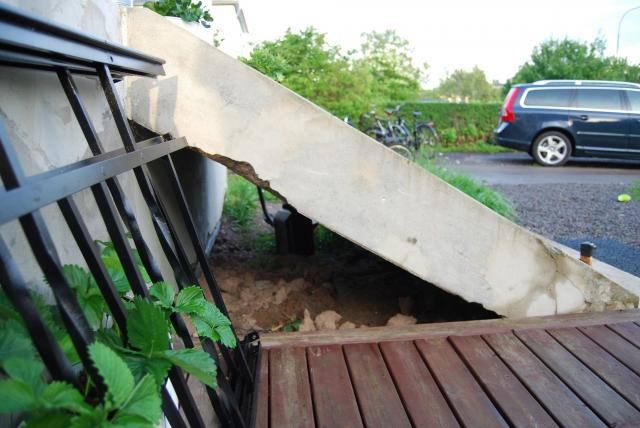
When we were going to epoxy-coat our concrete stairs, they were condemned. The concrete has deteriorated over the years due to frost damage and was deemed beyond saving. See the pictures. In my mind, it can't be entirely impossible to fix this myself, while it also seems fun to cast...
I now wish for some tips from you. Can anyone share a work description?
Some questions are:
- Is the staircase really beyond all saving?
- Can certain parts be saved (e.g., the lowest step) and the rest recast?
As you can see in the pictures, the staircase is quite brittle on the underside, the reinforcement bars are exposed. However, I think the lowest step/platform looks fresh.
When everything is done, the whole thing will be coated with epoxy to be completely sealed. I want to avoid frost damage in the future...:S
If now everything has to be removed, my idea is to first make a mold from the existing stairs, knock away everything except the lowest step, and then cast a new one. The staircase should be self-supporting and look just as it does today.
I will have a lot of questions about this but don't want to make the first post too heavy, so I think I'll settle with this info.
I gratefully receive all comments/thoughts and not least some much-needed cheer!!
Thanks in advance!
/Knicklas
I now wish for some tips from you. Can anyone share a work description?
Some questions are:
- Is the staircase really beyond all saving?
- Can certain parts be saved (e.g., the lowest step) and the rest recast?
As you can see in the pictures, the staircase is quite brittle on the underside, the reinforcement bars are exposed. However, I think the lowest step/platform looks fresh.
When everything is done, the whole thing will be coated with epoxy to be completely sealed. I want to avoid frost damage in the future...:S
If now everything has to be removed, my idea is to first make a mold from the existing stairs, knock away everything except the lowest step, and then cast a new one. The staircase should be self-supporting and look just as it does today.
I will have a lot of questions about this but don't want to make the first post too heavy, so I think I'll settle with this info.
I gratefully receive all comments/thoughts and not least some much-needed cheer!!
Thanks in advance!
/Knicklas
Well, wood is ruled out for several reasons:
- Not allowed since the house is a historical landmark. This means all actions on the house should be executed as if the year was 1936. Must be wrought iron railings, for example...
- Does not match the appearance of the house according to us.
- We want something more maintenance-free.
- Not allowed since the house is a historical landmark. This means all actions on the house should be executed as if the year was 1936. Must be wrought iron railings, for example...
- Does not match the appearance of the house according to us.
- We want something more maintenance-free.

Whether it can be saved, I have no idea. But if you cast a new one, you should order frost-resistant concrete. Also, when ordering, mention that it's a staircase casting so they can mix in some sort of additive that makes the concrete more viscous. Otherwise, you risk it flowing out at the lowest step when you fill up higher in the mold.
I would also suggest that you arrange for some form of railing.
I would also suggest that you arrange for some form of railing.
The railing is ready for installation - blasted and newly painted - around the corner. In the pictures, one can see the stumps from the 4-kantjärnen sticking up in 4 places. The goal is to reuse the railing so that the staircase becomes identical.
Remove all concrete, but leave the reinforcement in place.
Supplement the reinforcement/replace those that are damaged.
Build a form around and cast.
It may be easier to mix concrete yourself (bagged concrete) and cast in stages, step by step.
If you wait an hour between, it will be easier to prevent the concrete from flowing the wrong way.
Supplement the reinforcement/replace those that are damaged.
Build a form around and cast.
It may be easier to mix concrete yourself (bagged concrete) and cast in stages, step by step.
If you wait an hour between, it will be easier to prevent the concrete from flowing the wrong way.
Yes, I have thought about mixing the concrete myself, which understandably doesn't go so quickly and the concrete has time to set gradually. Should you vibrate anything or is it enough to chop/distribute with a shovel and tap the form with a hammer? However, the reinforcement doesn't seem to be much to rely on, but it becomes clearer when you start chiseling.
You should have a vibrator.
A staircase has an exposed position.
Also consider if you want to invest in buying any additive to increase frost resistance.
Feel free to reinforce a little more than it was before.
A staircase has an exposed position.
Also consider if you want to invest in buying any additive to increase frost resistance.
Feel free to reinforce a little more than it was before.
The stairs will be made frost-resistant by coating them with a type of epoxy. Thus, they will be completely sealed on the top side.
A vibrator should probably be used sparingly, right? It does increase the pressure on the form quite a bit, doesn't it? Regarding the surface structure, I don't think it matters since it will be coated afterwards.
Yes, exactly, if I double the existing reinforcement, I should be fine. Currently, for example, there is ZERO reinforcement in the steps.
A vibrator should probably be used sparingly, right? It does increase the pressure on the form quite a bit, doesn't it? Regarding the surface structure, I don't think it matters since it will be coated afterwards.
Yes, exactly, if I double the existing reinforcement, I should be fine. Currently, for example, there is ZERO reinforcement in the steps.

That resembles a bit of what we are working on right now. We had hoped to find craftsmen who can do this, but they seem to be rare, so we have started ourselves instead. We found the video Trappa on this page very useful: http://www.byggmax.com/se-sv/Byggmax/Byggprojekt/Markarbete.aspx
And this one: http://www.weber.se/media/22/pdf/gds/gjuta.pdf
We are not finished yet, but we have come quite far with our molds. We are going to have two stairs, but that lie on the ground. We chose to build the molds from formplyfa instead of boards as they do in the video.
We have also thought to use the edges of our stairs as a foundation for walls, so for us a couple of screw heads or other irregularities don't matter much, as it will be mortared over and buried after we have built the wall.
But if you think it will look bad with the screw heads, I would recommend that you fill them over with something like Plastic Padding and then apply a bit of wood oil before pouring. I think you might as well ignore them and pick away any small crosses once the concrete has set. Also, keep in mind to have a plan for how you will disassemble the mold after pouring.
Along the way, we have also learned that if you get concrete from a truck, they can mix in a bit of air which somehow makes it frost-resistant. You cannot achieve this yourself with a mixer. We initially thought of mixing ourselves just so it wouldn't go so fast, but when we poured our slab, the person who delivered the concrete said you can order "stair" concrete which is a bit thicker from a truck if you want. We need about 1.2 m3, so we have now decided to get the concrete from a truck.
Yesterday I tied up the reinforcement in one of the molds, but unfortunately, I don't have a more recent picture of the molds than this:
And this one: http://www.weber.se/media/22/pdf/gds/gjuta.pdf
We are not finished yet, but we have come quite far with our molds. We are going to have two stairs, but that lie on the ground. We chose to build the molds from formplyfa instead of boards as they do in the video.
We have also thought to use the edges of our stairs as a foundation for walls, so for us a couple of screw heads or other irregularities don't matter much, as it will be mortared over and buried after we have built the wall.
But if you think it will look bad with the screw heads, I would recommend that you fill them over with something like Plastic Padding and then apply a bit of wood oil before pouring. I think you might as well ignore them and pick away any small crosses once the concrete has set. Also, keep in mind to have a plan for how you will disassemble the mold after pouring.
Along the way, we have also learned that if you get concrete from a truck, they can mix in a bit of air which somehow makes it frost-resistant. You cannot achieve this yourself with a mixer. We initially thought of mixing ourselves just so it wouldn't go so fast, but when we poured our slab, the person who delivered the concrete said you can order "stair" concrete which is a bit thicker from a truck if you want. We need about 1.2 m3, so we have now decided to get the concrete from a truck.
Yesterday I tied up the reinforcement in one of the molds, but unfortunately, I don't have a more recent picture of the molds than this:
Thank you for the picture!!! Very interesting! Feel free to show additional progress with more pictures, it's been a bit difficult to find good descriptions online...
No, there seems to be a shortage of "betongare" unfortunately. I'm going to start today with our steps.
There shouldn't be any difficulties in knocking away the crosses with a chisel afterwards.
Now I'm a bit tempted to buy ready-mixed concrete, but it might be a bit difficult. I'm also going to cast new vangstycken, and those are made in an open form with "jordfuktig" concrete. That is "drier" than the rest of the steps, so it might be challenging to order ready-mixed concrete.
What do you have to pay for step-concrete from a truck?
No, there seems to be a shortage of "betongare" unfortunately. I'm going to start today with our steps.
There shouldn't be any difficulties in knocking away the crosses with a chisel afterwards.
Now I'm a bit tempted to buy ready-mixed concrete, but it might be a bit difficult. I'm also going to cast new vangstycken, and those are made in an open form with "jordfuktig" concrete. That is "drier" than the rest of the steps, so it might be challenging to order ready-mixed concrete.
What do you have to pay for step-concrete from a truck?
I don't know yet what it will cost, but for the slab which was 1.7 m3, we had to pay 4,800:- with delivery from a truck with a 9 m chute. It will probably be more expensive for the stairs as the truck will likely have to stay a bit longer. I don't think the cost of the concrete itself will differ much from what we used for the slab.
Buying in a bag or mixing it yourself would have been cheaper, but it's very heavy and time-consuming as well.
So if you value your time a bit, it's probably a profit to get the concrete from a truck if possible.
We got the concrete from Betongindustri. They were good, so they will be delivering for the stairs as well.
They seem to be quite large, so they might be available in Örebro too.
Call and check with them if they can do semi-dry concrete as well. It's not impossible.
Buying in a bag or mixing it yourself would have been cheaper, but it's very heavy and time-consuming as well.
So if you value your time a bit, it's probably a profit to get the concrete from a truck if possible.
We got the concrete from Betongindustri. They were good, so they will be delivering for the stairs as well.
They seem to be quite large, so they might be available in Örebro too.
Call and check with them if they can do semi-dry concrete as well. It's not impossible.


Administrator
· Skåne
· 8 351 posts
pinebar, I wish we could have hired you as a consultant when we were pouring stairs. In our first staircase, the mason mixed in the old way and used too much sand. Last winter it cracked. It was also because the reinforcement rusted. It's apparently important to have stainless reinforcement, in addition to the right concrete.
Then I see that you have built very solid forms, another prerequisite for a good result. During one of our pours, the forms gave way because the contractor chose material that was too weak.
Then I see that you have built very solid forms, another prerequisite for a good result. During one of our pours, the forms gave way because the contractor chose material that was too weak.
Pre-mixed concrete, frost-resistant and slightly thicker in consistency, costs over 1500:-/m³. Delivery costs over 1400:- for a truck (regardless of quantity). So a total of 3000:- for the concrete delivered if 1m³ is enough (haven't calculated that yet).
If you buy coarse concrete by the bag, it seems to cost about 60:-/each and provides about 13 liters. That results in a price per m³ of about 4600:-. Additionally, you would then have to feed 77 bags of concrete into a mixer... Phew...! Definitely an advantage to order a truck. The downside is that the whole process goes frighteningly fast for a beginner!
The problem that arises, as mentioned, is how I can make the vangstycken. A construction teacher said that you keep the form open over these and smooth the slope upwards while pouring, and then use soil-moist concrete. If I buy pre-mixed concrete, I probably need to put lids over these, but will I then be able to fill properly?
If you buy coarse concrete by the bag, it seems to cost about 60:-/each and provides about 13 liters. That results in a price per m³ of about 4600:-. Additionally, you would then have to feed 77 bags of concrete into a mixer... Phew...! Definitely an advantage to order a truck. The downside is that the whole process goes frighteningly fast for a beginner!
The problem that arises, as mentioned, is how I can make the vangstycken. A construction teacher said that you keep the form open over these and smooth the slope upwards while pouring, and then use soil-moist concrete. If I buy pre-mixed concrete, I probably need to put lids over these, but will I then be able to fill properly?