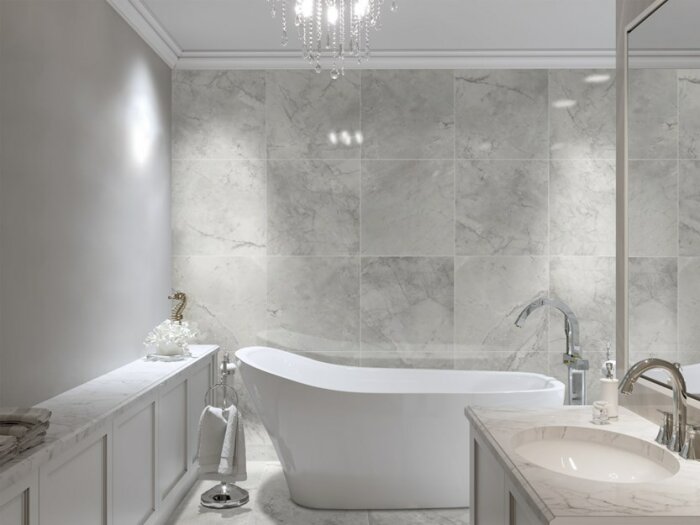
I was thinking of re-tiling my bathroom. Planning to hire a company to do the floor to get the right slope, etc. However, I plan to do the walls myself to save on costs.
I have some experience with tiling, but mainly with smaller areas like in the kitchen.
I think larger tiles look nice and am considering using 60x60 tiles. Is it difficult to work with such large tiles? Can an amateur manage it, or does it require more experience?
It's more difficult with large tiles and it requires partly a different technique, such as also having adhesive on the back of the tiles, narrow joints, etc.
As mentioned, it is much harder. It is especially much heavier, and harder to make small adjustments and corrections when mistakes occur. The tiles are often thicker and harder to cut. However, the work goes faster when it flows. So it's quite fun. You can also cut 5-10 tiles before mixing fix, which is enough for quite a large area, yet it's possible to keep track of the cut ones. Then there are also screws/wedges to help, so the tiles are placed evenly. So if you're fairly experienced already, you should probably manage it. It's not too difficult to lay the floor either. If the person who poured/leveled the slope has thought a bit and adapted it for such large tiles.
When there is already a functioning waterproof layer, is it possible to set the tiles with something like PL400 or is it best to tile in a traditional way?
When you already have a working waterproofing layer, does it work to set the tiles with something like PL400 or is it best to tile in a traditional way?
What does the waterproofing manufacturer say about permissible materials on top?
You wouldn't want to risk the adhesive reacting negatively with the membrane and its adhesive or sealant.
Tile adhesive has thickness that is used to counteract minor irregularities, slopes, etc. in the substrate and tiles.
When you already have a functioning waterproofing layer, does it work to attach the tiles with something like PL400 or is it best to tile in a traditional way?
The waterproofing layer is not just the membrane. All adhesives, mortars, and fixatives are part of the waterproofing system. You should never mix different components in the waterproofing system.
I was thinking of retiling my bathroom. I plan to hire a company to do the floor to get the correct slope, etc.
However, I thought I would do the walls myself to save on costs.
I have some experience with tiling, but mainly have tiled smaller areas like in the kitchen.
I think larger tiles look nice and am considering using 60x60 tiles. Is it difficult to work with tiles that large? Can an amateur manage it, or does it require more experience?
[image]
Would recommend 30x60 cm instead, much easier to get it looking nice and straight.
I am going to tile on top of existing tiles. Therefore, I was wondering if PL400 would work. But if regular tile adhesive is best, then I will use that of course.
I would absolutely not try PL 400. Partly because it doesn't provide the same adjustment margin as fix. It probably shrinks a bit (I don't know). There are materials developed by experts for setting tiles. Personal "inventions" might work if you're lucky. But there’s a reason why the materials used professionally are used.
If you now assess that your old waterproofing will hold for another 20 years and you intend to tile on tile, you should set the tiles in regular adhesive,
preparations
wash all tiles with an adhesive remover to remove any grease or silicone,
then prime the surface with a special primer that is a bit sandy so the new adhesive adheres,
if you are using 60x60 tiles, you will need more adhesive as the backside of the tile should be smoothly coated,
then a leveling system should be used so you can adjust to avoid uneven edges,
this will result in a 1mm to 1.5mm joint,
it's important to have a good laser and not rush, as mistakes can easily occur with these tiles due to the limited joint adjustment.
I think large tiles look nice and I'm considering using 60x60 tiles. Is it difficult to work with such large tiles? Can an amateur handle it or does it require more experience?