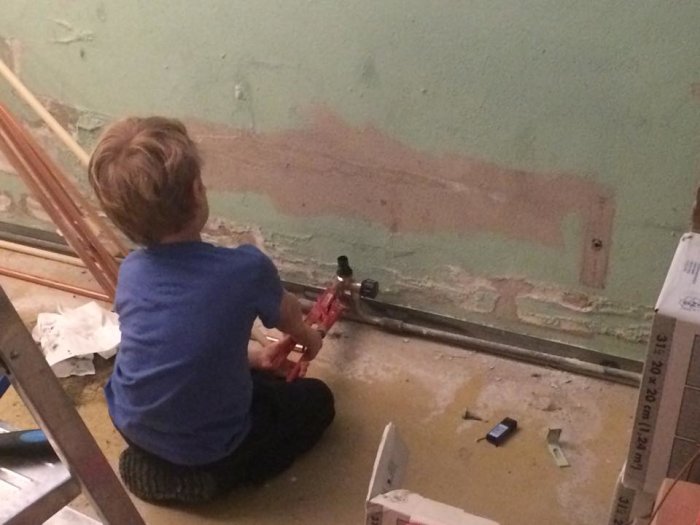
Even though the help is invaluable sometimes, my smallest craftsman could not answer the question regarding the color of the wall.
We have had moisture penetration before and that's what you see as bubbles in the paint. Now it is drained and insulated on the outside. BUT it certainly looks like a paint that does not allow moisture migration because it peels.
The question is then, is it enough to use a rotating steel brush and rough up the wall a little, or do I have to take more substantial measures before tiling?
I assume there's plaster behind?
The first question, in that case, is if the plaster is sitting properly...
You want the wall to be able to "breathe" so roughing up and "making holes" in the paint is good. Then you should avoid primer (or use a breathable primer) and instead vacuum and moisten the walls a couple of times before you tile.
Yep, something cement-based I guess because it's solid as a rock. Do you have an example of a primer that is diffusion-open or is it recommended to vacuum/moisten instead?
Weber Floor 4716 is the only one I know of. I think some Ardex can be used if you dilute it a lot. I would probably just vacuum thoroughly and dampen it properly the day before and then slightly dampen (with, for example, a spray bottle) just before laying. You can test laying a couple of tiles first and let them set to see if they stick...
Well, that didn't go according to my plan. The wire brush just "slides" on the paint until it finally breaks through, then it chews up 3 mm of plaster. Plus, it takes forever. It would take several days to brush off the paint, and the surface would be too uneven to lay tiles on without applying a skim coat.
Any other tips?
The reason I want to remove the paint is to prevent moisture from getting trapped underneath and causing my tiles to fall off, or is it that the tiles won't adhere at all?
Heat gun worked well enough to soften the paint and scrape it. Clean off with a wire brush to remove loosely adhering paint. Downsides, the air in the room isn't good after a while.
The upper part, does it also need to be scraped even though there's no moisture penetration there or won't the tiles adhere to the smooth surface? Maybe it's best to "scrape" it too...
You can use a concrete grinder on the angle grinder. If you hold it really carefully, it won't go deep, and since you're tiling, 3-4 mm deep grooves don't matter. It gets really dusty though...
I might need to purchase one of those. Tried with a regular diamond blade to test the concept and it worked excellently. Except the grooves are wide and the wall "wavy". How uneven can it be before you have to apply a skim coat? I've only tiled on drywall before and then it's quite flat. I have no experience with slightly uneven surfaces.
I have had the same problem. A disc for the angle grinder with layered sandpaper worked "well". I don't know what it's called but it has sandpaper that overlaps each other.



 How uneven can it be before you have to apply a skim coat? I've only tiled on drywall before and then it's quite flat. I have no experience with slightly uneven surfaces.