
In connection with blasting work conducted by the municipality near our retaining wall, several cracks developed throughout the wall. I am concerned that the cracks will become larger partly due to the wall moving from the pressure of the earth on one side and partly from water seeping in and causing frost damage, exacerbating the cracks.
Now the municipality suggests that applying a cement-based surface coating, StoCrete, is sufficient to restore the wall to its original condition. I am skeptical about this, as this material is unlikely to prevent the cracks from enlarging when (if) the concrete blocks start to move.
Does anyone have suggestions for better methods to repair these cracks and/or recommendations on where I can turn for expert help? Or is my concern unfounded that the cracks will grow larger and, over time, risk entire sections of the wall collapsing/disintegrating?
Here are some of the cracks (the wall is approximately 0.7 m high and 15 cm thick).
Now the municipality suggests that applying a cement-based surface coating, StoCrete, is sufficient to restore the wall to its original condition. I am skeptical about this, as this material is unlikely to prevent the cracks from enlarging when (if) the concrete blocks start to move.
Does anyone have suggestions for better methods to repair these cracks and/or recommendations on where I can turn for expert help? Or is my concern unfounded that the cracks will grow larger and, over time, risk entire sections of the wall collapsing/disintegrating?
Here are some of the cracks (the wall is approximately 0.7 m high and 15 cm thick).
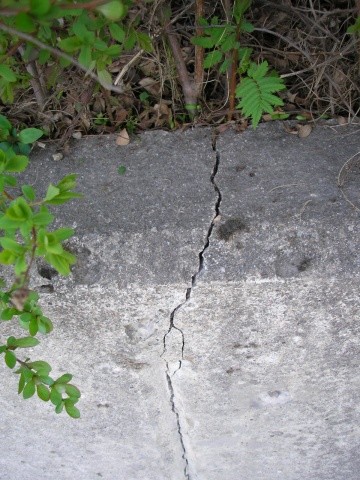
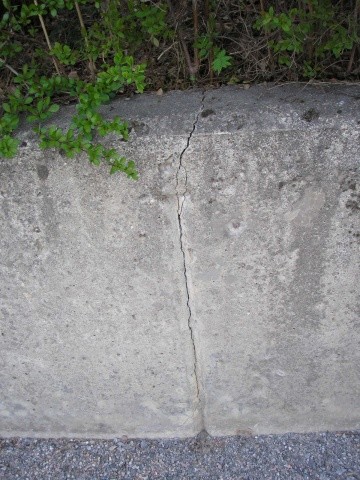
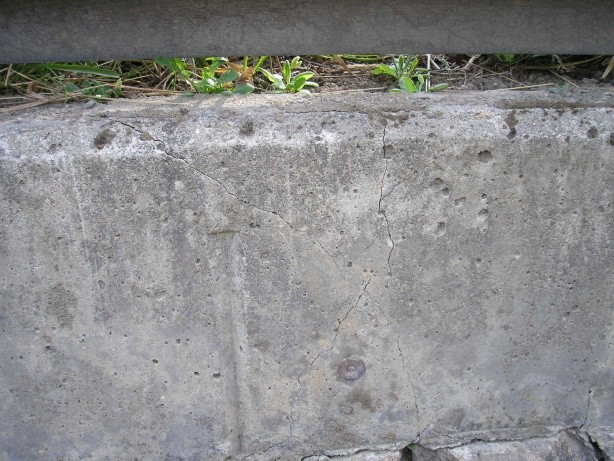

How is the retaining wall constructed? In the picture, it seems to be separate elements that were either mortared or glued with a small cast band on top.
Are they L elements and how deep are they set?
I think the municipality's proposal seems reasonable. You can't expect them to tear down the entire wall just because there is a crack.
Are they L elements and how deep are they set?
I think the municipality's proposal seems reasonable. You can't expect them to tear down the entire wall just because there is a crack.
Don't know much about the wall and how it is constructed since it was there when we bought the house. But it is separate elements, that much I can see.
Then it's not just one crack, but four through cracks (as well as a number of more superficial ones). I don't expect the municipality to tear down the whole wall, but I do expect them to restore the wall to the condition it was in before the blasting, i.e. intact and without cracks. And just smearing on a surface coating I don't consider to be restoring the wall...
Then it's not just one crack, but four through cracks (as well as a number of more superficial ones). I don't expect the municipality to tear down the whole wall, but I do expect them to restore the wall to the condition it was in before the blasting, i.e. intact and without cracks. And just smearing on a surface coating I don't consider to be restoring the wall...
But a crack between two separate elements that were mortared together is not so strange. It could be a shrinkage crack after the winter. I don't see how it can damage your wall. And if the compound the municipality wants to use is somewhat elastic, it should hold quite well.
The surface coating will not help with the cracks; they need to be injection-filled with either two-component urethane, epoxy, ultra-fine injection cement, or crystallization technique that flows down and seals the crack.
In this article, you will find more information about these methods:
http://www.byggmiljogruppen.se/doc/...ickor_i_betong_med_kristalliseringsteknik.pdf
In this article, you will find more information about these methods:
http://www.byggmiljogruppen.se/doc/...ickor_i_betong_med_kristalliseringsteknik.pdf
Click here to reply