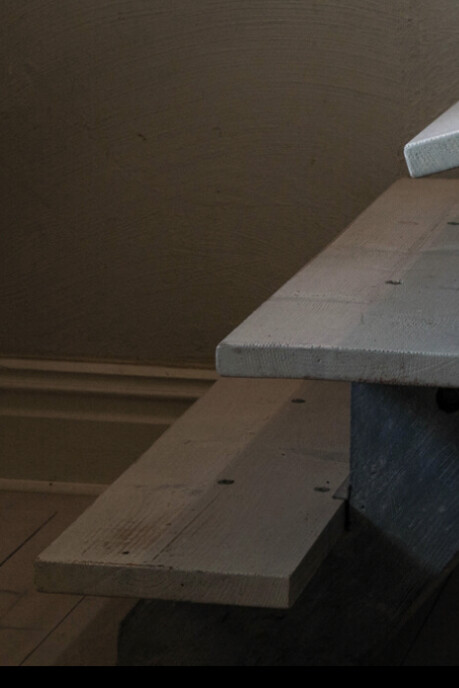
By the way, I also think you have built a nice staircase, I forgot to say that.
No, of course even a sturdy oak staircase will take damage from a gentle giant. But it won't break like that.
And I don't believe you when you say you can stand on the edge of your steps and bounce without it flexing. I'd like to see that on film if that's the case!
On the topic: clamp along the entire way, and make sure it is clamped together completely straight. Maybe clamp downward too.
To return to the question. If you are going to glue and get clean surfaces without gaps, regular wood glue is enough to make the stair as durable as before. The challenge is to get such a clean joint and make it both durable and invisible. Considering the construction of the stair, I think it looks easier to replace the broken step. If it can be done as simply as I think it looks, it's the least risky and not more work.
I will just have to try. If it doesn't work, I will of course replace the step. The only reason to try to fix it instead is because a new step will be so different in wear.
But to return to the gluing. Someone suggested removing the step and pulling apart the fracture surface to get more even gluing. Perhaps this is preferable (despite being a bit reluctant) compared to trying to carefully get the glue into the existing crack? Naturally with 3-4 clamps and letting it cure for a couple of days just to be safe.
I also think you've built a nice staircase, I forgot to mention that.
No, of course, even a solidly built oak staircase would take a hit from such a situation. But it wouldn't break like that.
And I don't believe you when you say you can stand on the edge of your steps and do little hops without any flex. I'd like to see that on film if it happens!
On the topic: many clamps along the way, and make sure it's clamped together completely straight. Maybe also clamp downwards.
Thanks.
No, 10 cm of oak probably wouldn't break.
However, you're wrong about the flex. I just stood right on the edge of the step and did some flex jumps. They do NOT move. I'm actually too lazy to film it. You'll have to take my word for it
Did some calculations on the force the step was subjected to at impact. With various assumptions, one ends up in the range of a load equivalent to at least the weight of 1500 kg for some 1/100th of a second.
Calculated a bit on the force the step was subjected to upon impact. With various assumptions, you end up in the realm of a load equivalent to at least the weight of 1500 kg for about 1/100th of a second.
Yes, it was one of those seemingly unlikely events. Renovating the facade and windows and had used linseed oil paint on the window upstairs and placed the dumbbell (40 cm window reveal) on the inside above the stairs to prevent the window from blowing open. And a day later, I'm outside painting and my brain disconnects when I pushed a little on the window to reach with the brush. It went KA-BOOOM on the inside, and I already knew that it would, in some way or another, be a mess to witness. The step had taken a direct hit on the outer edge of the step. Not the least bit surprised that the wood couldn't withstand it. Sometimes you just have a brain lapse. At least at my age
If this staircase is outdoors with rain and bad weather, you can forget about regular white glue. If it's outside, you need to switch to polyurethane glue. Protte
If this staircase is outdoors with rain and rusks then you can forget regular white glue.
If it's outside, you need to switch to polyurethane glue.
Protte
prototypen said:
If this staircase is outdoors with rain and rusks then you can forget regular white glue.
If it's outside, you need to switch to polyurethane glue.
Protte
All rain and rusks occur outside the staircase's domain
Don't be angry but I confirm that the overhang is too big in your stairs with this material and this step thickness. But to the point:
Why don't you want to exchange this degree? It's the easiest way. But if you insist on fixing it, you'll have to break the step completely to be able to glue it properly. And additionally, I would use long screws (about 3cm shorter than the depth of the step - 6mm in diameter) screwed in from the back edge. For a better effect, you can drill a recess for the screw head and plug it with a wooden plug. It would be a good idea to buff all ranks this way.
I'm sorry but: These steps don't look lively. Do you live in Stockholm? Do you dare to bet that I can stomp them off on the first try? Something I'm not even close to on any regular stairs, it should be said. Something that should be impossible, I would argue.
edit (forgot)
I would take the opportunity to replace all the steps with something better. With some form of hassle at the top as a consequence, which is worth taking. Take a picture of that part if you want help with the solution there.
All the steps in the picture seem to be bent... the fibers can't bear it forever. It will become fatigued.
You can drop a glass on tiles that hold. But the next time you touch it, it explodes.
Just because it has worked so far doesn't mean it's right. Listen to those who point out something sensible instead of dismissing it as threatening your pride.
The fact that you also show pictures of stringers with screws also indicates that you haven't quite understood what has been presented?
No one needs to worry about the durability. Regardless of overhang, support from the stringers, and the grain direction of the wood in the construction, it is a thoroughly stable staircase with full bearing capacity and not the slightest 'give' in the steps. Theory is one thing, but 15 years of empirical research has shown that none of the above is a concern. If the theory says that a bumblebee cannot fly, then obviously the theory needs to be revised.
Those who read the posts will see that I am asking about a suitable glue and that I initially planned to reinforce with angle iron. When it was pointed out that a glue joint 'becomes stronger than the rest of the wood', the discussion moved on to whether it would be sufficient to just glue if done in an optimal way.
Replacing a step is, of course, an option I have been fully aware of all along. But if a repair would suffice, I would avoid a different appearance on the step, as it is white linseed oil with 15 years of wear on the others.
What adds something in the latest posts is the recommendation to take apart and separate the parts to apply glue on all surfaces. Perhaps it's best to get a strong joint, even if it goes against the inclination to separate everything that's now held together?
And I can still consider reinforcing with angled flat bars if, after all, the glue joint does NOT match the strength of the original step.
Try Karlssons klister since you're focusing on empirical experiences.
Not durable!?!? Save your insults. It has two 10 cm beams reinforced on the underside with 5mm iron strips, and I, weighing 90 kg, have been walking up and down it for 15 years. The fact that it didn't withstand a 10 kg solid dumbbell from 2m height is excusable. It's a damn stylish and good staircase. Spare me posts that don't add anything to the question itself.
I'm not being rude, but on this forum, we are honest to contribute with constructive progress.
The staircase has aesthetically pleasing elements but is poorly constructed from a materials technology perspective. If someone gets injured due to a break in a step, you risk a lawsuit for causing bodily harm. There are building regulations that must be followed even if you live in Knohult and have your own inspiring ideas!
And for that matter, don't need to get anything other than a decent 'regular' white wood glue? Everyone agrees on this?
With slightly uneven gluing surfaces and missing chips, I would have used PU glue. I've glued a fairly "delicate" chair that suffered "similar" damage in a quite heavily loaded part, and it still holds after many years.
Vi vill skicka notiser för ämnen du bevakar och händelser som berör dig.


Hep said:
To return to the question. If you are going to glue and get clean surfaces without gaps, regular wood glue is enough to make the stair as durable as before. The challenge is to get such a clean joint and make it both durable and invisible. Considering the construction of the stair, I think it looks easier to replace the broken step. If it can be done as simply as I think it looks, it's the least risky and not more work.Ulltand said: