That staircase doesn't look sustainable. Get accident insurance.
If you built the staircase, you could replace the broken board but make sure to put up a warning sign "Max 70 kg"
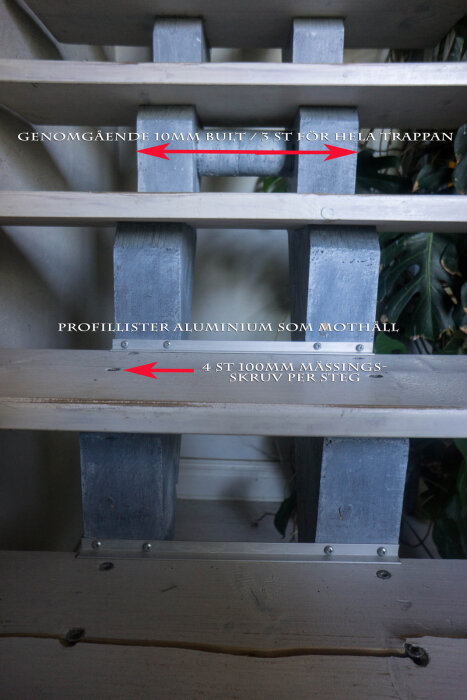
Not sustainable!?!? Save your rudeness. It has two 10 cm beams reinforced on the underside with 5mm iron rails and I, weighing 90 kg, have walked up and down it for 15 years. That it didn't withstand a 10 kg solid dumbbell from 2m height is excusable. It's a damn nice and good staircase. Save me from posts that don't add anything to the question itself.
Not durable!?!? Save your rudeness. It has two 10 cm beams reinforced on the underside with 5mm iron rails and I, weighing 90 kg, have walked up and down it for 15 years. That it didn't withstand a 10 kg solid dumbbell from 2m height is excusable. It is a very stylish and good staircase. I would appreciate posts that do not add anything to the question itself.
But surely you see that you have too much overhang on the steps and the wood is arranged in such a way that it's weakest in the direction it broke. Clear design flaw in my opinion.
If you want to safely bounce up and down this staircase without risking your 90 kilos breaking the step again, you probably need a new step. Possibly, if you remove the step, separate the two parts so you can completely fill the fracture surface, and then glue with glue clamps. However, I would argue that reinforcement is needed from the stair nose throughout the entire depth of the step to provide enough strength.
I agree with the previous speaker regarding the design flaw. Your steps might be okay, but not in combination with your stringers, which only provide support from half the step, causing all the load on the stair nose to result in exactly this outcome.
No one needs to worry about the durability. Regardless of overhang, support from the stringers, and the wood grain direction in the construction, it is a thoroughly stable staircase with full load-bearing capacity and not the slightest 'give' in the steps. Theory is one thing, but 15 years of empirical research have shown that none of the above is a concern. If theory says that a bumblebee cannot fly, then obviously the theory needs to be revised.
Those who read the posts see that I am asking about suitable glue and that I initially planned to support with angle brackets. When it was pointed out that a glued joint 'becomes stronger than the rest of the wood,' the discussion turned to whether it would suffice to just glue if done optimally.
Installing a new step is, of course, an option I have always been fully aware of. But if a repair would suffice, I would avoid a differing appearance on the stair tread since it's white linseed oil with 15 years of wear on the others.
What adds something in the latest posts is the recommendation to take apart and separate the pieces to access all surfaces with glue. Perhaps it's best to achieve a strong joint, even if it goes against separating everything that is now connected?
And I can still consider reinforcing with angled flat irons if it turns out that the glued joint does NOT match the strength of the original stair tread.
If you remove the step then replace it with new instead of gluing. Not because a glued joint makes the Step weaker (rather the opposite) but because it's easier to fix the surface.
Is it possible for you to swap the damaged step with the bottom step? If you need to reinforce the damaged step underneath, the repair will be less visible if the repaired step is at the bottom.
I can probably agree that the overhang looks a bit large, but at the same time, it works...
I would have added a triangle under the glued step to get a little more surface to glue on.. you can also place the step at the very bottom so it won't be visible....
Agree with previous speaker regarding design flaw. Your steps may possibly be okay but not in combination with your stringers which do not provide support from anything other than half the step, making all the load that lands directly on the tread nose generate exactly this outcome
Agree (except for the last, incorrect, but common, use of the word "outcome")
I would like to see a film of the OP standing on the edge of the step and gently rocking. And then jumping and landing on one foot .. Sure, your staircase hasn't given up over the years, but we can all see that it's poorly constructed.
Regarding what you're wondering, glue will probably work. You can at least try that to start with. You should be able to get very good pressure with clamps along the entire length. If it doesn't work well, you can just replace the board.
Might as well show the entire construction, and regardless of everything else mentioned in the thread, it is a completely stable, durable, and stylish construction that has been a completely trustworthy and non-springy staircase for me for 15 years. I had a vision of a floating staircase and executed it.
I'm taking tips on gluing, and if the joint is as strong as the wood, then an optimally executed gluing should correspond to what already works. If I want to reinforce, I'm considering creating two angle irons attached to the back of both beams with a twist so that the iron runs horizontally out under the step. For the most part, such reinforcement will be hidden, the question is whether it will become necessary.
By the way, I'm proud of my design. The beams are painted with gray glue paint and then rubbed with diluted linseed oil paint, giving them that slightly 'antique' look (I read about painting techniques from the 18th century, I think it was). The steps are treated with white linseed oil.
The vang pieces are not the problem with your design. It's the excessively large projection on the ladder on such weak timber. Sure, such a blow can cause a lot of damage, but if you had built it better, it would have withstood that as well.
I don't think anyone doubts that the vangstyckena will hold, what people are worried about is precisely that the staircase will break in the same way it has now, the wood is not very strong in that direction.
What tools do you have? I would probably have routed a groove on the underside and embedded a piece of wood in the other direction, in addition to gluing where it has broken off.
The side pieces are not the problem with your design. It's the excessively large overhang on the steps with such frail wood. Sure, such a hit can cause a lot to break, but if you had built better, it would have withstood even that.
Sigh. If you drop a compact 10kg iron dumbbell from a window sill 3 meters up and it hits a wooden step, I don't think it would look good even if it were 10 cm of Oak. My wood is evidently not 'frail'; I can stand out on the steps without the slightest flex. The reason for the beveling is that otherwise, you would hit your toes when walking up the stairs. And as I said, they have proven sufficient. As the saying goes... if the bumblebee flies, then it's fine with that .
To return to the question. If you are going to glue and have clean surfaces without gaps, regular wood glue is enough to make the staircase as durable as before. The challenge is to achieve such a clean joint and make it both durable and invisible. Considering the construction of the staircase, I think it looks easier to replace the broken step. If it can be done as easily as it appears to me, then it is the least risky and not more work.
Vi vill skicka notiser för ämnen du bevakar och händelser som berör dig.





 Sure, your staircase hasn't given up over the years, but we can all see that it's poorly constructed.