Old thread as mentioned =)
Wondering how it went, planning to use the same solution, afraid that mice might like the solution.
It's a summer cabin that will be cold for a large part of the winter.
Mice and rats tend to avoid gnawing through styrofoam. I've heard it has something to do with the squeaking. Then again, there are tall tales about mice that eat their way through foam mixed with glass and those that eat through concrete. But styrofoam as a subfloor works great.
I am going to use cellulose insulation, and today I talked to a building supply store that sells that, he thought that mice eat up foam plastic, Can't make sense of this :screwy:
I see that several people have opened this old thread, I also found it as I have been searching for information on how to best construct a floor structure in a crawl space built directly on a rock.
What I have seen in several threads is that foam insulation is preferred at the bottom because it reduces the risk of mold and moisture coming up but not between the joists because it is difficult to seal tightly. But is it possible to combine these two?
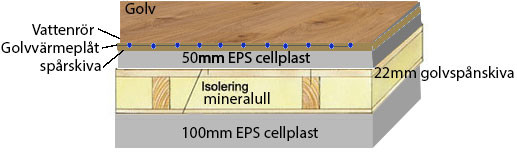
The question is, if you use foam insulation at the bottom, mineral wool in the middle, and then foam insulation on top to add more insulation before laying the underfloor heating, is there a risk of creating moisture in the mineral wool because the foam insulation is tight both above and below?
Spontaneously, the above sketch feels a bit like overkill; do you have tips on how to make the construction simpler (cheaper) but still have foam insulation at the bottom and a stable floor? titanium's picture on page 1 was a great source of inspiration to attach the foam insulation directly to the joists to support the insulation. In total, the insulation should be 30+ cm.
So, it can look like this, I believe:
Lamellparkett
lump-papp
golvärmerär in aluminum plates
milled chipboard (expensive and stupid) I prefer glespanel 28 x 70 (better and cheaper)
Vapor barrier plastic foil taped carefully (good if you get a water leak or if it rains before you've secured the house)
Beams, here I chose masonite beams (which now have a core of chipboard, which is better)
Mineral wool (I chose blown-in loose wool, but you can also manually install mineral wool) A big advantage of mineral wool is that it is a great sound insulator. Here, cellplast is completely worthless.
Bottom board, here you might consider placing cellplast on the lower rule of the masonite beam. It should be stiff enough to carry the mineral wool. With blown-in loose fill, the pressure can be much greater, and there is a high risk that the cellplast board will collapse.
I chose an aquapanel that I got at an extra low price. There are bottom boards made of masonite at a good price, they work if the foundation is well-ventilated. My house stands on plinths on rocks and it is completely open underneath.
I wouldn’t install the upper cellplast board, not because I’m worried about moisture but because the board compresses over time due to loads.
Just exactly as you describe, I have done in our guest cottage in the countryside. With regular tongue-and-groove styrofoam that was nailed with yellow insulation plastic washers from underneath and glued tongue-and-groove. The picture is from the newer part, but I also installed it on the old crooked building without any problem. Super tight.
Neat and very good with tongue-and-groove EPS glued in combination with cellulose with salt that rodents and insects avoid.
Click here to reply
Vi vill skicka notiser för ämnen du bevakar och händelser som berör dig.


titanium said:
Just exactly as you describe, I have done in our guest cottage in the countryside. With regular tongue-and-groove styrofoam that was nailed with yellow insulation plastic washers from underneath and glued tongue-and-groove. The picture is from the newer part, but I also installed it on the old crooked building without any problem. Super tight.