
47,575 views ·
23 replies
48k views
23 replies
Suspended Ceiling Styrofoam
Couldn't decide if this fit best under flooring or insulation, but then it hit me that it's probably more appropriate here in Building Materials & Construction Technology. I’m going to level the floor, which means I will be tearing down the entire base of the floor, and then I started wondering if the best/easiest option isn't foam plastic like this one from Byggmax: Fasadskiva S80 EPS, 12-pack Not och spont, 1185x585x50mm Art. Nr: 61012002. The price seems pretty reasonable, it's cheaper than the base floor panels made of masonite that I used a few years ago. I’d like to try to find what gives the most value for money, and it feels like this also provides some extra insulation, which is a plus considering it's an old summer cottage where parts of the house are on piers.
I think it makes sense; paying for tongue-and-groove, asfaboard, or subfloor panels that have no insulating capability can be considered wasted money. Right now, I have 50 square meters of open floor down to the ground. After replacing the beam and aligning 5-6 floor joists (the beam "disappeared" due to an old water leak), I plan to lay 70 mm foam plastic between the joists, partly to avoid as much organic material as possible. On top of the foam plastic, there will be a 12 cm mineral wool mat, totaling 19 cm of insulation. I'm buying from Byggmax. On the ground, I'll lay plastic and also add a dehumidifier. ikeo. The board you're considering is tongue-and-groove; are you thinking of nailing it under the joists or laying it between the joists? Kurtivan. Yes, probably, mice chew on most things, hopefully, they won't eat enough for the insulation to fall to the ground.
Planning to attach them under the joists and build the foundation with them, then lay fiberglass directly on them. For me, it gives an extra 5 cm of insulation plus it should be airtight because they are tongue and grooved. The trickiest part seems to be finding washers to keep them in place. Mice don't worry me too much considering the neighborhood cats hunt them pretty aggressively, and if you want to secure against mice, you'd probably have to build the foundation in concrete or something.
Chippings and sawdust are not something mice eat and build nests in, however, they like to live in fiberglass. Especially considering it's a summer cottage, maybe one should think about not building something that is good for mice.
Perhaps I was a bit unclear, I apologize for that. I meant that it has been a summer cottage that is now converted and extended for permanent living, so mice probably aren't a major problem. The problem I have is more likely that the part hasn't been addressed and needs to be straightened and get a subfloor that is more sealed than the current one, which consists of hanging asfaboards sagging down, making it quite chilly in winter right now.


Exactly as you described, I have done in our guest cabin in the countryside.
With regular tongue-and-groove polystyrene nailed with yellow insulation plastic washers from underneath and glued tongue-and-groove.
The picture is from the newer part, but I also installed it on the old slanted building without problems. Super tight.
With regular tongue-and-groove polystyrene nailed with yellow insulation plastic washers from underneath and glued tongue-and-groove.
The picture is from the newer part, but I also installed it on the old slanted building without problems. Super tight.
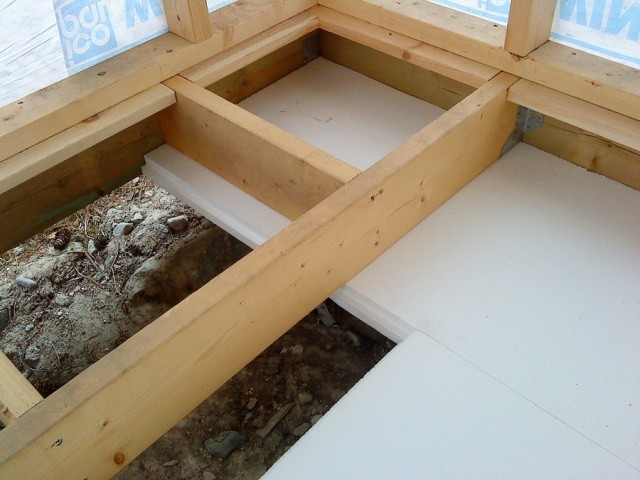
thanks titanium that picture was spot on, exactly what I want to do.
two questions where do you find the plastic washers is it something available at the hardware store or does it have to be ordered I've just taken a quick look at byggmax and k-rauta and I didn't see anything at either of them.
what did you use to glue the tongue and groove?
two questions where do you find the plastic washers is it something available at the hardware store or does it have to be ordered I've just taken a quick look at byggmax and k-rauta and I didn't see anything at either of them.
what did you use to glue the tongue and groove?
Tiles are available at Beijer Bygg (1 SEK each approx), I glued them myself with latex sealant and it hasn't cracked yet. I also did the economical version (Sunday, ran out of tiles and the store was closed) in a couple of places by gluing the sheets directly onto the floor joists with the latex sealant and used a nail through the styrofoam just to keep it in place until the sealant hardened, and 2 years later, no sheets have fallen yet. So you can also glue them if you can't find the tiles. I used regular non-tongued styrofoam; if you use tongued sheets, you don't need to secure all sheets with tiles. Instead, glue them up and use tiles at the corner sheets, which will hold the entire construction together.
Now that a few years have passed, what are the experiences regarding mice and durability?
Are there more people who have tried this? How has it worked?
Are there more people who have tried this? How has it worked?
Well, it's not been a few years for me, but in the short time that's passed, it feels like it's gotten warmer inside, which might not be the best in the middle of summer 
But it can probably make quite a big difference in winter if you notice it already now.
Considering how well the mice lived in the old trossbotten, which was asfaboard and some old rock-hard insulation, I have no idea if it was mineral wool or glass wool, it feels like it doesn't matter if you have styrofoam or something else.
But it can probably make quite a big difference in winter if you notice it already now.
Considering how well the mice lived in the old trossbotten, which was asfaboard and some old rock-hard insulation, I have no idea if it was mineral wool or glass wool, it feels like it doesn't matter if you have styrofoam or something else.
I was thinking of reviving this thread since I'm going to insulate and replace the previous floor joists. I initially thought of installing new floor joist boards and then insulating with fiberglass, but I did some googling and saw this thread and wondered if using the tongue-and-groove polystyrene mentioned would work well? That would give a bit of extra insulation and hopefully make it windproof.
What I was most concerned about is whether it would be too tight with polystyrene or if it lets through any moisture?
What I was most concerned about is whether it would be too tight with polystyrene or if it lets through any moisture?
old thread and sold house but if I were doing it today, I would skip the interlocking foam boards and instead use regular non-interlocking foam boards and overlap them, it would be a bit cheaper.
I can't see how there could be any moisture problems either, where would the moisture come from if it's sealed?
but if I were doing it today, I would skip the interlocking foam boards and instead use regular non-interlocking foam boards and overlap them, it would be a bit cheaper.I can't see how there could be any moisture problems either, where would the moisture come from if it's sealed?