How do I best support the roof of my house? Some of you might recognize this house as I previously received good advice on how to hang the ceiling beams in the living area.
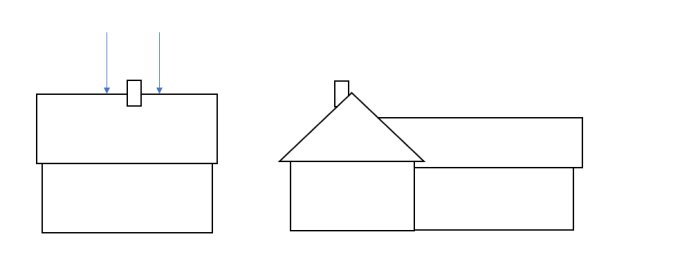
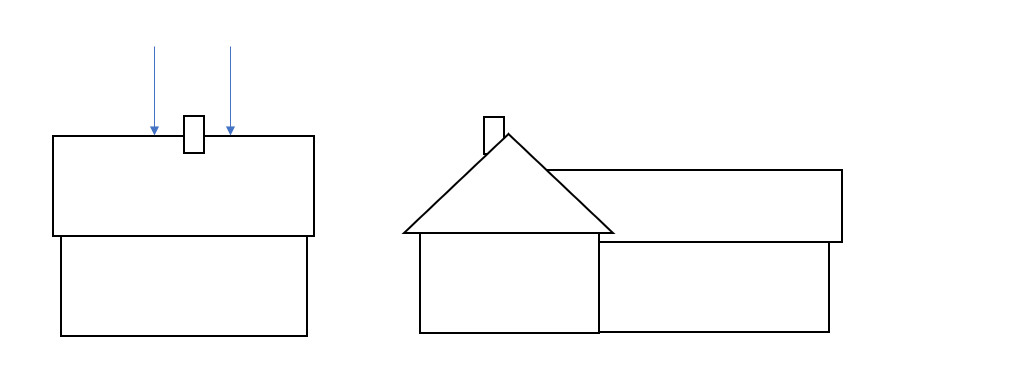
The house consists of two connected structures, a smaller part from 1930 and a slightly larger part added in 1975. The problem is that the roof of the older structure sags approximately 10 cm in the middle of the ridge. I have marked it with two arrows to show this.
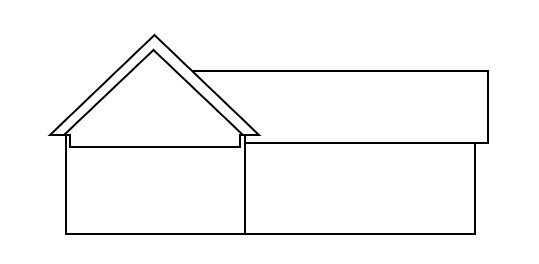
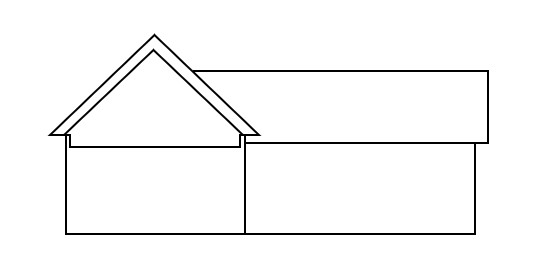
The construction of the roof on the older structure is completely open inside and there are no supports or braces. The ceiling is fully covered with insulation and paneling to the level with the dimension of the beams, so I cannot see the beams, only where the panel is nailed. The sketch below shows what the attic space looks like. The attic space in the old part is used as storage and is easily accessible and is dry with no visible damage from leaks or moisture.
I don’t know when the attic was insulated and clad with demolition lumber/paneling on the inside, but something makes me believe it happened in the early 60s as we found some old magazines from that time in the insulation. I also don’t know if there was any other construction on the roof trusses initially and if any supports were just cut away to get easy passage up there.
In the added section, there are roof trusses with supports, and that section is not insulated in the roof. That attic section is not used and one only goes out there when inspecting the roof.
Probably after 1975, the then-owner saw that the roof sagged and placed a 4"x4" post between the attic floor and the ridge on each side of the chimney, approximately where the arrows are. It could also have happened earlier, but I don’t know. I have not been able to determine if there is a longitudinal ridge beam or if any such beam is supported by the chimney. As you can see, there is no support where the ridge of the addition meets in the middle of the old structure's roof, but I don't know the load at that point. Probably not negligible anyway.
The entire added section and everything done during that time could be called a DIY project where they used what they had and nothing seems to have been calculated concerning dimensions, given how many astonishing surprises we have encountered during the renovation. Plumb and level are also two concepts that were completely unknown.
There are two things I want to do: firstly, to more seriously support the roof to stabilize it so I'm convinced the problem is correctly addressed, and once that is done, re-roof and correct during battening to remove the remaining sag.
My question is where should I support the roof? At the ridge with a post similar to now, or should I install an internal ridge beam on each side of the chimney and support it, or should I attach a cross beam at an appropriate height in a truss and then support it like a "T"?
Should I try to lift the roof with jacks, or should I just secure it as it is? I don’t want to cause any damage, and there is a risk when it’s an old construction that has settled that it doesn't want to move anymore.
I can keep the same posts as now if someone can convince me that it is a serious and correct action.
One must go down to a more detailed level both to see what the problems are due to and what are appropriate measures. A framework truss normally has collar ties and struts, but it can work without them if the rafters are sufficiently strong and the attic floor joists can function as collar ties. Snow load zone, roof pitch, and measurements are important information to proceed further.
Click here to reply
Vi vill skicka notiser för ämnen du bevakar och händelser som berör dig.