
5,405 views ·
3 replies
5k views
3 replies
Suggestions for the construction of a floor structure over an old basement

When renovating a bathroom in an old house from the mid-1800s, I had to tear up the entire floor including the old floor joists as they were in poor condition. Now I'm considering a good way to attach new joists to the outer wall (the opposite side is easier as the foundation wall "protrudes" along the entire short side).
The old joists had approximately 80cm spacing, so just placing new beams in the old attachments I assume is not enough, especially considering it should support a bathroom and typically should have 30cm spacing.
The room is about 3.5 * 2.7 meters.
The options I have considered:
1. Make new attachment holes in the wall. If I make another hole between each existing one, I get joists at 40cm spacing. Unclear how easy it is to make such holes without causing too much damage to the wall.
2. Attach a ledger board to the wall and then place new joists on it. Unclear if I can secure a ledger board properly to the old wall to support the entire structure.
3. Build up or cast the existing ledge, which is currently about 50 cm, to the desired height and then place a ledger/joists on this. A problem with this is that I cannot build all the way into the corner where the drainage goes down.
4. Settle with the existing attachments, place glulam beams in them, and then cross-brace them at 30cm spacing.
Suggestions are welcome!
The old joists had approximately 80cm spacing, so just placing new beams in the old attachments I assume is not enough, especially considering it should support a bathroom and typically should have 30cm spacing.
The room is about 3.5 * 2.7 meters.
The options I have considered:
1. Make new attachment holes in the wall. If I make another hole between each existing one, I get joists at 40cm spacing. Unclear how easy it is to make such holes without causing too much damage to the wall.
2. Attach a ledger board to the wall and then place new joists on it. Unclear if I can secure a ledger board properly to the old wall to support the entire structure.
3. Build up or cast the existing ledge, which is currently about 50 cm, to the desired height and then place a ledger/joists on this. A problem with this is that I cannot build all the way into the corner where the drainage goes down.
4. Settle with the existing attachments, place glulam beams in them, and then cross-brace them at 30cm spacing.
Suggestions are welcome!
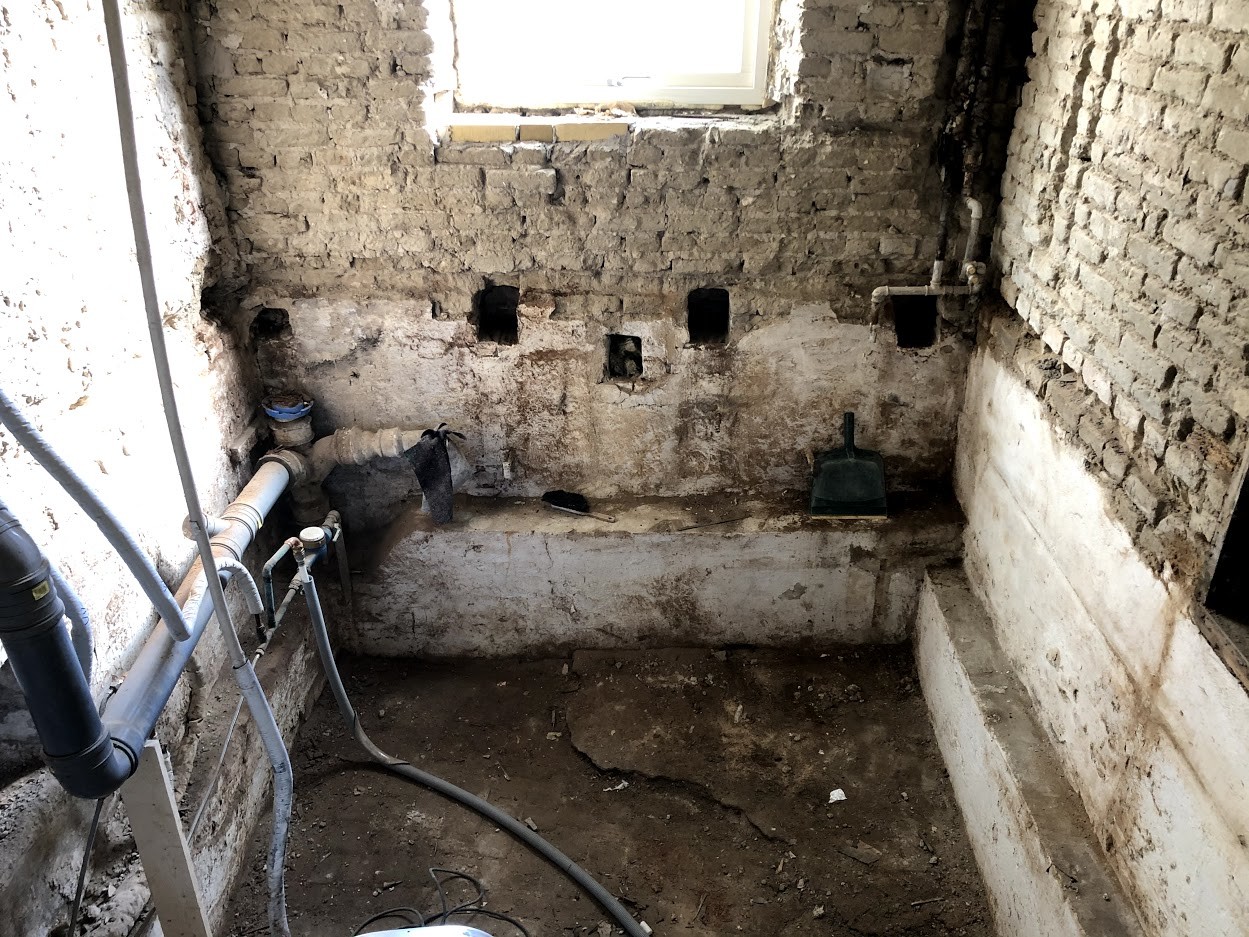
Isn't it possible to build up from the foundation wall then? That is, lay down syllpapp and a sill board on the ledge that sticks out from the foundation wall. On this, place pillars that support a load-bearing beam for the floor joists. It might be difficult to get a joist in the corner with the drain.

Place sturdy beams in the existing holes in the wall. Between these, set short studs against the wall, which you also attach to the wall with anchors. Now you can place one or two studs against the short studs at cc 40 or 30.
Best regards,
/CC
Best regards,
/CC
Click here to reply